
That cursed ruler wouldn't let me live any further. In math, it was different; I didn't get hit at school. My mother made sure to voluntarily take over the teacher's job. What kind of school is it where the parent isn't involved? It's like a boat with only one oar working, it just goes in circles, someone used to say. My mother, the first engineer in her family, had excitedly learned about a flawless pedagogical method. All her intellectual colleagues from the factory had told her it worked one hundred percent: hitting with the ruler across the veins of an outstretched palm, with all the strength of an adult, onto the flesh of a child. The only problem was if you could manage it. To not pull back the hand, that's all. There could be no other problem here. If you succeeded, the child would lie belly-down on the book and devour it through direct absorption into the stomach, through the skin of the belly. The machine-tool factory groaned about the success of this method.
I am proud of myself. It was one of the few times I saw my mother genuinely happy about something that involved me. Otherwise, she was always a sad person, sensorially hypersensitive, and who constantly victimized herself 24 hours a day. She had married without any satisfaction in it and had given birth to three ugly children, so she could be martyred and saved through the suffering they generated. Because she was a religious person and had learned that you are saved through childbirth. You just had to endure. But, well, that takes effort, because people have to be made. In our house, there were various tools for 'making people': some meant for eating meals, others for doing homework, others for sledding with good boots. To penalize such a thing, on the first day it snowed, the carpet beater was used. Justifiable, because the boots were those procured illicitly, directly from the factory, saved by a corrupt employee – right from the pile set on fire in the yard, from a batch of several wagons refused for export due to a minimal glue leakage near the sole during the assembly of a few pairs, and which were sold at exorbitant prices in the city, with fear in their veins that the Securitate would find out, lest we all die from radiation. Of course, you'd get it if you put on those boots and went into the snow with them. They were leather, they were for export!!!
Well, thanks to me, my mother rejoiced on that first day of fifth-grade math class when I told her I couldn't write everything in my notebook and hadn't understood the lesson, after I came home from school and she from the factory. She rejoiced that I had trusted her when she said stretch out your palm and held it with her left hand, so she could strike with her right. And then, what an effect it created – she was ecstatic, seeing how I shivered with a tremor and how my eyes welled up, how I bit my lips not to cry, because I was about to get it across the mouth too. She was convinced that from now on everything was arranged on the planet: as if by magic, I would understand everything in math.
Sometimes, over the years, out of astonishment that I still didn't understand calculations that she, an engineer, also found difficult – but only out of astonishment, because she couldn't console herself with anything, and this was the only gesture of astonishment she could make – she would also hit me on the head. It didn't matter that I always had migraines. Being hit on the head didn't generate my chronic migraine; I was born with it ‒ the hitting is just trigger. And I still have it, I'll die with it, I've resigned myself. Otherwise, hitting a child on the head makes them open-minded, it was for my own good. And what, do you mean I'm not open-minded? Let's see, let the one who can claim I'm not completely open-minded comment here!!!!!
To better understand, the person my mother hit on the head for not understanding math suffered from context dichotomy. It's a psychological condition I named. I was one of the county's top students with a perfect ten in math the previous year. Because for fourth grade there was no next-level Olympiad, I didn't go to the national one. But I had gotten a ten. Teacher Ursu had been a phenomenon; she really drilled knowledge into us, believe me. Almost the entire class got a garland, because she couldn't differentiate us, and when there were Olympiads, she would appear on the school board with 25 finalists with a ten, only from her class.
I loved math, I was interested in math, I tried to understand math, even though the teacher would give me bully ferociously, that I was ugly, mean (I sometimes talked back, or asked why) and, much more seriously, I was unacceptably weak. When, during one of those pioneer elections for receiving various responsibilities marked by colored cords with tassels to be fastened on the shoulder, and a classmate proposed me as detachment commander, my candidacy was rejected before the vote by the 'comrade' (teacher), assisted by the chief propaganda teacher for the county, who interrupted the process, explaining to the children that I couldn't be their leader if I was the smallest and frailest among them (she said "sharp," it stuck with me!) and if my forehead barely reached everyone's chest.
She didn't quite understand how I had physical fitness just because I had lived in trees in the countryside: during sports class, in races, I would outrun the group of girls, catch up with the boys, and finish tied with the first or second place. She finally explained this to herself: "Because she's so mean." I wouldn't give up; I had both critical thinking and critical speed. It was, however, a bit disappointing for me – at pioneer meetings, when someone wanted to approach me and asked the classic question: have you ever been commander of anything? I always replied with no. So rating- my rating was constantly below sea level. Luckily, I would still win a county sports competition at the stadium. Or a drawing contest with the team from the Pioneers' Palace led by Master Fluierici. He is my only mentor who has a street named after him in the city.
But I knew math, I was an artist! I had inherited the humanist side from my father, who still sings and writes for pleasure, like me, and the realist side from my mother. As a child, solving math problems relaxed me; they most often had beautiful solutions, thus conveying an aesthetic experience.
One day, the 'comrade' teacher took all of us, her whole gang of Olympians, for a walk to an interesting didactic confrontation with the math and computer teacher (a kind of prehistoric IT) from the Pioneers' Palace. The host issued a challenge to everyone, writing on the blackboard the story-text of an algebra equation with exponentiation and three unknowns, at a sixth-grade level. Because only I correctly stated the problem's data from the beginning and then transferred it into the intuitive graphical method, only I solved the test with a maximum score and was lovingly shaken from all sides by children, and by parents, and by that fascinated 'comrade' (teacher), who predicted a purely scientific future for me. Without knowing that I wanted to become a seamstress. Or that my grandparents, who praised every one of my teeth, every step, and every new syllable, had prophesied that I was so sharp that I would one day tell the weather on TV. That is, I would become a TV weather announcer, they believing that women with significant birthmarks ‒ for example, a hair whorl right on the forehead, as I had ‒, being so smart, could predict and transmit in front of cameras how the climate, precipitation, and weak to moderate winds would be all week, an essential thing in agriculture. All my grandparents dialogued with me and offered me a type of respect as if they were talking to an adult, not a child. Only the burdens were symbolic, toy-like, necessary for learning, age-appropriate. The others did the opposite.
(to be continued)
Cosmina Dragomir
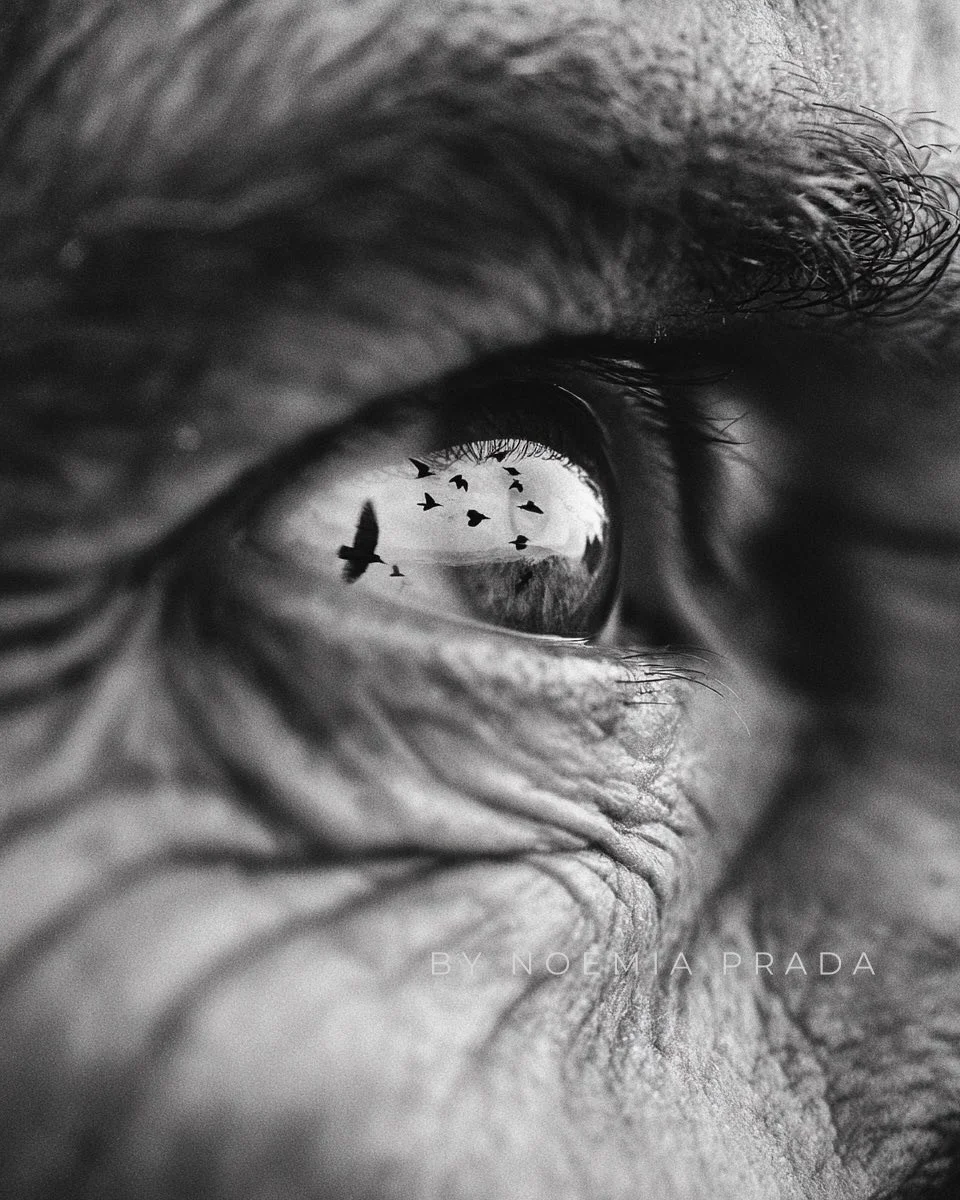
Photography by Noemia Prada
See the other episodes HERE!