
Let's be clear, what the math comrade taught was NOT in the same form or order in the textbook, sometimes it wasn't there at all, as that would have been easy.
My mother would find the homework, exercises with the four operations using smaller or larger numbers written in different bases, and she wouldn't immediately understand the notations she saw. I would childishly explain the principle to her: imagine a world where digits end at two or three, there are no others, and we have to logically create large numbers from two, three, four, five digits using only them, to count further, just like we do in base ten when we run out of digits 0-9, but we can count up to two thousand fourteen. She understood, but couldn't perform the calculations, because she hadn't grasped the idea of automatic transformations. Because she hadn't been in class. With her mouth, she scolded the teacher and his greed for enrichment that everyone knew about, and with her fist, out of helplessness, she would hit me on the head. In base two, I immediately understood how to operate; this lesson was found at the end of the textbook in the optional category – extended curriculum. He taught it on the first day, the day of the ruler on the palm, and by the second meeting, we had reached base five, eight, and twenty. To do divisions with them.
The number of those with fours across the board slowly tightened around my neck like a noose and began to strangle me. At home, those with tens were another reason for arguments and beatings; I believe you all know the parental question: "But how much did so-and-so get? Ten? Bloody hell! But how CAN so-and-so do it??? Is this why I work, don't eat, and give to you, you slacker?!" And then, usually a hit on the head, to make it sink into yours too, if the other person can. Or, rather, if that wallet can.
If the Romanian teacher was delicate and short, not surpassing any of her fifth-grade students in height, the math comrade was a massive colossus, whom I perceived as being two meters tall. I wasn't afraid of him; I felt sickened by him.
I had a slight fear of the petite Romanian teacher, but an interesting, fabulous, motivational fear, like the fear of falling from God's grace. Every student felt authentic fear of her; this state had been induced by parents since second grade. Less so for me, who, one day, stupidly scanning her, saw the angel troubling the waters on her face as at Bethesda, simply fell in love with her and switched my interest in olympiads to her subject.
The guy didn't hit, didn't touch you, but he tortured you to the point of squirming.student Zaharia,student Câmpan,the comrades (female) au devenit fiecare Mrs./Ms., iar Opincaru din banca trei s-a transformat în Oana, și Bilaus din fața catedrei în Bogdan. Proful de mate nu a schimbat însă strategia numelor. Chiar și cea care îi aducea maxima mulțumire pe chip când rezolva la tablă cu viteză totul, impecabil ca un computer, ca să scape de privirea lui și să fugă rapid în banca ei, și aceea se numea invariabil student Ilade.
The feeling of nausea came viscerally the moment he entered. He was huge, and tall, and slightly overweight, generally coming in sweaty and constantly dabbing his face with a handkerchief. Because he was very hot, he didn't squeeze into that desk, which was too small for him; he would place his chair towards the middle by the blackboard, spread his legs, and lean back relaxed as if at the cinema, delighting in the numbers he had written on the board for some poor kid to solve. Or he would bathe in the negative adrenaline of the wretched one. His extreme physical closeness invaded your vital space and narrowed your mind; you made more mistakes at the blackboard than at your desk.
Towards the end of middle school, he no longer called anemic, scrawny, and skeletal Gostat kids like me, or boys, to the board. We solved problems in our notebooks. He'd lean back more and more, call some brilliant problem-solver from the team he was coaching, a beautiful and smart girl who would fill the board, explaining what she was doing more extensively than he ever did, while he'd grin stupidly with intellectual satisfaction, breathing more and more wheezily, because his nostrils would stick together for some obscure reason and he'd draw air in with increasing difficulty. Our nausea intensified because, apart from this unique sound accompanying the squeak of chalk, he'd emit an undefined, detestable smell, which was nowhere near a tractor driver's sweat, even though he was obviously very warm. The children in us couldn't identify its meaning or source, but it would put our brains on irrational alert and we simply wished for his disappearance. The student always got a well-deserved ten, and returned stressed and disgusted, while muttering, “I feel like killing him.” We rejoiced for her sake for the grade.
Once he proposed an incredibly interesting problem; I followed it. He solved it and erased the board. Four of us didn't understand anything from his solution, but I could visualize the data, I would have grappled with it, but I needed a hint, something. Măgduța, a niece of Minister Bobu at the time, a child of rare intelligence and strength, had the audacity, raised her hand, and proposed to the teacher to solve the problem using another method. She had nothing to fear; this child had already gone through death twice.
Before the Revolution, she was the sole survivor of a road accident, a head-on collision of two cars at high speed, followed by a fire that engulfed a third car that crashed into them. Everyone burned to death, except for the child not wearing a seatbelt, who broke the windshield with her head and flew in an arc through the air, landing 30 meters away on the road, the only one not consumed by flames. She had her spine fractured in multiple places and a fractured skull, but her spinal cord was intact. The country's doctors performed miracles; she was related to a high-ranking official, so dear, freckled Măgduța, after spending several months in a cast like a mummy, returned to classes and, until the last day of school, remained encased in an iron frame that supported her neck, forehead, and back, like a backpack secured all over her with leather straps. Exactly like Forrest Gump, but from head to toe. She allowed herself to cry only at night from pain; during the day at school, she endured like a martyr. I would faint just by looking at her. Malicious tongues had commented on the accident as the result of a curse from an wronged person, where death miraculously bypassed the child due to her purity. After the Revolution, she suffered a different kind of death, becoming overnight guilty in everyone's eyes for her kinship with the former counselor and for the resonant name she bore. Luckily, in our group, she was loved for her charisma and sincerity. And for her freckles. And for her math ideas.
The teacher asked for feedback after that explained problem, as he usually did to justify a pop quiz. Did you understand? His team's hands were all up; mine trembled to raise it, but I wasn't sure I could follow through. Măgduța insisted and explained from her desk, almost without getting approval, she simply couldn't hold back, as another way to approach the problem had been revealed to her. She was very illustrative, bypassing algebra and proposing a playful approach, at which point I received hintthe one I needed. Essentially, I understood what I had to do thanks to Măgduța.
When I heard 'now take out a sheet of paper,' I didn't faint anymore. He put a similar text on the board, with different numerical data. The team of ten got the highest grade, Măgduța and I got a seven, even though we reached the same result as the others, and those who couldn't write a single line got a two. The guy mumbled something like, 'Bobu and Răvnic, too bad for you, having stubborn and stupid parents.' I took it as a form of admiration; I was proud of myself for having stupid parents.
But what I didn't understand was that the pogrom had begun. It was my last seven. My mother wrinkled her nose at it in disgust: what, she works at the factory just for me to get a seven? Are these grades? How can Lavric do it? How can Rușcior do it?
From that moment on, no one from the team of four got more than that; in fact, you'd get a four if you were good. We failed the first semester. Everyone who wasn't doing 'tutoring,' including the former detachment commander, who was brilliant and an Olympic participant in everything, except she hadn't even been selected for math at the class level.
Mom grumbled and did what she could with me from the textbook, sweating with her palm on that ruler. When I saw it displayed on shelves in bookstores, I'd forgotten its purpose; I was convinced it was sold as a tool to make people. Otherwise, why would it come in all sizes, and made of plastic, and wood, and aluminum, according to the child's behavior?
I confess to you that not for a moment, not for a single moment, did it cross my mind that I was NOT to blame for all of this. I mentored myself, I was my own psychologist, so to speak, I talked loudly to myself to hold onto the edges of reality, I had split my personality in two, walking swaying on the way home, as I deliberately doubled myself to ask where I had gone wrong, what was to be done, how we could both hide from our parents today and convince myself that everything was because I was extremely stupid. God had become bad, very bad; I blamed Him for not giving me the same amount of brain as Camelia or Cătălina, Irina, Cecilia or Iuliana, whom I loved with all my heart, but I didn't understand how that guy would ask a question and they'd instantly have their hands up.
I didn't talk to anyone, but I sincerely did my duty, humbling myself and conveying to my mother at one point that I was so idiotic that I would have to be sent for tutoring, with anyone, just so I could understand something.I'll give you so many lessons your head will spin as much as it takes! Get to work and think!
He made us fail the second semester too, in eighth grade. In other years, he had only failed very weak students. He was desperate to finish that villa. I needed to have at least a seven average in the third semester to dare to enroll and apply for high school. I would have pursued art, if I could have. But I felt a noose around my neck; it was invisible, but I could barely speak of it. I became tense, falling asleep only with clenched fists. And now I'm clenching my fists; I can't calm down when I close my eyes; my body is on alert.
(to be continued)
Cosmina Dragomir
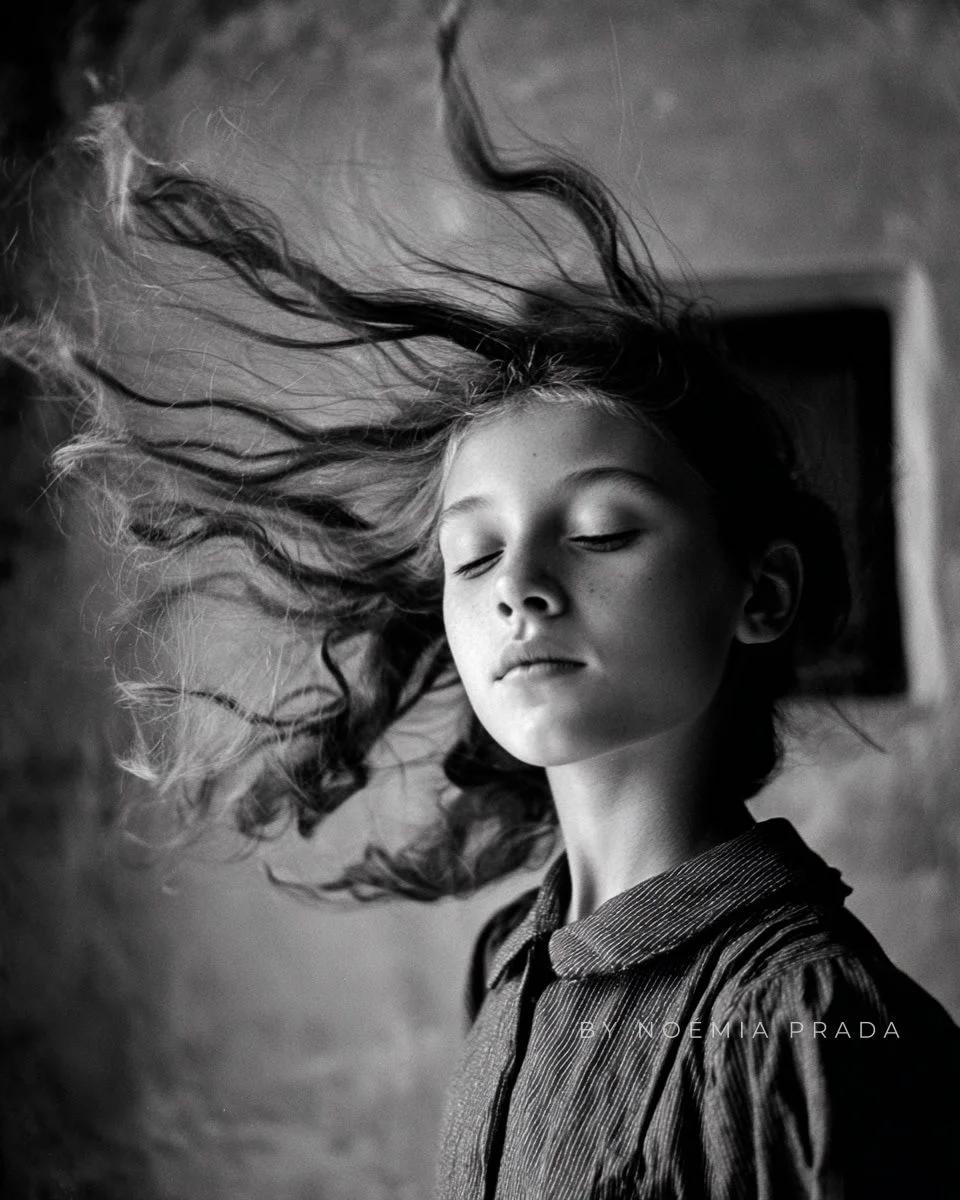
Photography by Noemia Prada
See the other episodes HERE!