
I sit and wonder why we didn't collectively go mad then. We are still functional. But I admit that pause between two bell shrieks was the massacre of our identities. It was shown to us that we are not ourselves. We were creatures frozen in survival, we didn't stop a single blow, we didn't raise our voices for anyone, we didn't defend anyone.
Us. Those of us who secretly held hands on stage at the House of Culture choir so that each of our voices wouldn't tremble along with our bodies at the festivals for the party and the people. Those of us who froze together, on the road between Suceava and Șcheia, lined up in single file, facing the road, forced by a lady patrolling with a megaphone to smile, but this forced smile, after an hour, made our cheeks terribly sore. We were forced to wave from seven in the morning to nine at night some flowers with wire stems and crepe paper petals made during handicraft class, even though our hands had weakened like that shredded paper, all with the promise that the car of the beloved leader and his distinguished wife would rush past us, visiting our city, but they would choose at the last minute, as a security strategy, a different route than the announced one, and schools had lined up children between localities for nothing. Us. Those whom Romanian teacher Boroș struggled to make sensitive with texts she cried reciting, English teacher Plămadă to emotionally stabilize with her sunny Transylvanian gentleness, and geography teacher Rugină to offer new horizons, self-esteem, and future advice.
Music teacher Macovei told me that in life I would sing, I had the most generous vocal range among the hundred children in the school choir and never sang off-key.I would someday enter an art academy. Miss Boroș, on the other hand, said no, I would become a writer. For sports teacher Baraboi, I was a revelation, beating the county finalists in running by an entire stadium length in an endurance competition, and she told me that, beyond the medal brought to the school, I had an iron resilience for my weight and that life wouldn't easily bring me down. My grandparents continued with their hope that one day I would tell the weather on TV, which, from a certain point of view, I am doing right now.
All these people valued us, blessed us, and shaped us, and the grade book was full of perfect tens… While all of us who couldn't build that giant his villa were failing math.
His next class came, in the last week of the year. The first after the meeting. The tense one. A chance to fix our grades.
Those failing in the first two trimesters were given a list of ten exercises as long as the blackboard was wide. Clear. As many as you solve correctly, that's your grade. No help, no interruptions when you make an error; you just have to discover it yourself and correct it. Or not, and you're stopped, you don't jump to the next line. Only the last ones, from the seventh onwards, weren't terrifyingly difficult. It was clear he was forced to pass at least some, at least those whose parents had made a fuss.
We were so united that we intertwined our ideas like a choir that couldn't whisper for fear of getting a one, but screamed from the distance of clear thought, every step of every struggling colleague, like in a common prayer, like a wordless service. The service of numbers. Some of us pleaded for the one at the blackboard, telling God that, if He existed, He should intervene, because even Colțuneac was human.
I remembered their faces from when they were little… Cătălina, in her first first-grade class, recited Luceafărul by heart until the teacher stopped her, because no child could follow how far she had taken the poem. Otilia filled a blackboard with New Year's wishes for us in calligraphic writing, with small cursive letters; she had come to school writing cursive just as I had come reading cursive. Mădălina played the piano as if for a concert, Tudor and Răzvan were world champions in swimming.
Colțuneac got a five, Pântea a six, Corduneanu a seven.
It was my turn, I solved the first seven lines slowly, but relatively easily, I heard the "alpha" hissing from the back row the victory of a yesssssss and I felt better, the kids are with me, I'm fine, I'm fine, I tackled line eight, but without the initial stress, technically I was no longer failing!!!! Seven was also okay, even if I couldn't do more.
The professor, intrigued, started asking me to explain aloud what I was doing there; only me, he hadn't asked anyone else. And at that moment, I began to feel that cursed cortisol tying my tongue, stinging my soles, I started stammering how we f-f-first solve the inside of the p-p-p-parenthesis, then the operations of di-di-di-division and mu-mu-mu-multiplication, then the others, how we extract the f-f-f-factor c-c-c-common, how this r-r-radical, a-a-after solving the inside, has a p-p-p-perfect s-s-square and we extract it, and so on. I finished and, terrified and overwhelmed by stress, I started line nine, which I knew I wouldn't finish well, because halfway through it was something difficult for me, those silly things I didn't master, but I wanted to get halfway out of caution, so he wouldn't somehow nick my eight, I don't know. The children watched me without breathing, they didn't even know I could do anything other than draw.
I had a first hesitation, I was waiting for the professor to stop me, to tell me student Răvnic, go back to your seat, you have an eight. He didn't stop me, he let me get tangled, untangled, tangled and then burst out: AAAAA! So, you don't know basic operations with bases? Unacceptable. These are operations for a five! You don't know them? You stutter at something like this?! You don't deserve a five, you're a four, but I'll give you a five out of pity.
In the first second, I didn't realize, I waited for it to be an error in the Creation's programming and to be instantly remedied, in the second, the one in which he emphatically wrote the grade with his pen in the ledger, I was rigid in my desk, something like a knife hurt my heart, around me the children murmured, stunned, the man had violated his own rule, stated earlier. He had reduced my work to five lines, even though I had completed three more. In the third second, I burst into the deepest cry of my life, the kind where you push your head through the wood of the desk and the parquet and drive your forehead into the earth.
He had trampled me under his boot, he had destroyed me. He had failed me, he had killed me, he had already killed me by perversely using my parents' hands, who would physically complete what he had started by filling in a digit with ink. I was convinced my parents would beat me until I took my last breath or throw me from the balcony and bury me, because they often repeated to me I made you, I'll kill you, and I knew that was perfectly legal and without legal consequences if the wretched offspring was yours.
I kept repeating to myself, while screaming with tears in every cell: "die, die, die." My scream found an invisible echo those days and amplified in 8 A, and in 5 B, and in 6 A, and in 7 B. I never wanted to live as much as I wanted the professor to die.
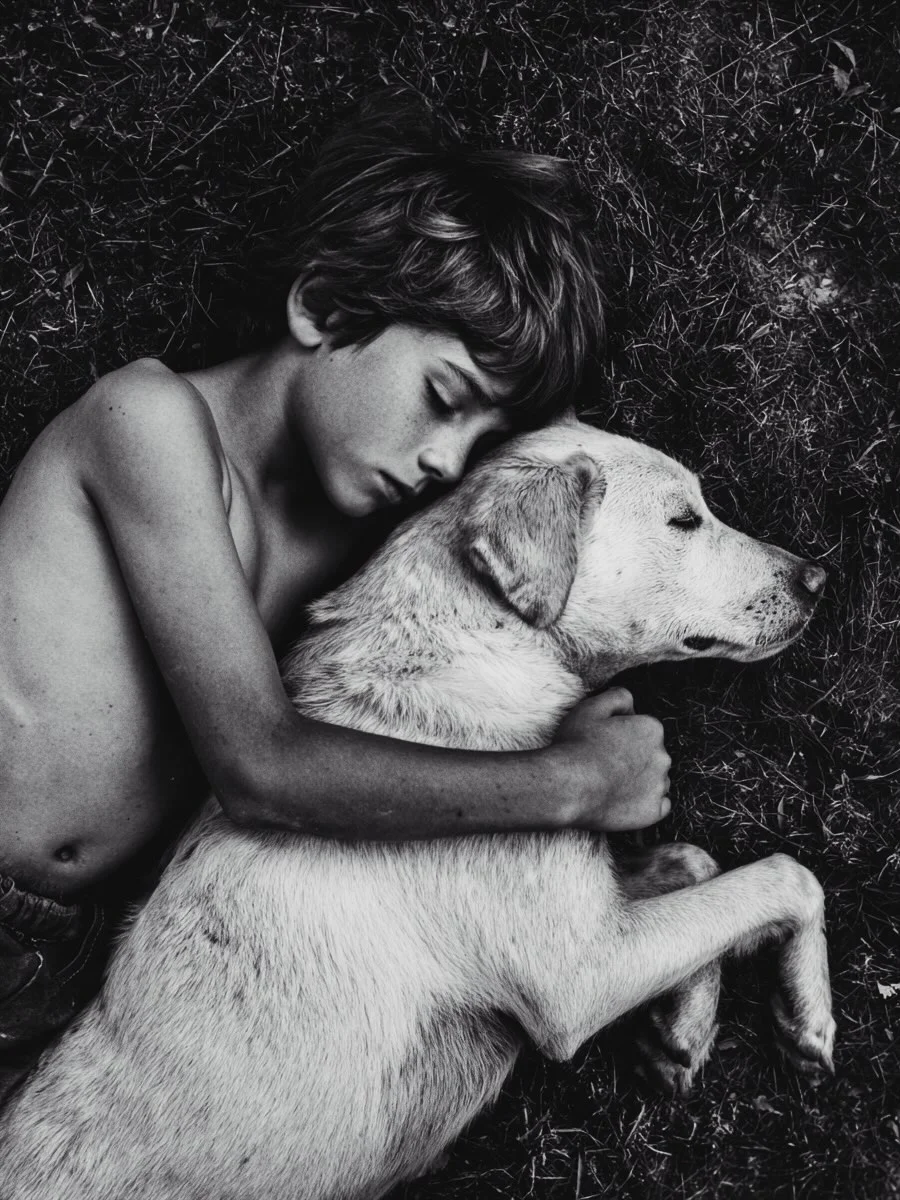
I still remember that, crying muffled, my mind a mess, like before an execution, walking home on that scorching day, I passed by a dog sprawled in the dust.
I still remember the dog's shape. The dust's shape. The heat's shape.
I am fifty years old and I have never prayed to God with such power to become, to be, to do something, as I implored Him that afternoon TO BE A DOG. To become THAT DOG.
Not to know math, not for my mother to find me, not for her to ask why so-and-so can, not to have a family, not to be to blame, not to know how to speak, to die only of hunger in the Zamca forest, not hanged in trees, and to eat shit from the roadside, just to be that dog. It was my deepest ontological prayer related to my own being: non-being. I implored my animality.
It wasn't a prayer, it was a scream that shatters quasars.
(to be continued)
Cosmina Dragomir
Photography by Noemia Prada
See other episodes HERE!