
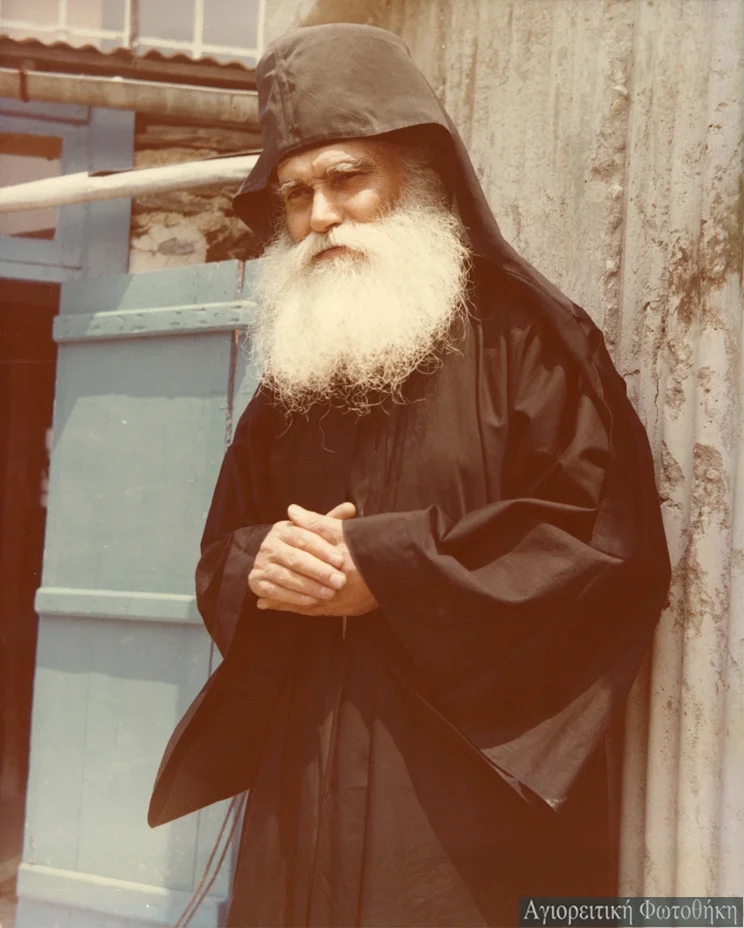
Saint Efrem Katunakiotul speaks to us
Divine grace is one, but according to the measure of each, it appears, works, and is seen. Yes, it is seen! Ah, and how much you inwardly thrill when you see, when you feel this divine grace!“I said, ‘You are gods, And all of you are children of the Most High.’” (Psalm 81:6).
* * *
Oh, grace, grace! Come to us too! Come quickly! Come! How much a person changes, how they transform, how the poor human becomes when divine grace overshadows them! This divine grace enabled the martyrs not only to not feel the pains of their martyrdom, but also to rejoice in confessing Christ.“For Your sake we are killed all day long; We are accounted as sheep for the slaughter.” (Psalm 43:23). It is one thing to feel it, and another to read and speak about divine grace.
* * *
This divine grace caused Motovilov, the disciple of Saint Seraphim of Sarov, to be unable to see the saint's face due to its great radiance. Shall I tell you something else? Why could the children of Israel not look upon the face of the prophet Moses, but he was forced to cover it when he descended from Mount Sinai, holding in his hands the two tablets of the Old Law written by God?
* * *
Man encounters many things in his life. Many times I wondered why the Holy Fathers raised their hands when they prayed. I could not understand, but when my turn came, then I understood. You cannot control yourself when grace comes. You cannot. But never in my life have I raised my hands to heaven. Spiritually I have raised them many times, like a son to his father. You cannot control yourself. When grace pours forth, you lose yourself. And when it withdraws, shivers embrace you. How much grace exalts you! How much!
* * *
I cannot control myself, and that is why I speak. I do as the ant does, which, when it finds food somewhere, goes and alerts the whole anthill, so that the other ants may come and eat of that food. Just as Saint John Chrysostom, who says: “The calf is fat, the table is abundant, let no one leave hungry.” (from the Paschal Homily), so I too cannot but tell what I have learned. I call everyone to share the treasure.
“In this way, man learns to humble himself.”
Once we were gathering almonds around our cell, and an airplane passed by. And, because our cell is located between two mountains, the roar of the airplane sounded like a melody, like a choir. Then my soul immediately went forth to meet the Bridegroom, as it is said in the Apostle: “Then we who are alive and remain shall be caught up together with them in the clouds to meet the Lord in the air. And thus we shall always be with the Lord.” (1 Thessalonians 4:17).
Only when you experience this do you understand what the Apostle means. When you don't go through it, you understand it in part, you don't fully understand it. Only then did I understand why the Apostle says: “We shall be caught up”. Such things are not provoked by you, but come on their own. It is one thing to sketch them, to study them, to write them, and another for them to come on their own.
When I do prostrations, the thought comes to me: “Here, where you do prostrations, are the feet of Christ.” Then I fall and kiss the ground where Christ trod. But such thoughts come on their own, you don't provoke them. This is grace, my brother.
* * *
When you approach a spiritual person, you receive. Yes, you receive.
* * *
Grace is also transmitted from a distance through prayer. For instance, when I feel grace during prayer, it means that my elder is praying for me.
* * *
The day before yesterday I read Vespers of the Transfiguration. In one of the lectionary readings, God tells the prophet Elijah: “And before Him there will be a mighty tempest that will split the mountains and shatter the rocks, but the Lord will not be in the tempest. After the tempest there will be an earthquake, but the Lord will not be in the earthquake. After the earthquake there will be fire, but the Lord will not be in the fire either. And after the fire there will be a gentle whispering breeze, and there the Lord will be.” (3 Kings 19:11-12). In a gentle breeze, man can see God. And that only at night, because during the day man has many thoughts within him.
* * *
When grace comes, you forget both sorrows and toils, and all goes well. But when sadness comes, you forget the consolations of grace and say: "God has abandoned me. I can no longer even pray, it's as if I am doomed to hell!".
When grace visits you, you forget the bitterness of pains, and when you are overcome by sorrow, you forget the sweetness of grace. This is how it is. In this way, man learns to humble himself. "But not I, but the grace of God which is in me" (1 Corinthians 15:10), as the Apostle says.
From "Elder Ephraim of Katounakia" by Hieromonk Joseph the Athonite,
Evanghelismos Publishing House, 2004
Translated by Hieroschemamonk Ștefan Nuțescu
No comments yet. Be the first to comment!