I believe each of us carries in our souls memories that have shaped our becoming through their discretion, which we never intended to recount, even to keep them as a gift beyond the confession of words.
In one of my few moments of contemplating Scripture, I found myself before the words of the Savior: „The Law and the prophets were until John; since then the Kingdom of God is preached, and everyone strives for it”, therefore the Savior urges us to confess the Kingdom within our souls in season and out of season, devoid of ostentation and joyful for the encounters He offers us.
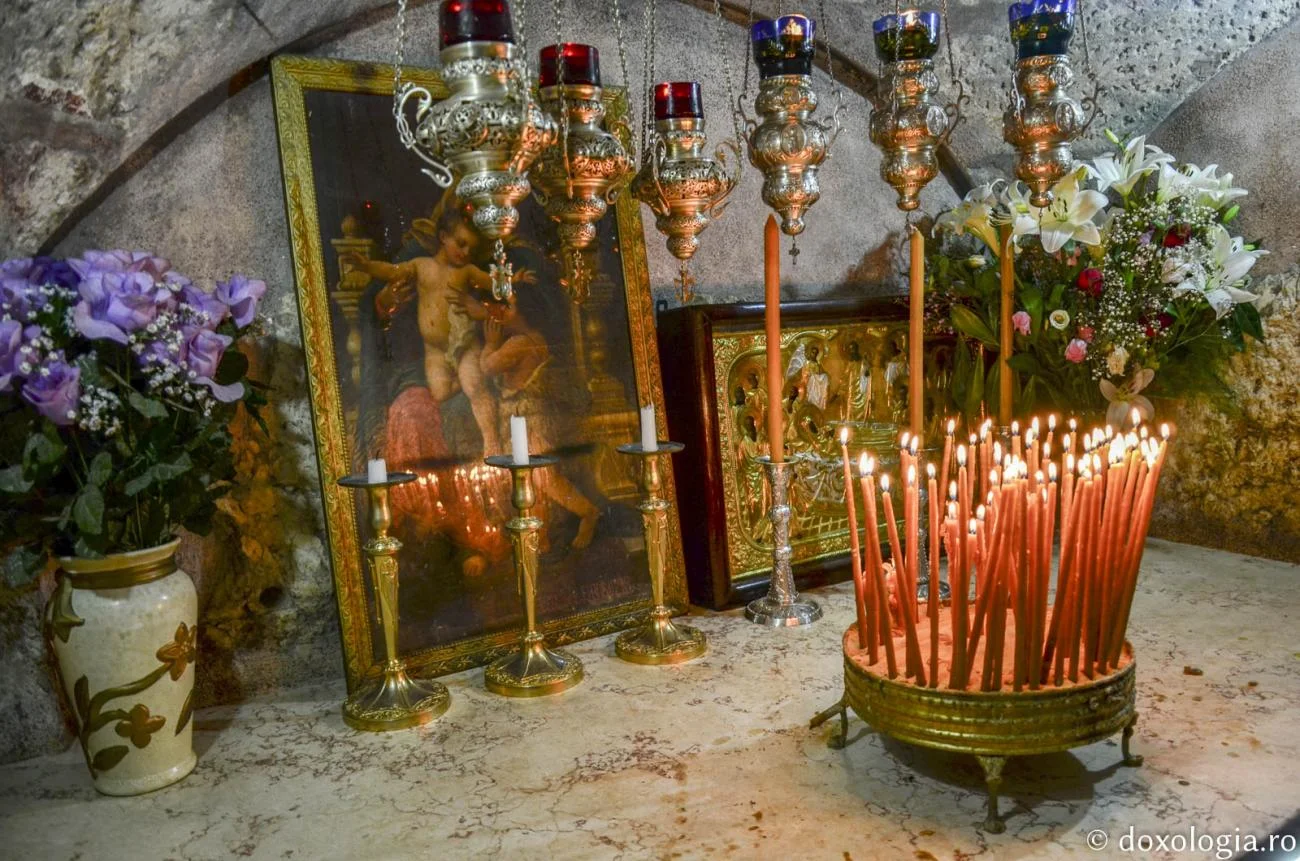
My Jerusalemite experience began on a warm May day when I arrived at the Church of the Dormition of the Theotokos in the Garden of Gethsemane. It's my first memory of the Holy Land, because it's the first Orthodox church I visited in Jerusalem after the Romanian one, and the one who took me there was a Romanian believer who often went to that church, especially in the evening, for vespers; he didn't understand anything of what was sung from the choir stand, but he came to be near the tomb of the Virgin. Almost unconsciously, I adopted his model of devotion and, despite all future experiences in those wonderful places, that church remained discreetly in my soul, following the delicate model of the Mother who ceaselessly embraces the closeness of her son, not just of the Son.
I don't know why I feel the need to write these lines now, thirty years distant from those times, perhaps also because I realize at this moment what maieutic process I almost unconsciously went through. I often went to the nearby church, where the Savior prayed on the night He was seized and judged, and from there, to re-enter the city of Jerusalem, you must turn towards the Lions' Gate, through the Kidron Valley, past the church of the Mother's tomb. It is an invitation to silent contemplation. It is as if the Son's prayer watches ceaselessly, it is the absolute model of maternal devotion… present in silence. This is the invitation He extends to us, to be present through silence in the reality of confessing faith.
The 48 steps you descend into the “womb” of the church, towards Her tomb, can be steps of initiation towards light. You cannot partake of Her light if you do not descend into the depths of the church, and this physical exercise makes you aware of the necessity of the spiritual one. The deeper you descend, the more conscious you become of Her light and warmth. Some might say it's autosuggestion; I call it realization.
There is an inner communion that one experiences with another person, like the friend who took me to church, but there is also an inner communion that one experiences with God, which you carry as a formative experience for the rest of your life, even when you are not convinced it is the source of your becoming. Here, the presence of the Mother of God makes its way for me.
I was experiencing a continuous emotion related to encountering places I had only read about, and this encounter would mark me over the years, but the Mother of God's “womb-church” seems to have no equal. I cannot forget that quiet evening, devoid of the bustle of pilgrims hurried by the multitude of objectives to tick off in Jerusalem, during which I remained undisturbed near the Mother's tomb, fixed on the stone slab on my knees, tired and frightened by the world that had revealed itself to me differently than I had expected.
I had time to ponder the wonder of the place. What is it like to view the world from the Garden of Gethsemane – or from what remains of it? What is it like to stand in the places where the apostles trod? I am helped somewhat by the three Byzantine lives that speak so beautifully about the birth, life, and Dormition of the Mother of God. Saint Maximos the Confessor, in “The Life of the Virgin,” describes the Savior's arrival at His mother's tomb and the dialogue between them: „Bless me, Lord, with Your right hand, and bless all those who glorify You and remember Your Name and bring You all their prayers and requests!”.Then the Lord stretched out His right hand, blessed His Mother, and said to her:"Blessed be you and let your heart rejoice, blessed among women, Mary, for all grace and all gifts have been given to you by My Father in heaven, and therefore, every soul that will call upon your name with holiness will not be rejected, but will find mercy and comfort in this life and in the age to come. And you, enter the eternal dwellings with peace, joy, and into the endless treasures of My Father, so that you may see My glory and rejoice through the grace of the Holy Spirit!"
It's a new Annunciation! If in the first, the infinite appears in the finite and the immeasurable in measure, now the finite becomes eternal through the will and work of the Trinity. The Annunciation becomes Incarnation and Resurrection alike. It is the sign by which anyone who calls upon both the name of the Virgin and that of Christ will be recognized. It is the very life of the Christian, who is invited to live it as an unceasing good tidings.
Fiat- of the Mother from the Incarnation of the Word receives a new dimension through fiat- from her Dormition. From a Virgin who shelters Heaven, she becomes the Mother of Heaven.
There is an icon of the Dormition of the Mother of God, painted by the celebrated El Greco (the Cretan Domenikos Theotokopoulos), a work that combines Byzantine tradition with the Western Renaissance style. I learned its story, perhaps not by chance, in a superb poem written by the wonderful poet Liana Sakelliou, "Sequentiae." The poem begins in the 16th century and ends in the 21st century. Between 1544 and 2014, the icon connected the destinies and experiences of several people, and its journey through different eras is highlighted in five powerful sequences (Ioana Pârvulescu). In fact, the poem traces the icon's journey through the history of its own time and how it came "home," meaning it rediscovered the joy of veneration, as it can be seen in the church of "The Dormition of the Mother of God" in Ermoupolis, Syros. I will not dwell on the poem; I would rather focus on the icon's representation that reveals fiat- that I was talking about.
The icon illustrates El Greco's early creative period, when he was still in Crete, and differs from his later representations of the subject.
In the icon, we see the Mother of God surrounded by apostles and angels, grouped around the bed on which she rests. We see the Savior affectionately bending over His Mother, receiving her soul in the form of a newborn, suggesting that He was with her before her birth and receives her again at her translation to heaven. We simultaneously see the Mother of God enthroned in heaven, receiving the mystery of her bodily ascension to heaven, showing the significant place she holds in the Church. Embracing the three-dimensional art of the Renaissance, through the appearance of perspective, El Greco renders the Mother's passage from earth to heaven by a splendid ladder bathed in angelic light, which psalmodizes through colors the emergence of the Virgin as Queen of Heaven. The icon is full of movement, in a dynamism of the Spirit.
It seems that the glory of the Theotokos is not a theological teaching, but an empirical one, since it has been seen by many saints. El Greco surprises us, trying to convey that God's eternal plan was fulfilled through the Mother of God, as the Church Fathers say.
Tradition records Mary's words when she met the apostles in the house of Saint John the Evangelist on Sion, before her translation: "Rejoice, blessed children, and do not make my translation a cause for sorrow, but fill yourselves with even greater joy, for this comes for eternal joy. The grace and mercy of the Lord be with you always!"
Joyfully, I always left her tomb with the beautiful procession on the eve of the Feast of the Dormition in mind, when, by candlelight, the path of the Virgin from Sion to the Garden of Gethsemane is recreated. Of course, the configuration of today's path is different, but the testimony has remained the same.
Rejoice, you who are full of grace, who in your dormition do not abandon us!
Rev. Cristian Muntean
Photos from doxologia.ro