
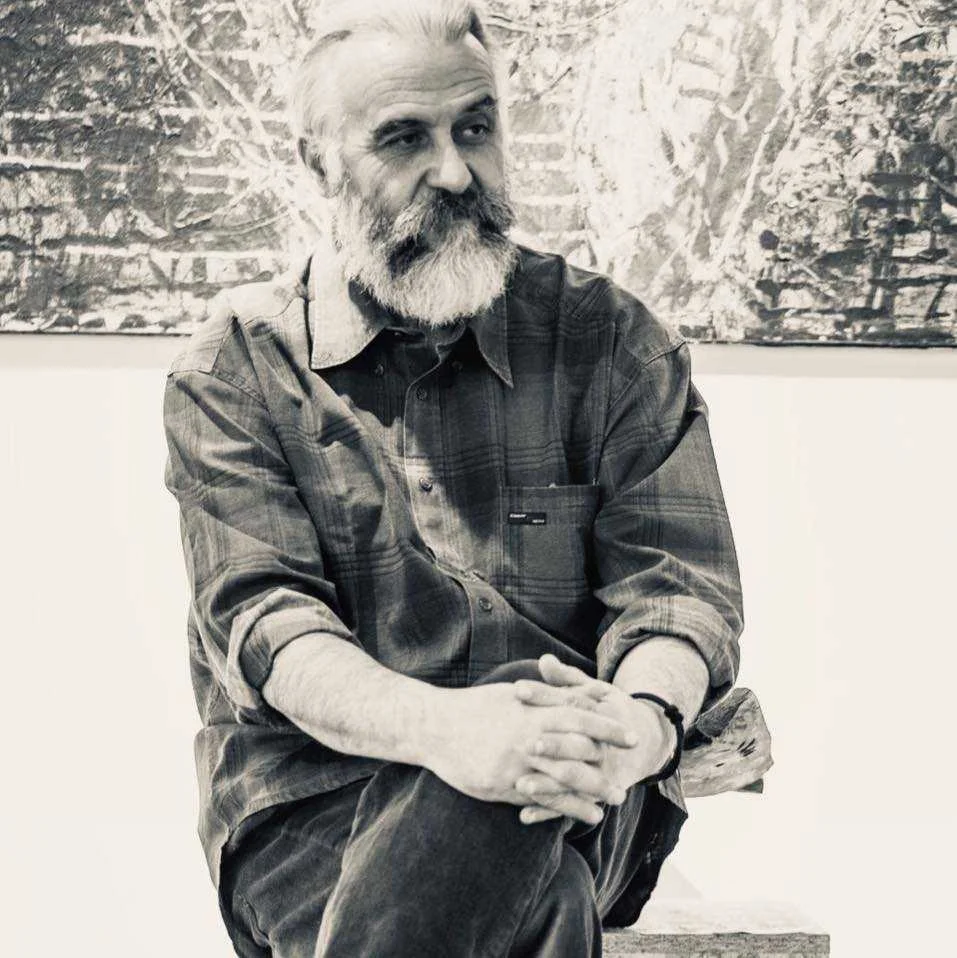
At the Multicultural Center of Transilvania University in Brașov, the vernissage of the exhibition "Apocalypse" by visual artist Ioan Aron Țăroi took place. He passed away two years ago while working, among many other things, on the exhibition that came to light through the care of his wife and curator Cristina Simion from Nuremberg.
A graduate of the Faculty of Visual Arts in Timișoara, ceramics - decorative arts section, Ioan Țăroi specialized in several techniques: graphics, painting, ceramics, and metal. He debuted with the exhibition "Nature and Birds" in 1986 in Brașov, and internationally with "Passerelle" in Tours, France. Throughout his career, he expressed himself using extremely varied techniques and materials: metal, ceramic, wood, glass, watercolors and acrylics, ink, pastel, charcoal, pencil, and his major themes were oriented under the sign of spiritual archetypes that bring to the forefront the forms of the sacred in various "Manifestations," if I were to mention the exhibition at the "Europe" Gallery in Brașov, 2017.
Specialized criticism portrays him as a profound and complex artist, who seems to have the mission to organize the chaos of the world into surprising aesthetic forms, and the way he succeeds is equally surprising. His involvement in Brașov's cultural life is also highly relevant, as he "shepherded" the editions of the Blue Biennial in Brașov, establishing the "Artessentia" Association with his family.
The painter's current exhibition has a distinct atmosphere and presents you with a reflection on life, prompting you to search for the meaning of existence in a world of chaos, which can be caused by man's displacement in the world. There is always talk of Ioan Țăroi's profound nature, of his inner anxieties, which breathe through every pore in the current exhibition. Others have said before me that, in itself, the word does not define the state of an image, but it signals that state. Any comment I might try to make about his exhibition is incomplete as long as the image is absent.
I could talk a little about the "states of mind" that the artist conveys, thanks to the care of his loved ones, who organized the event.
Ioan Țăroi's "Apocalypse" has something distinct about it, as it places the viewer in a universe of reflection on the flow of time between the earthly and the heavenly. The fact that the artist engaged with this theme before crossing the threshold of earthly existence makes the viewer's eye linger differently on his canvases, searching for signs of the world beyond, even if finding a sign is not the same as understanding it. You only feel that it is a truth in which you somehow participate from the outside, awaiting the time when it will dwell within you.
We enter a space of symbol where the face plays a significant role. Țăroi's "Apocalypse" is under the sign of revelation – a world of the face transfigured through suffering, the test of enlightenment and illumination. The symbol, in this case, represents the diverse act of an essence with infinite roots that makes the transition from earthly to heavenly, from life to eternity, in the mystery of the face.
"A person who does not live the mystery of their nature is a person devoid of truth," the artist seems to tell us through this exhibition. You can remain at the physical image of the works, attentive to the expressive play of colors and forms, or you can look further, intuiting "as through a mirror, dimly" the deification of the transfigured face, which has shed the game of life's masks through a true transfiguration. The transition of transfiguration is painful and reflective, sealed by prayer, which leads the face towards a distinct luminosity, even haloed in some works. The persistence of white, blue, red, and gold leaf brightly unravels the consciousness of life's unknown inferno. The colors impart a sensation of both cold and warmth – it is the measure of another world where the thermal relationship between warm and cold configures a new realm, through the need for color complementarity.
The artist does not evade the evil in the world, the suffering of man, with which he identifies, but seems to convey to us that, at the end of the sufferings from which none of us is absolved, enlightenment can be reached, insofar as we have converted our masks towards the uniqueness of being in truth, because we have lived the mystery of nature, as much as we could.
It seems a truism to say that our world relates to the other world inasmuch as the other world relates to our world. The artist invites us to look at his world, aided by the effect of colors that consume the distance between worlds under the seal of a hope, of another world that leans on this world through communion with the other. This sentiment is represented by the artist through faces united in prayer or intertwined, in which any delimitation is united in the matrix of the Kingdom.
The experience of art is entirely one of body and spirit. We don't just look with our eyes, Thomas Schlesser tells us, but also with what we have lived, with the elements within us, with our experiences, and with the projections of the unconscious.
Ioan Țăroi seems to make us partakers of this truth through this exhibition, which is present throughout July at the Multicultural Center of the Brașov University. An invitation to everyone's apocalypse.
Fr. Cristian Muntean