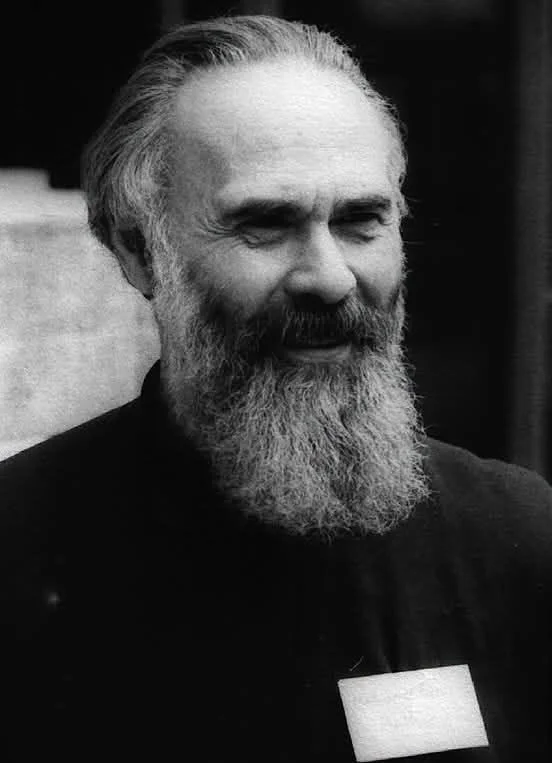
Metropolitan Anthony of Sourozh Speaks to Us
The first thing that amazes me, both about myself and about others, is the way we recite 'Our Father.' Usually, we think that this prayer unites us all—believers, Orthodox, parishioners of the same church, or members of the same family. However, we rarely meet someone who truly feels that when Christ taught us to say 'Our Father,' He was speaking about His Father—and about ours, anticipating the moment when, later, in the history of the Gospel, He would call His disciples 'brothers.' This is a tremendous thing, because it would already be much even if it were only about acknowledging God's fatherhood over us. But when we realize that this fatherhood includes the Only Begotten Son of God and that, through this appellation, 'Our Father,' it places us, together with Him, in the same relationship with God the Father, it is something profound and wonderful.
Fatherhood has distinct properties. The Father is the source of our life; He is the one who educates us through boundless love that accepts no compromises and asks us to become what we are called to be. He is content with nothing less than what rises to our dignity. Consider, for instance, the parable of the prodigal son (Luke 15:11-32). The son, coming to his senses, sets out for his father's house, repeating a prayer full of repentance to himself: “Father, I have sinned against heaven and before you, and I am no longer worthy to be called your son; treat me as one of your hired servants…”. This is a lament of the soul, not a mechanical recitation of what he will say to his father; he feels this unceasingly and sets out for his father, despite his unworthy life. Although he is unworthy, he knows that his father remains a father, that his love did not waver even when the son had told him: “I cannot wait for you to die so that I can start my life. Give me my share of the inheritance now! Let's understand that you no longer exist for me.” Even then, the father did him no reproach, but gave him his share of the property and let him go in peace.
Remember, however, when the son makes his confession before his father, the latter does not let him finish. The son utters: “Father, I have sinned against heaven and before you, and I am no longer worthy to be called your son...” — and here the father interrupts him. The son or daughter may be unworthy through their conduct, but they cannot transform their relationship with the father into that of a servant or slave. The father cannot receive him as a hired servant, but only as a son: repentant—yes, unworthy through his deeds—yes, but still as a son, and nothing less!
It is crucial to understand that God will never reconcile Himself to the fact that we might live beneath our dignity. This is God's fatherhood. And, in this context, when we recite 'Our Father,' the image of what we ourselves should be appears. If we are truly brothers and sisters of the Only Begotten Son of God, Who became the Son of Man, then this is the measure of our humanity—nothing less! We must be icons of Christ and, moreover, resemble Christ in such a profound way that everything that can be said about Christ in the end, when all will be perfected, can also be said about us.
Therefore, when we say “Our Father,” we must understand that we are embracing this boundless calling and are prepared to accept this unfathomable state, in which we are not merely brothers and sisters of Christ through His humanity, but that nothing less than the fullness of Christ’s image is sufficient for us to be fully ourselves. This demands much from us. It is not a request to God to do for us what we do neither for ourselves nor for Him, but an exhortation to heroism in the pursuit of this fullness. Although we cannot attain it through our own strength, this is our calling, and we have no right to think of ourselves at a lower level. We must be humble enough to accept this greatness and bow before it, but also to fulfill it.
And how can we do it? The answer is found in the words that the Lord spoke to the Apostle Paul when he asked for strength to fulfill his mission: “My grace is sufficient for you, for My power is made perfect in weakness” (II Corinthians 12:9).
This “weakness” does not refer to our laziness, our rigidity, or our cowardice, but to that creaturely fragility which becomes transparent to God's work, which becomes malleable in His hands when we entrust ourselves to Him with faithfulness, trust, and obedience, according to the Savior's word: “What is impossible with men is possible with God” (Luke 18:27). Therefore, we must believe that this is possible. The Holy Apostle Paul says: “I can do all things through Christ who strengthens me” (Philippians 4:13). Thus, we have a calling that surpasses our strength, but also the confidence that we can grow to the measure of this calling — not by ourselves, but through spiritual exertion. This is the calling set before us.
These words, simple and so well-known: “Our Father”, immediately place us before our brotherhood with Christ and the unfathomable greatness of our calling, giving us the assurance that it can be fulfilled through the power of divine grace, if we fully surrender ourselves to God with malleability, transparency, and obedience.