Before dawn breaks and the cat jumps on me for food, I often know what I'll write before the day begins. For quite some time now, ideas have started waking up before me.
This morning I thought about noise.
On Sundays and holidays, I serve in a chapel. Small spaces have a useful quality for spiritual life: nothing human can hide too well within them.
From time to time, a person smells strongly of sweat. Another has a smoker's cough, loud and persistent. Someone mutters the prayers after me with enough conviction that I start to wonder which of us two is leading the service. From another corner, a voice rises, determined to follow its own tune, regardless of what the nuns are singing at the choir stand.
These situations are delicate. Before I speak with people, I make a habit of speaking with myself.
For such conversations, over time, I've built a kind of first aid kit. I leaf through the notebooks where I've collected words from the holy Fathers whom I had the joy of knowing.
A monk told Father Teofil that when he prays, he covers his watch with a pillow so he wouldn't hear its ticking. The Father was amazed at the fragility of a prayer that a watch could conquer.
“Brother, you should be able to pray even near a noisy tractor.”
A splendid image.
Just as I was writing these lines, Nichita came down to the living room and turned on the vacuum cleaner.
– Nichita, you're vacuuming at this hour?
– But everyone vacuums on Saturday at nine.
I looked at him and realized that Father Teofil had just sent the tractor into the living room.
Nichita quietly continued his work.
And I, the text.
Father Teofil used to say that we spare ourselves too much when we demand ideal circumstances for prayer. Strength is better tested amidst voices, doors, footsteps, engines, and all the hustle and bustle around us, rather than in a quiet specially prepared for us.
– Note down to get vegetables for the soup too.
My morning proved determined to contribute to the demonstration.
During my student years, when I was studying sculpture and confessing at Sâmbăta de Sus, I also had my theory of suitable conditions. The young artist has many convictions about the studio, light, quiet, concentration.
It was around 1997 when I heard something I will never forget.
Father Dumitru Stăniloae was working on the translation of the Philokalia, and Father Arsenie Boca was writing at his dictation. The first volumes were born in a Romania at war. On one of the pages, a passing note remained:
“Machine-gun fire in the street.”
I underlined that one.
In a room, a theologian translates one of the great books of inner life. Outside, people are killing each other.
– See, you also need to stop by the pharmacy for Sinosun.
Father Serafim Popescu used to say that, through the translation of the Philokalia, Father Stăniloae “brought Orthodox heaven to Romanian soil.”
That heaven descended in 1944, with machine guns in the street.
When I think about this, my student years light up again. I met people from whom a single saying received at its proper time could take the place of a library. I put their words in my satchel without knowing how often, years later, I would find myself searching through it.
– Get feta for Sara too.
From those years, I also carry with me Father Stăniloae's words about Father Teofil: he was one of the best connoisseurs of the Philokalia he had met.
To whom could such a thing be said today, with the same certainty and joy? Where do we find the person who has read the Philokalia so deeply that its pages have permeated their way of speaking, of enduring, of praying, of receiving others?
Tomorrow is the commemoration of the Holy Confessor Priest Dumitru Stăniloae. On October 29th, seventeen years will have passed since Father Teofil's departure to the Lord.
I think of both of them and that way of reading a book until it enters one's life, and life begins to resemble it.
Around us, there's quite a lot of noise today. News, haste, anger, meaningless words. Ideal conditions continue to be delayed.
– I messaged you to get a kitchen roll too.
– Noted.
The vacuum cleaner had stopped in the meantime.
The Philokalia was translated while people were being machine-gunned in the street. This text was written amidst a vacuum cleaner, soup vegetables, Sinosun, feta for Sara, and a kitchen roll.
The resemblance stops here: the surrounding noise and the ongoing work. The proportions are, of course, entirely different.
Silence may still be delayed. Until then, we'll get on with our work.
Fr. Ioan Gînscă
In photographs:
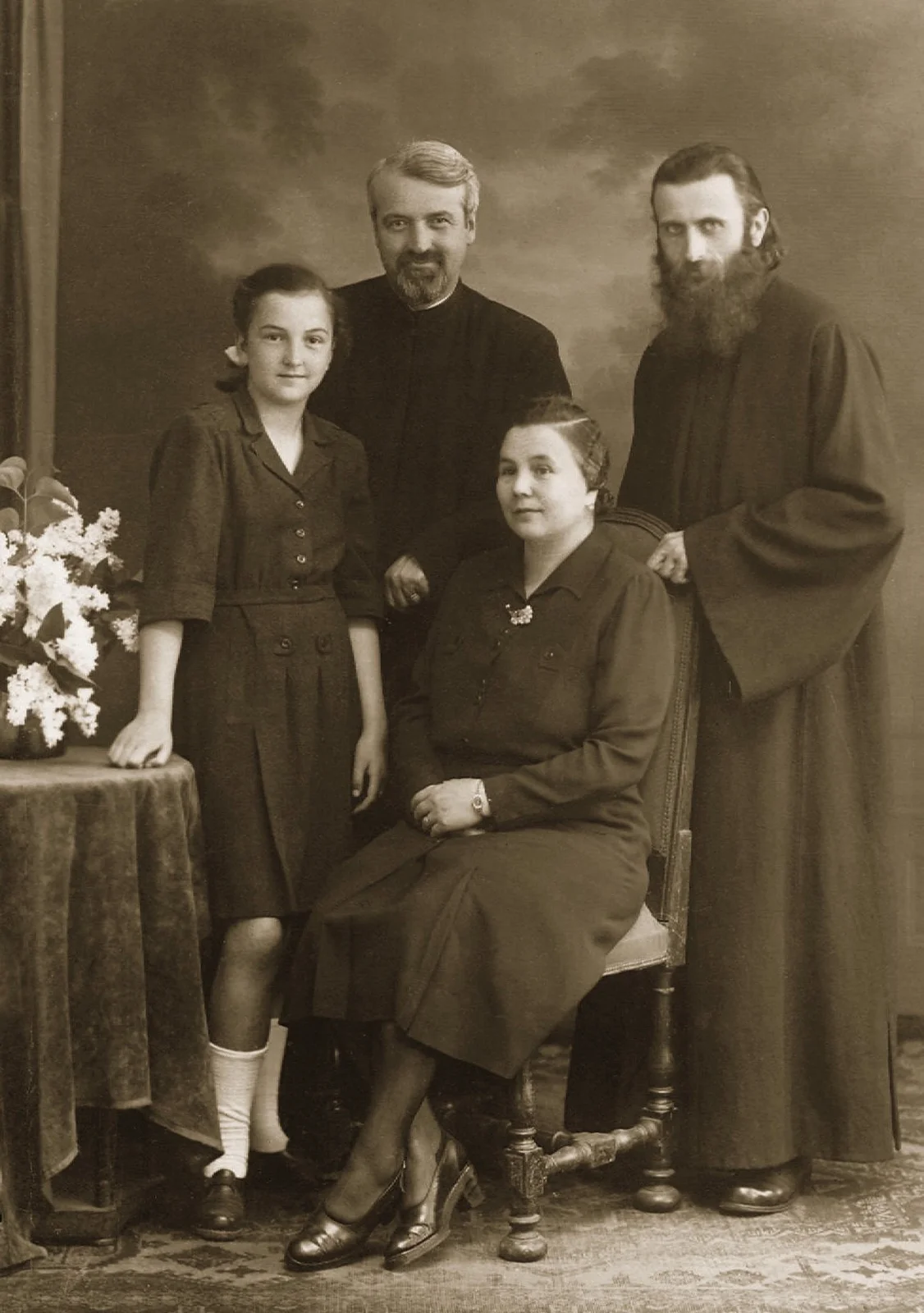
- Father Arsenie Boca with the family of Father Dumitru Stăniloae, in Sibiu.
- Page from the manuscript of the Romanian Philokalia, written by Father Arsenie Boca after Father Dumitru Stăniloae's dictation: Saint Mark the Ascetic, "Epistle to Nicholas the Monk".