
This is how Constantin came into the world: daring too much!
He had dared to be born precisely at the time when his two-year-old brother was dying, after carrying him for four months on his frail young shoulders, which were barely forming in the secret shadow of the maternal womb. For the young woman, torn by grief, no longer paid attention to the unborn child, but supported the little body of the one who was slowly dying on her belly that grew more each day. Then, the one who had just come into the world had dared to receive the name of the one who had just departed. Unconsoled, the woman had believed that her firstborn had received a second chance in the being of the second, who was to remain the firstborn, though never truly the first. And she baptized her second boy with the name of the first one too.
Later, he had dared to dream in a yard where heavy labor, the toil of the land, the tending of animals, the drudgery of puszta summers where you had to let yourself be bitten by the relentless sun to wring a drop of food from the poor dust, took precedence. Instead of bending stubbornly towards the heat of the rock-hard clods that resisted under hoes, he dared to straighten his back, to cup his hand over his eyes, and to immerse himself in the disturbing coolness of the clear summer sky. Instead of filling himself with the miasmas of stables full of animal excrement, he dared to fill himself with the fragrance of the tall, dry grasses of the 'sărătură' (that's what the dry, scorching plain around his native village was called). He came home with his hair full of their stems, smelling of bitter wormwood and the sweetness of sun-scorched foxtail millet. Instead of grooming, feeding, and watering the horse, Mișu, he dared to throw himself onto its velvety back and gallop wildly towards the endless horizons of the burnt fields, with his arms flung wide, as if in an unreal flight. And Mișu fully understood the longings of the olive-skinned boy with an emperor's name and flew with unseen wings until they both became one with the wind, only to then fall exhausted, but full of sky and freedom, onto the patch of grass brimming with water around the sweet spring at the edge of the village. Instead of remaining a responsible adult for an entire household, full of vegetable gardens to weed and water with his unripe arms, and animals to water and feed, and yards to sweep and laundry to wash, he dared to be a child, to live all his stages in their time, and to rebelliously go swimming in the river that encircled the village, inundated by the relentless sun, like a belt of coolness.
At the time of rebellion, he dared to stand up to a merciless and cruel father who systematically crushed their lives. He had come back broken after seven years spent in the Russian camps of Siberia, after falling prisoner at the Don Bend. What he had suffered there, they never found out. What is certain is that he had left as a young father who carried his children on his shoulders and taught them happiness and security, who lifted them into the saddle, beside him, and taught them to fly, who told them the most wonderful stories on summer evenings, when the 'sărătură' resonated with frog and cricket songs, and the acacias with nightingales. And he had returned a terrible, silent, withdrawn monster, hatingly working the ground beneath his feet and the people around him. Constantin dared to disregard his commands. And, as punishment, he ended up tied with a chain, in the full sun, without food and water (likely memories of the terrible times his father spent in the camp). Then, one night, when the man, maddened by terrible chimeras, threw a sharp axe at his wife – who was trying to escape, with a newborn infant at her breast – he dared to knock him to the ground and return all the punches and kicks he had generously dealt him, his mother, and his siblings until then. He almost killed his father then.
And, when the clarity of the morning helped him understand what was about to happen, he dared to be completely free. And he left his parental home. But he did not take the conventional path of those forsaken by fate. He didn't drown himself in drink. He didn't let himself be dragged into illegalities. He didn't become a directionless vagabond. He went to his aunt's gate and asked for the right to a human life, not an animal's. And he received it. Because he had dared to be a human being when everyone had believed he would end up being subhuman. And because his aunt chose to believe in him. And he began studying with ferocity. He felt that this was his only chance. With each passing day, he dared to hope more and more for a future without sin. Beloved by all his high school teachers, he amazed them with the clarity of his mind, the beauty of his behavior, his inventiveness, and his thirst for knowledge.
But, for some of us, the peaks become accessible only after we've crushed our flesh at the bottom of the abyss. And he hadn't reached there yet. He fell madly in love, like any dreamer, with two fluttering eyes attached to a diaphanous butterfly's flight. He wanted so much to love and be loved that he sacrificed his straight path and deviated from the goal he hadn't taken his eyes off until then. And, from his momentary straying, an illegitimate child was born in those times. He quickly decided to get a job to support his family and continue his studies in the evening. But these steps, blinded by the deceptive brilliance of a butterfly that loved all the flowers it met, brought him to the sharp edge of the chasm. The butterfly took flight, the newborn child, too fragile, withered away from longing for his mother and perished, and he let himself fall lifelessly towards the bottom of the abyss, arms spread wide, like on the back of the brown horse in his childhood. When he reached the lowest point of the abyss, the peak from which he had fallen was so high that everyone abandoned all hope. Well, almost everyone.
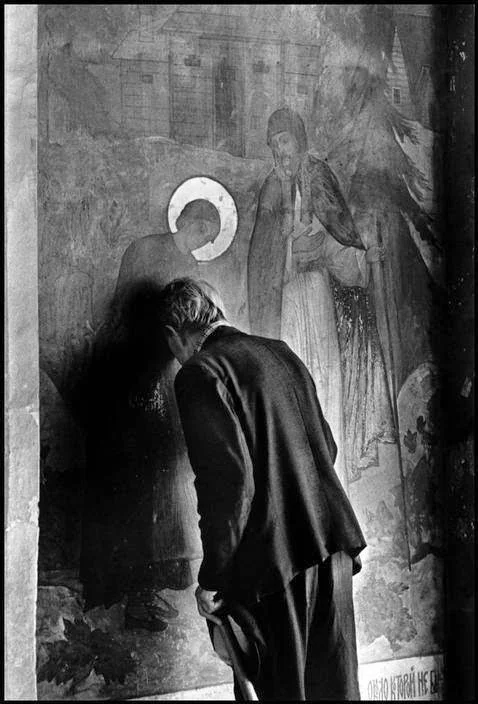
Because, from the darkness of the depths where he was groping, at times one could hear: 'Lord, God, where are you? Why don't you come? I want to see You! I want us to fight, both of us, so I know You exist! I want to confront You, to convince myself that You are real and not lying that You are alive!' His mother, hearing his blasphemies, sobbed before the icons blackened by the smoke of the oil lamps in the good rooms and begged for mercy. God-fearing people stopped, trembling, crossed themselves, and drew aside. They wouldn't even step in the footsteps of this unholy man. The lawless were filled with pagan respect for one bolder than themselves. His second wife cowered in fear and spasmodically clutched her clothes to her frail, bruised body. The children ran to hide from him. And the celestial powers wept, with their faces covered by palms, wings, and mantles, trembling at the recklessness of this man. Only one smiled: 'Very well, Constantine, you who are too bold! Your will be done, poor one, I will come to you!'
And He came, as only He knows how to come. From the storm of drunkenness and shameless debauchery, He pulled him out with the shiver of regret. For He had gifted him a child, already old, who waited for him late at night with bare feet, in a long nightgown, on the cement of the entrance hall, to ask him about his troubled and lawless day, patiently listening for hours to his terrible confession, until he completely sobered up and started to cry. From the rage of his anger, he was awakened by the pity evoked by the frail back of his daughter, upon whom he would accidentally land a punch when the child rushed to defend, with her tiny body, her mother's body, broken from beatings. From his wanderings far from the peak from which he had fallen, he was turned back, at first, by the longing for his children, and then, by the longing for conversations with his daughter, which had taken an unexpected turn: they had started to talk about the God of the Liturgies from which the girl was never absent. For the only One who knew how to smile when everyone else was hiding in fear, opened the way for him to Him, but let him take all the steps himself, held by the hand of a child who outwardly was only nine years old. But inwardly, nine hundred thousand millennia of assumed pain, vanquished fears, and unabandoned hopes. And the road was arduous. He climbed with difficulty, but he climbed.
Eventually, in the very twilight of his life, when the body with which he had ridden the stallions of his own Apocalypse was completely weakened by a terribly painful cancer, eaten away by torment and burned by regrets, he watched his daughter bustling about the house and dared to call out to her:
- Forgive me!
- Why should I forgive you? I am your child. A child has nothing to forgive their parent for...
- Yes, you must forgive me! Because I have tormented you greatly!
- Never mind...
Then, after a while, again:
- Forgive me!
- Again?! You already asked for forgiveness once, earlier.
- Now forgive me for my father, and for my mother, and for your mother, and for all those against whom I mercilessly sinned!
And Constantin, he who considered himself invincible, tormented himself ceaselessly, daring what few dare in the world: to confess his mistakes before everyone, with contrition, trampling on his pride. "Lord, I am so thirsty!" "What can I give you to drink? Tea, water, juice, milk... what would you like to drink?" "Water?! If you gave me an ocean, father, it would not quench my thirst. You think I am sitting on your couch, but you cannot see everything. I am in a terrible fire that burns me in a way I cannot describe! For my deeds, father. How good! Let it be, so there's nothing left for you to pay!"
Then he turned to his grandchildren, who watched him motionless, and dared again, with too much boldness:
- Children, listen to your grandfather: I tormented people, and now I torment myself like a worm in the scorching heat of the road; I smoked, I drank and I ate, then I took Holy Communion to see what might happen to me, and now, for three months, I can't eat more than a bite a day; I trampled upon, with wicked audacity, everything that was good and holy in my life, and I renounced God. Now I am a reject, a carcass good for nothing... Do not repeat my mistakes!
And, finally, he turned his eyes to the One who still smiled kindly at him from the icon, and dared far too much: "Lord, how I blasphemed You! How I sought You, groping like a fool through the hell of my life! I didn't know where to look for You. Forgive me! And let me leave with all my sins, so that no one has to account for what I, like a wretch, have done wrong!"
And the Lord once again granted his will. He let him depart as he wished: a weak, wasted, humbled carcass, full of regrets and weeping from eyes closed in death, as a sign of the final cleansing.
From Constantin, the far too audacious, my children and I learned two enormous things: that evil audacity throws you into hell, even while still in the body, and good audacity saves you from it, even when no one gives you any chance anymore.
Alina Mirică