
I spent entire years on University Street, past the Transylvanian School group sculpted by Romulus Ladea. I thought I knew it. I saw it, without really looking at it anymore.
One day, my wife asked me:
“Have you noticed that all three are looking down?”
The three scholars keep their heads bowed towards their books. Their posture has the tranquility of study. The page gathers their attention, and the body follows the mind's movement. They have before them something that deserves more attention than their own image.
Monuments often offer important people a personal horizon. The chin rises, the chest opens, the future settles somewhere above the rooftops. No one can verify if the great man truly sees anything there.
Ladea chose the book.
Knowledge can elevate man or inflate his self-image. The difference is often seen in the direction of the gaze. Truth received as a gift gives birth to gratitude. Carried as property, it becomes a decoration of the ego.
The Apostle Paul summarized this tension in a few words: “Knowledge puffs up, but love builds up” (1 Corinthians 8:1).
The academic title initially rests quietly on the diploma. Later, it can rise in the tone of voice, in one's walk, and in the way one interrupts a conversation. Intelligence thus comes to defend the image of its possessor, instead of broadening their vision.
The gaze of the three preserves a demanding idea about education. The cultivated person remains open to correction. The book obliges them to patience. Reality disturbs their preferred theories. A close person can see in a few seconds what a highly educated mind misses for years.
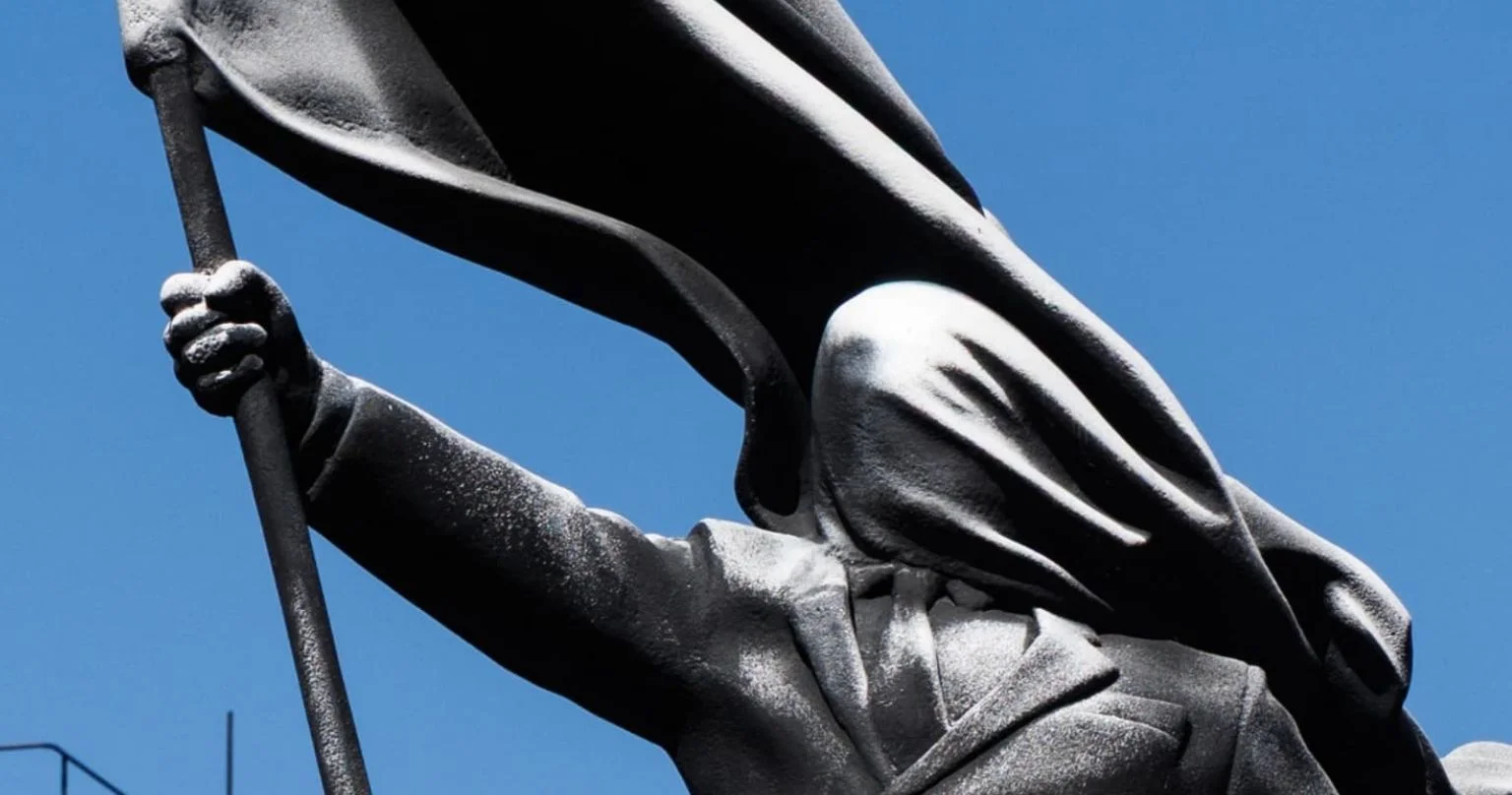
In a recent sculpture by Banksy, a man in a suit advances with a flag covering his face. The image is simple and disquieting. The symbol he carries has come between his eyes and the world.
The London work makes the Cluj bronze speak more clearly. Ladea's scholars bring their eyes closer to the page to understand. Banksy's man advances with his vision covered. The book disciplines their attention. The symbol confiscates their sight.
The danger of the educated person appears when what they have acquired settles between them and reality. Prestige, ideology, career, and competence become filters. They tend to observe mainly what confirms their position, convictions, or interest. Intelligence can deepen this blindness, building impeccable arguments for a wrong path.
After graduation, what you know begins to have consequences in the lives of others. Your skill can help or harm. Maturity is seen in how you use it and in the courage to accept correction. Love keeps this power in service to the person in front of you.
Beyond the last exam, a question remains: what do you hold so close to your eyes that you no longer see the world?
Fr. Ioan Gînscă