Or how to see and (not) believe
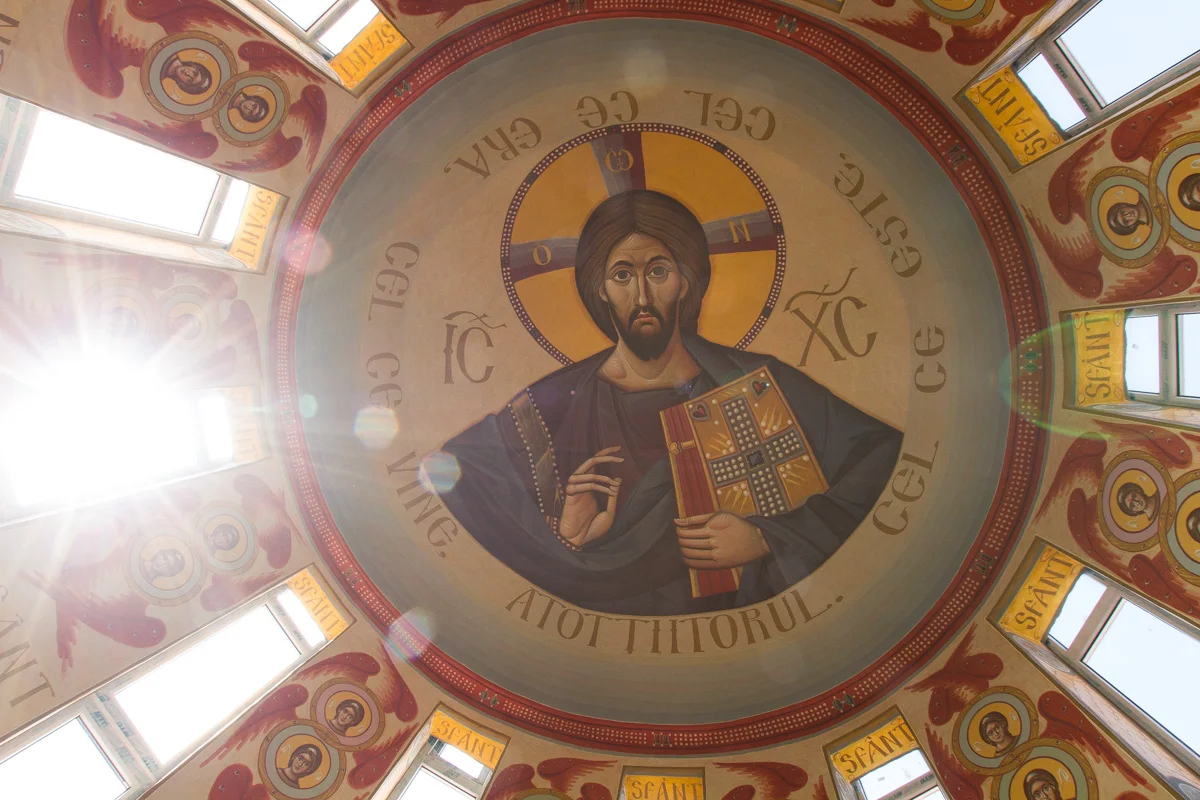
Sometimes, when I enter the church, I glance up. I have to tilt my head far back to see the painting in the church dome, and I'm a little embarrassed by this unnatural position and what people might say.
A year and a half ago, it was different. I was up, in the church dome, perched on scaffolding with my camera, and that face was only a meter above me. In fact, at first there was nothing. Just unplastered concrete walls. The church stood like that for several years, and it didn't seem unusual for me to come into that space that looked like an unfinished construction. I even felt more at ease that way. I even got married there, among saints and concrete.
That was until the Virgin Mary was painted on the vault above the altar. Seemingly a little shy, with a hint of redness in her cheeks, not smiling, yet not sad. I loved her expression and her silent beauty and the shades of gold and blue with which she was surrounded, like a clear sky edged by the sun. As soon as you entered the church, it was as if she greeted you with open arms.
Then, after a year, it was the dome's turn to be painted. A team of icon and church painters worked from dawn until nightfall. It was Lent, and they hoped to finish the work by Easter night. And we, who came to church, helped as best we could: we cut and teased hemp fibers for preparing the fresco, especially the women, while the men mixed the hemp with lime and prepared the plaster for the fresco.
I would come every few days to photograph the craftsmen and people at work and to document the progress of the work. I would climb the massive scaffolding in the middle of the church, about ten meters high, up to the wooden platform placed above the scaffolding, at the upper level of the altar. Then followed another climb on a narrower scaffold, another 15 meters or so, all the way up into the tower, where the craftsmen were working. I saw how slowly, slowly, under their brush, the face of Christ was born. First a sketch, and then the colors.
I was photographing, but even so, sometimes I felt like turning my face away. That gaze from the face in the church dome followed me and pierced me to the depths of my soul. It disquieted me, because I felt so... small. I felt seen and known to my depths, where I myself had never reached. And sometimes, for all the hard-to-name feelings that were born in my heart, tears would come to my eyes.
I usually try to look people in the eye, but it's hard because I feel exposed. Only eyes are the window to the soul. But here it was different.
Days passed and the painting progressed. The craftsmen lowered the scaffolding to window level, painted the cherubim and seraphim, then the prophets, then the angels performing the Liturgy. Every time I went there, I was amazed by the silence in which they worked. Each concentrated on their own work, they didn't speak to each other unless necessary. But if you were down in the church, you couldn't see anything of the painting and the work, because the wooden platform at the altar level covered the dome from our view. Something was happening up there, but you couldn't see it. People were eagerly awaiting to see the scaffolding removed and the painting finished.
And then the painting was finished. The day before Easter. The scaffolding was removed, people came to clean. All the people entering the church invariably looked up, with their heads tilted far back, and smiled. The dome is tall and narrow and guides your gaze as if through a tunnel, at the end of which Jesus looks at you, right in the eyes. But even if you look down, the reflection of the face can be seen in the icon on the tetrapod or in the tiled floor, and that gaze seems to follow you everywhere.
I started to be preoccupied with the question of how I could represent faith in images. How to convey in photographs something that cannot be seen? How to move beyond the obvious, visible manifestations, the gestures with which faith is visually associated – kneeling, clasped hands, looking upwards, presence at services or in church – to the unseen? How to capture something that, ultimately, is a private experience, a personal relationship with God? A photograph must have a subject that can be visually expressed. But good photographs do just that, from something seen they lead you towards something unseen: an experience, an emotion, a question, an irony, a story, a stirring of the soul, an entire state of affairs that would be difficult to put into words, which invariably moves you and changes your perspective.
It was a question about photography. But, as usual, it was something more. How to believe without seeing? Someone else asked this about two thousand years ago and was named 'Doubting Thomas'. From Arghezi, who wrote 'I want to touch you and scream: It is!', to those who stood at the foot of the Cross and asked Christ to come down, to save Himself, to perform a miracle, so that they would believe in God, to scientists today who analyze communion under a microscope to clearly see what is there, the world wants to… see! For, in today's materialistic culture, what is not seen does not exist.
And I… I look at what I see and start from there. Towards the faces in icons, towards the painting in the dome − which, when I meet its gaze, reminds me that what is not seenexistsand is more important than what is seen. I don't say this as a final judgment, but with much doubt, sometimes. But I do what I can. It's a deeply personal quest, after all. And it lasts. Roughly a lifetime.
Claudia Tănăsescu
Photographs by Claudia Tănăsescu
(Text written on the occasion of painting the Romanian Orthodox church "Fabric Vest" in Timișoara)