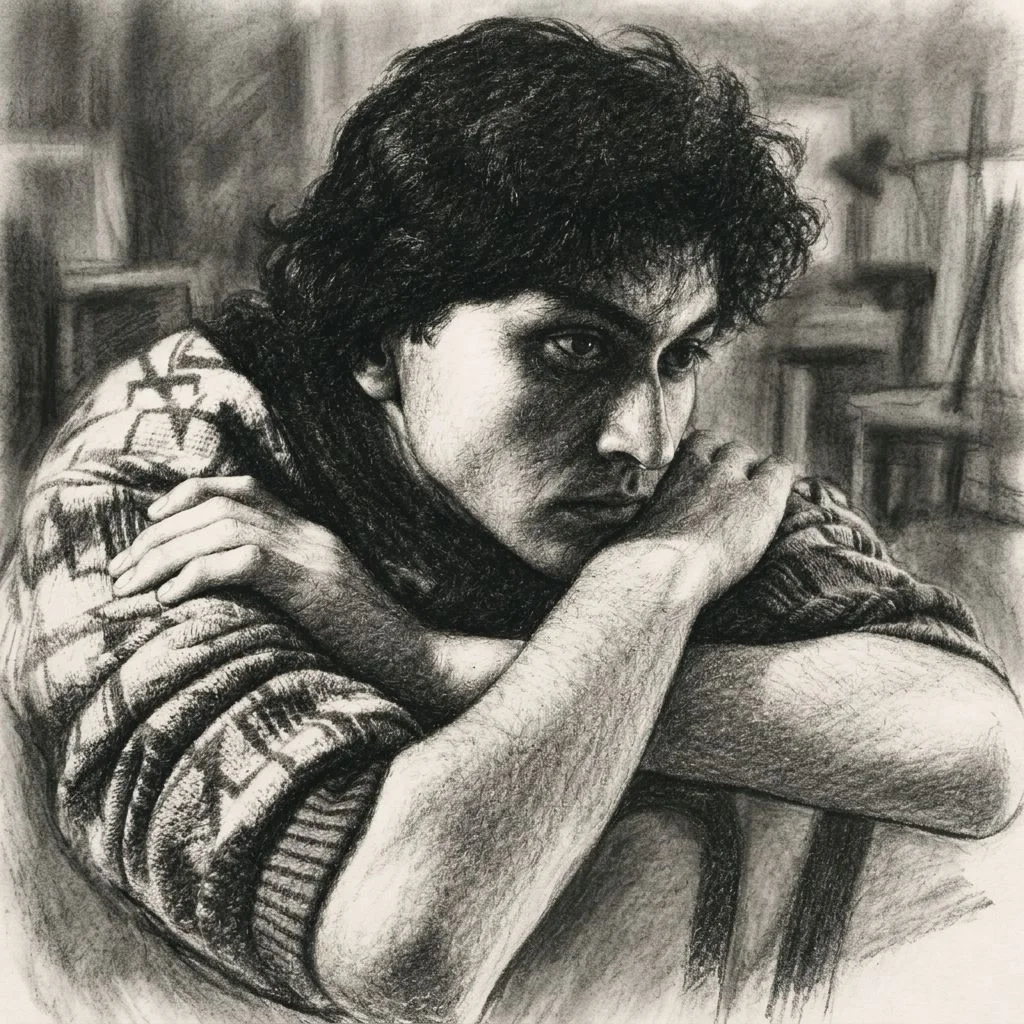
Let me tell you about this guy. Whoever finds him is a hero. I offer a flying horse.
More than a quarter-century ago, on my name day, I received the photograph after which I sketched this drawing, with a lovely note inscribed by himself on the back.
When I met him, I didn't get to find out too much about him, other than that his name was Ionuţ and he was from somewhere in the south. And then I completely lost him for almost three decades in the metropolitan thicket. But I decided to take on a new job, that of unicorn retriever and restorer, and I will begin compiling a sort of reading file for each of them, just like the books in God's library that I have already read. And which, for the most part, are people, wonderful people.
I can tell you that the event I'm about to tell you about took place at Mother-Fairy's house, as we affectionately called Stan's sister, an atypical (or typical?) theater student, who housed us, dedicatedly and responsibly, while we stayed in the capital around '96, when we had come from the province to take the post-high school admission exams. At our vocational academies there were many specialized tests and, including the bureaucracy, we spent about two weeks in this cosmopolitan city.
We were out of place, unfashionable without knowing it, modern provincials alien to the ice of Bucharest, barely staying afloat above it.
I remember that, for this journey towards civilization, I had received some extra money beyond travel expenses and potential registration fees, to buy clothes. I had turned 18 that year and it seems that, on the eve of this departure, my mother, who hadn't noticed until then how I dressed on the streets, realized that I was a young lady and was still going off to university, so she made an effort. The money I received was enough for a pair of fabulous, I thought, khaki corduroy trousers from a second-hand shop. Although they were three sizes too big for me and had been donated because the material had split at the knees, they gave me immense satisfaction because they had that cool, 70s cut. I hadn't felt the texture of corduroy until then; I only admired it worn by other young people in town, because you couldn't find such a thing either before, during communism, or immediately after. I sewed them up with a discreet linear stitch, tightened them with a fabric cord (authentic belts were certainly expensive and too much trouble to find), and so that they wouldn't look too baggy, I was going to wear them with ample and long shirts. Retro, as they say.
The shirt was found in my father's closet; I chose it because it was unworn – he avoided it because it had yellow and grey checks, but that made it match the khaki of the corduroys. It didn't matter that it was also large – I wasn't concerned with the fashion of the day; all the girls in my group listened to rock, dressed like our parents in their youth, and wouldn't have judged me. I rolled up the sleeves twice and was the proudest art high school graduate, raised mostly in the countryside, taking her first train to Bucharest.
Ionuț, mentioned above, recently confessed to me that he had noticed all these clothing mismatches and said nothing, but instead took pictures of one or another in the group, enjoying that we showed no complexes... Well, I believe it too; we were happy with the purchases we had been allowed to make. We were privileged ones!
We were trembling with stress, so, freshly settled in at Zână's, we were leafing through some enormous books, laden with the entire history of arts, from Altamira to the Avant-garde. We had to memorize an enormous amount of data in a short time. We were told that, practically, in the written general knowledge test, ANYTHING could come up, so we had to know EVERYTHING by heart. The periods, currents, styles, decadences, artists, works, years, even though all this subject matter, because it hadn't fit into the high school curriculum, had been taught to us selectively. We knew the essentials, we had studied at home, but it was a time when it was hard to find art albums in anyone's library, those with the images you needed to remember. For the Art History exam, we were supposed to present a commentary of about ten pages on one of them, the one drawn by lot, roughly what you write in three hours of work.
A really cool thing that happened to us in high school was that we learned, thanks to our camaraderie back then, incredibly well together. It was someone's idea, before a philosophy test, to gather at the park's artesian fountain and, so that almost 98% of the class wouldn't have to cram the lessons anymore, for each of us to say what ideas we had grasped from the textbook and to talk like that, relaxed, as we usually did in that park when we met to listen to music. To tell a little bit each and, perhaps, forgetting the rigorous part, we would still remember the feeling and the storytelling. The next day, an unexpectedly large number of us got a 10, and those unmotivated classmates, who usually only wrote their names, scored 8-9, so the young professor, who until then had been rather distant and contemptuous towards us, became a nice friend. From then on, he started going out for beers with the boys.
Moving past the fountain digression, I wanted to tell you that Mama-Zână was very delighted by what bookworms Dana, Stan, Oxi, and I seemed to be, commenting day and night on those interminable albums (with delight and adrenaline, possessed as if by a passion, especially when we had a dispute) and how, at the end of such a multi-hour marathon, we'd realize we remembered nothing and would start all over again. Of course, we managed with the principles, but the details... they were killing us. It was exhausting, and there were only two days left until the written exam. The practical exam for academic drawing and painting also seemed insurmountable, given the competition in those years, so our fatigue was chronic. Concurrently, we'd stretch paper over Zână's wardrobe doors, opening them to look like easels, and do scholarly charcoal studies.
And what bright idea came to her, that inexhaustible mama-lion? (the kind who collects stray dogs and gives shelter to homeless travelers found at Gara de Nord). It occurred to the general savior of humanity that we were quite smart, and, in time, she had another flash of genius. She asked us to let in, ONLY for one study session, so we wouldn't be disturbed more, as there wasn't much time anyway, just for A SINGLE AFTERNOON, a good friend of hers, to help him pass a specialized art exam, because he's a sensitive, talented boy. What?!!!, we said. Anyway. This Ionuț...
Guess what the philanthropic fairy envisioned! That we should teach him, in those remaining hours, the entire history of arts that had been taught to us over fooour yeeears and that we didn't even know well ourselves, as it was material for decades of study from then on, in Art History and Theory.
Why?... Because poor Ionuț had enrolled too, I repeat, 'because he was very talented' (this argument drives me crazy, one that no one contradicts, obviously, but you don't stand a chance at any university with it in itself and that's all), in the Image-Film section, at her school, at the fairy's place, at the Academy of Theatre and Film. She called the man into the living room with everything he knows how to do, for us to give our opinion on his photos, she gave him hopes, anyway.
I saw his portfolio, good. He was a talented photographic artist; all his friends had probably noticed this and encouraged him to change his amateur status. He knew technique very well (he was going to be tested on it), he had a folder of photos that I think would have gotten a good grade, but he was still missing something. He had never studied theoretical matters with anyone. Everything was pure passion, you understand? A hobby. Something like that, if the jury members detect it at an admission exam, you're a dead man.
You have to play an absurd theater when competing with twenty others (fifty in the case of theater) for that spot; you must not appear to them as a dilettante, but rather as having an impeccable professional background. If necessary, you invent the high school, steal names of professors who supposedly trained you, deny your origins, your hometown, if you're put in that situation, do you believe me? In my year, candidates who graduated from Tonitza lied about the name of their high school, saying they were from completely different towns. Because there were too many with the same training, style, construction, line, etc. And our professors told us: "Never let two of you, candidates for the same university, the same department, say the same thing: they will only choose one of you, they fear recipes, epigones on repeat. Invent, that's what you've learned."
And, just like us poor souls, this Ionuț had to take the Universal History of Arts exam. Yes. Everything from Altamira to the Avant-garde. Yes, all periods, movements, decadences, artists, with names, years, and works. EVERYTHING. The committee members were visual artists; the rigor for this exam was the same as that of the Art Academy, where we were going to take the admission exam on the same day as him. And the guy had to appear professional, perhaps a graduate of a vocational high school. And he wasn't. Cool up to this point.
I met him. A beauty. A garden, a kingdom of a man. His naturalness and unawareness of his candor and humility struck me. We came from the countryside, we were 18, just kids with patched knees and borrowed clothes, and he lived in Bucharest and was a decade older than us, but it seemed to me back then that he was twice our age, such respect he exuded.
No breath of superiority, no questions. He behaved like the Japanese, where you don't depart from deference towards your master even with a glance... A curious total submission. He listened to us one by one as we struggled to explain to him, like a desperate child receiving the last cups of water and the final five minutes of instructions before being sent into the desert by adults.
What we wanted from him was complicated, but so was what he wanted from us. He was sweet, handsome, and unrealistic. It was a lot that he hoped to absorb, and we three, like chicks around him, were still pecking at the crumbs of information we were scattering. By the way, how effectively it works to solidify theory by explaining it to someone else! All the information actually builds itself into the neural network, it's for real.
It was very difficult. Bless his heart, he had attended a regular high school and had no specialized language whatsoever. Not only did he not know fine artistic terms, but he didn't even master the basic ones well. It was hard to teach in another paradigm, with the nomenclature reinvented from scratch, without neologisms. I don't know, I'm just giving some examples:contrast of quality, quantity, simultaneity, then modeling, modulation, modeling. But we all worked and recreated them for him, using everyday vocabulary. I can't tell you what explanations came out. An anthropologically noteworthy moment!
We presented to him, triumphantly of course, the entire history of art, essentialized to fit into those few hours, from Altamira to... until we got tired seeing that he was listening to our story with a child's joy, but that he couldn't swallow it like an aspirin. Obviously. He was very intelligent and tenacious. He was absolutely NOT the type to learn such things by heart; it was evident that he only retained what he enjoyed, what pleased and delighted him.
This Ionuț, in the sincerity and delicate nature of his hope, wrote down everything he had understood in an extraordinarily neat ruled notebook, with tiny, extremely round letters, like those taken by well-behaved boarding school girls. I fell in love with that notebook then as if it were a being in itself. I promised myself that I would write to him someday and, in return, years later, give him a notebook, also calligraphed.
Within me grew a flower of compassion with buds of admiration. But it seemed to be dehydrating due to the lack of fertile soil known as chance. He had no chance. No matter how much he worked.
It was absurd - what kind of exam could you take like this from such material??? The book The History of Art in Images... for those of you who know, it's enoooormous, especially for an afternoon's browse, and we had summarily gone through all the notorious periods, just so that something would have reached his ears regarding at least... their names. At least those movements should tell him something. I wasn't sure he could put terms like realism, surrealism, Romanesque, romantic, futurism, fauvism, impressionism, expressionism, post-impressionism, baroque or rococo. And I said: Stop! We don't have a method.
Ionuț worried as if before giving up, he had already stepped into the desert. He humbly asked for only one thing... "tiny," he said. To know only a 6. (He didn't realize what an absurdity this was, but I kept silent instead of screaming, so he wouldn't form an erroneous image of all people from the countryside). He only needed just a passing grade, he said, for this subject, for which he had had NO information until that day. Just so, not to be disqualified from the start. He was convinced that he would strive and get maximum marks in techniques and portfolio and, with this 6, he would be able to enter the competition. There was no way he could be admitted to the final list, and he realized this, because it was already difficult to get in, even with proper studies, because there were exactly six places for the whole country, six in total. Even fewer than at our place, at Arts. That's how many were formed at ATF that year: a group of film image specialists consisting of six students. I shuddered, concentrated, and, considering there was only an hour left and he was leaving... uff... I adopted a desperate solution. It's practiced in high school. It's called tricking God. Do you know it?
What was actually required of him? Well, like us for the certification exam: all contestants in the room were to draw a ticket with a color picture on it. A small image of a masterpiece of universal art history – sculpture, graphic art or painting, a famous piece of decorative art (or even another postmodern invention), printed without any accompanying information. The contestant had to recognize it and note everything on the rough draft, just like in literature, orally, at the baccalaureate: author, title, current, historical period, ideal and years, possibly the reflection of the social, historical, political, ethnic, religious context as appropriate, and finally, an extensive visual commentary. Chromatics, compositional structure, line modulation, graphics, plasticity, decorative aspects, volumetry if it was sculpture, balance of expressiveness, message, manifesto, psychological introspection, concept. And by what technical methods the author transposed all these.
Then, unlike us, who were to take a three-hour written exam, he had to present orally, extremely coherently, without much time to think, before the fierce jury. You could burn your mind out, considering that Stan had the most condensed of the publications that had synthesized art history, and it contained only the most renowned... a thousand works. Maybe a thousand works doesn't sound like much. Well, a thousand works that you don't confuse with each other and know the author of − maybe it sounds more realistic. Otherwise... there could have been even more thrown into the mix, art history holds an infinitude, you could have stumbled upon something never seen before, not taught at your school, etc. There was no rule regarding this, because in 1996, art high schools had neither an obligatory curriculum nor specialized textbooks, they hadn't been printed, and all our knowledge was the fruit of the endeavor of wonderful teachers.
We, who had attended art high school, were not only trained or accustomed to doing this type of exercise, but we relaxed doing it, just as chess players relax while playing, or mathematicians while solving equations. It's not tension, it's a release of tension. The teachers had handed us the keys related to compositional paths, chromatics, elements of plastic language, expressive techniques, etc., and we deciphered the plastic territory like a map full of challenges. If you found one thread, you followed it and found the entire string of meanings. This is why multidisciplinarity has always been important in the education of artists. Without being able to contextualize (historically, politically, psychologically, logically, philosophically, ethnically, ethically, religiously, anthropologically, even mathematically − see Fibonacci's sequence, logarithms and rhythms), holding the bunch of keys is useless. I had been playing with read images since fifth grade, even before I was in a specialized high school. Simply put, in my time, in the province (Suceava!), this was the school and this is what Professor Ionașcu did in class.
Having practiced such things for many years, flipping through an art album with so many images and offering consistent and honest commentary was like tying prayer knots on a prayer rope for monks. A quietness, a peace, a communion with those who had left the secret of treasures on earth... In museums or in books, in our case. But for a novice, it was impossible to acquire this experience all at once, just by deciding to do so.
And I told him: "Ionuț, you can't retain something like that. Not with a thousand works. Look, we'll do it differently. I'll give you just one example. Just one, you can't handle more. I'll comment on it from start to finish with you beside me, please, note down what you understand. (I'm a good critic; I had already gotten a ten for these at the baccalaureate, although my colleagues told me the explanation was that I write beards and that I probably have a parrot on my shoulder).
Stan handed us the deadly weapon, his encyclopedia from abroad, the one with the English synthesis of 1000 masterpieces, and we decided to stop at something... conclusive. But, at what? Everything there was conclusive, that's why they had edited the book. I fanned through the pages for a few seconds, quickly; it weighed many kilograms... where should I stop? Ionuț was on the verge of... I was afraid he would despair, like us.
Let's cut it like cards. Like playing cards, Stan said. He placed the album face down, opening it blindly; we were to stop at whatever unfolded. The opening of the boooook!
We stumbled upon something absolutely beautiful. Degas, "Absinthe." We all liked it and agreed to focus on it. But wait a minute... There was a problem: the example was totally atypical! It didn't align with anything previously explained in a scholastic way. I told him to forget everything we had all told him in the last few hours about how compositional and chromatic balance is achieved in art.
I decoded it for him as if in a dream; he was writing frantically, exhausted, as if about to faint. I started with "you see, in the example that came up, it's the other way around... forget everything you learned from us today".
I apologized, but this work is an exception to the rule of contrasts with which I had indoctrinated him all afternoon.
I had initially told him persistently that, in visual arts, there is a perfect equation (the balance of warm-cool, dark-light, between quantities, between qualities of color, that we have color complementarities that support each other, etc.), to be found in any masterpiece. That it's architectural, that it's like in a math notebook, that otherwise nothing would sit well on the page (I started with the basics, so that the person would understand art, and, as was natural, I led with balance). Well, and in Degas' "L'Absinthe," not a trace of all that balancing act could be found. Because the painter, being a revolutionary, created "L'Absinthe" at a moment when he himself was overturning rules. We had stumbled upon a deliberately contradictory work.
Our systematization work from the previous hours had been in vain; this was a work that demolished classical principles, and I explained why.
The imbalance induced by forms in the composition, by placing the figures only on one half of the page, by chiaroscuro, by that heavy quantitative black towards the edge, which is weighty and turns the painting upside down (a forbidden thing in a school assignment, where it would have been considered a flaw) had a purpose: to induce a psychological state and create a manifesto. Which was powerful. And justified then, in its era.
My colleagues stopped me, annoyingly, commenting not to fill his head with nonsense, but I felt the supreme need to explain it to him, nonetheless, with enthusiasm, like to a novice who wouldn't contradict me.
First, about what that is absinthe. I knew! About how even then the pharmacy drug was abused, how this absinthe consumption had become a social phenomenon, about the feeling of inadequacy, about how you fall into depression when you're misunderstood, when there are no role models and values are turned upside down, about the historical and political crisis of the period, about war and shortages, about the wound in the spirit, visible in the empty gaze of the unfocused character, about the perfidious and paradoxical solitude of man in the metropolis, about the bitter burden of lack of hope, communication and communion, trust and benchmarks, which had led the character to seek refuge in alcohol, found in despair in that apothecary medicine. And, consequently, the characters' inner world was turned upside down, in accordance with the entire universe of the work. They lived in a world overturned from within, just like the chromatic and compositional balance that the artist and Post-Impressionist Edgar Degas deliberately juggled with, so he could scream the message to us, and to the public hundreds of years later. The work depicted the absent one next to the absinthe. After rambling uncontrollably, much like I've consciously written here, and somewhat incoherently, I looked him deep in the eyes, asking: "Are you okay?".
He was hypnotized. But he had written everything. This handsome boy would have been a very good art student, if he had ever had the chance... He had liked it, he regretted not having had the opportunity to learn all these things in time, or at least to have met us a few days earlier. Yes, Degas had fascinated him. He had a ridiculous, frightening hope within him!
Oh, and if he had had – not for four years, but at least for four days – Ms. Goraș as a teacher, or our Camelia, the homeroom teacher from whom we knew all this, he would have soared.
Hm. Do you remember I mentioned the method of tricking God? What was the idea? Let me explain what subversive thing I advised him to do...
He was to learn this by heart for an hour-long bus ride. This thing with Degas, that's how it turned out, that's what it was. It doesn't matter if any other picture came up; the plan of ideas is ultimately identical in any commentary. He should remember it, as he could adapt. And, according to the method tricking God, for any picture drawn, regardless of period, movement, and author on the ticket (considering that he wouldn't recognize anything anyway, let's say) he had to do everything to be allowed to reach the commentary. To what he knew. Points would be deducted in turn. Don't know the name of the painting? Lose two points. Don't know the author? Another two points off, but don't despair and don't give up. Because ten minus two twice makes exactly six, just ramble that commentary perfectly. The secret was not to give up, to spontaneously comment on exactly what he received. Because he only needed a six, right?
And at this point, he had to remember the principles I had delivered, which were a kind of general, applicable parameters, adaptable as needed, and modifiable for any work. He would have known that, because he was a smart boy. I was very concise and systematized them thoroughly; he just needed to apply them intelligently for a somewhat consistent commentary to emerge. I also gave him practical suggestions to apply the tricks: at first, leveraging the fact that he's likable, he had to mislead the jury by claiming a huge emotional lapse regarding the chosen artist's name, and then to declare a second, slight lapse due to overwork concerning the title of the artwork in the picture. Or to invent a title based on what the painting intuitively represents. Portrait, landscape with poplars, still life, church on the outskirts of the village, girl with a headscarf, garden with chrysanthemums, ha-ha. If it's an abstraction, you say composition, there, it's normally not like that, but then you apologize. To get past the embarrassing moment. He literally couldn't have known these correctly from flipping through those pages, and we didn't even intend to teach him.
It seems that if you're well-dressed, in a suit, sitting in the front row and looking politely at the professor, perhaps with admiration, without ever lowering ever your gaze, you can win their sympathy or, in fact, their compassion, and in the worst case, they'll deduct points, but they'll help you with suggestions and you'll be able to continue with the visual commentary. Which you're supposed to recreate based on the given model. You'll be able to breathe a sigh of relief as if after a block, I had told him, and exclaim: “...Yes, sir, that's right! How hard it is for me to concentrate in stressful moments! Riiight... professor.” The fact that you agree with the professor who's prompting you can only flatter him. The rest, creativity... Oh, he only needed a six. An impossible and grandiose six.
That day, I decided I would become a teacher. Of anything.
* * *
And the unicorn disappeared into the urban jungle. I remember having a rare communicative compatibility with this character, which is why I added him to my collection of exceptional encounters. Yes, incredible communication. Effectively, the words of the last hour of time crunch disappeared from my mind, because he had drunk them like absinthe. If I had gotten this on my test paper the next day, I would have failed, because I wouldn't have known what to write, my brain had become blank. I have the impression that such a terrible all-understanding between two people is nothing but an unseen kind of transfusion, one that vitally links two people in need through a third fluid, which I know is Christ.
Oxi said, exhausted: “Hey, Stan, come on, we need to go out for a beer, my head is exploding, we're all idiots! Starting with Mother-Fairy. Listen, to make him get a six! What, is a six that simple??? And us, who did four years of art high school, we'd want to get a 6!!! The passing grade, which we'd combine with the specialty grade and portfolio... to at least have an average on that list of failures, because we're not getting into any state-funded spot in this madness anyway...”.
Avea dreptate, săracul. Erau tensionaţi amândoi. Lumea dădea de ani de zile la profilurile artistice şi nu intra... A existat o concurentă în anul acela care dădea a douăzeci și cincea oară.
Şi băieții au plecat la bere.
Eu le‑am refuzat invitaţia. De teamă şi neîncredere îmi venea să plâng, mi‑am amintit cu jale cum l‑am petrecut toți pe acest prim învăţăcel, aproape de două ori mai mare, în staţie la Vitan, cum a apucat să ne spună că are chitară şi cântă, că îl aşteaptă iubita acasă, că treaba asta cu imaginea de film e unicul lui vis de mult timp încoace, că s‑a săturat să trăiască din comenzi în genul „damă-pe-tocuri-în-toc-de-ușă, în costum de baie şi cu câinele în lesă, în fundal patul acoperit de-o cuvertură leopard” etc.
M‑a dezarmat ce privire de copil avea, mijită deja de vântul deşertului în care încă nu plonjase. „Dumnezeu cu tine, frate al meu”, i-am gândit... „Te voi mai vedea vreodată?”, i-am nădăjduit.
What's going on with beer, good people, we're all up in the air, no beer, I got sad... I suddenly missed those at home, who had made a great effort to send me to the city, to buy me torn jeans from the second-hand shop, I became sad realizing our precariousness in everything, the lack of chances of success in that competition with dozens of people for each spot, the fact that we actually know nothing even when we like and want to learn, let alone when we don't want to... It all seemed like a great waste of resources. My mother's money, my father's shirt, the time, the sleeplessness, the discarded hopes.
I felt an essential need to curl up in a shell of space, that is, to somehow kneel, to wrap myself in a nest, and this translated into a ritualistic headscarf, then to read outside, in the park, something from those tiny books. Retro and cool high schoolers are a bit embarrassed to open them in public (those are the books with a mother and a child on the cover), so I secretly retreated into the landscape and browsed, I spoke reading to Him for a while, although none of Them had much connection to art history...
I ran my hand over my face, trembling, I couldn't see well, my eyes were clouded with fatigue and I cried out a little, for lack of time, to God. That was a moment when it no longer works, no matter how much of a high schooler and friend of English you are, with please, please, God, help me.
You somehow have to move fast and shout louder. “Come on, Christ, what the hell, do I really have to get here, to have my chin tremble and cry in front of You like those hypersensitive girls, really, haven't You seen how much this guy wants it? We are ignorant compared to him... Seriously, forget it, it's just a number! What is a number to You? A modest abstraction! Six?! Come on, send him a six tomorrow!!! Haven't You seen? He's one of ours, one of those who absorbs You from others, extracts You and sends You from person to person like a cherry pit. My God, you know what?”, I shouted to Him, remembering I was a post-December high schooler in retro jeans who listened to rock: “I need a SIX for him tomorrow!!! Hey!... God??”.
Well, my prayer was probably a bit imperative, impetuous, and quite postmodernist. He probably didn't like it. He probably wants, at least sometimes, for cool high schoolers to be nonconformists by conforming. He's tired of seeing us always abuse oh-my-God in all sorts of mundane or absolutely inappropriate, impudent situations, especially when there's no need to call Him present, when we do all sorts of stupid things. Therefore... God did NOT listen to me. No six. He didn't give it to him, didn't consider it, didn't want to.
* * *
With him, for his purity, He spoke differently.
The guy got a 10 in Universal Art History.
With laments drowned in the broken hearts of the professors on the committee. There were handkerchiefs, astonishment, shock, sighs, etc. He revealed to those women on the jury the meaning of existence, showed them how much loneliness crucified in works of art overflows in the world; they didn't even know as much as he did, and anyway, they had never problematized a routine subject so profoundly philosophically.
The only connections to the number six were that he got into film imaging the sixth out of six possible admits, exactly above the red line.
He forgot a name there, but he recovered. The only name he had a lapse for was his own; he knew the rest without hesitation.
* * *
He drew a ticket. He got Degas, "The Absinthe".
* * *
The miracle isn't that he got in. It's not that he got a ten.
It's that, for his hesitant smile in the hour I made him resort to tricks even though he loathed it, the Mother of God did anything.
She arranged everything.
Anything, just not to let him LIE.
* * *
By the way.
This text circulated on the internet for a while when I wrote it a few years ago and... I found it again.
He is a university professor at the National Academy of Theatre and Film and teaches Image.
And yes, I gave him the promised calligraphed notebook, written in intervals, until I finally found it, and yes, he continues to be the wonder and celebration of my soul. And yes, he hides in the urban jungle like any unicorn.
Cosmina Dragomir