
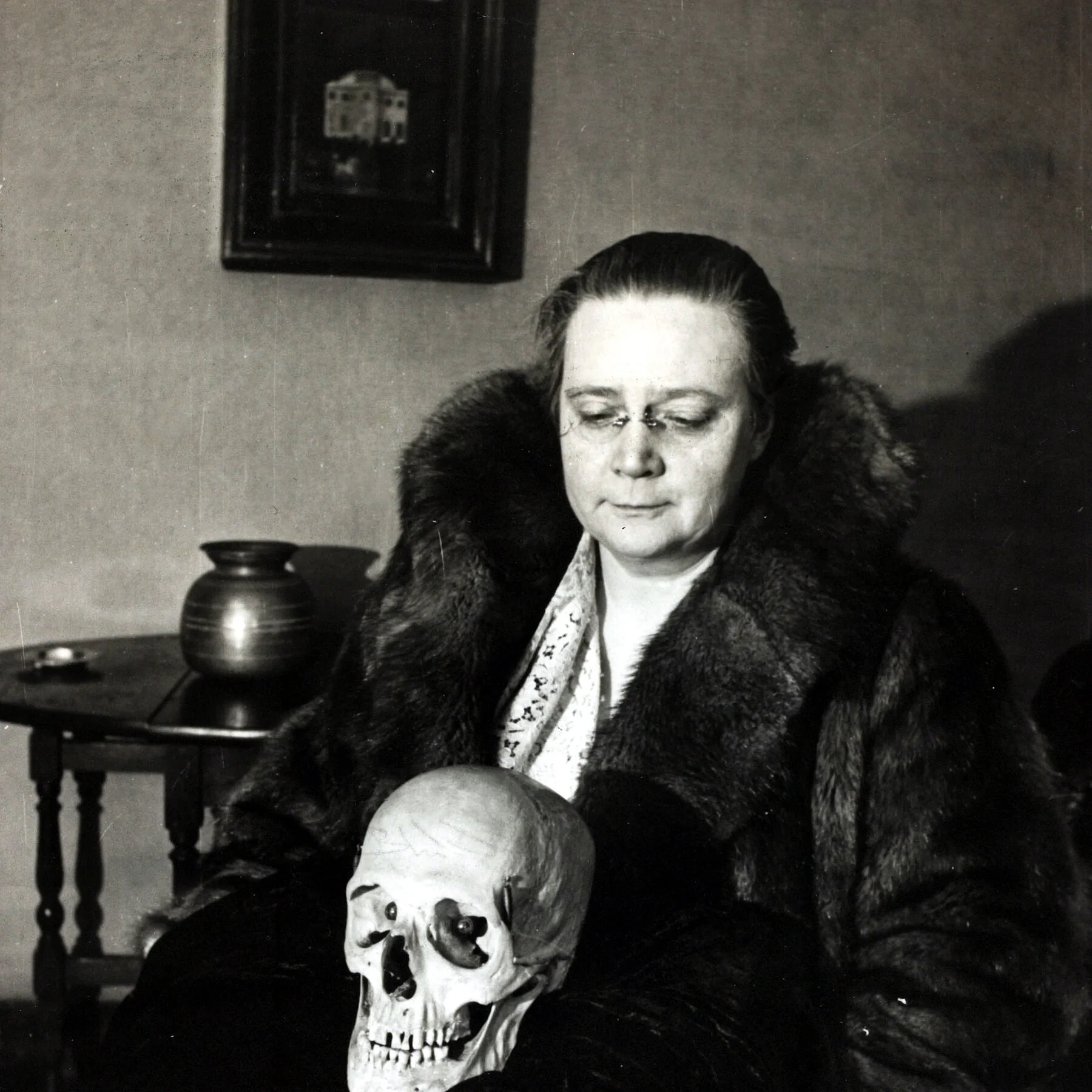
Dorothy Sayers is a lesser-known author in Romania. I discovered this recently and was surprised, considering she was part of the wider circle of C.S. Lewis and J.R.R. Tolkien, known as Inklings. And among their important precursors was G.K. Chesterton, translated and known in our country, who also wrote many detective stories that can be classified as theological – or, as it seems more fitting to me to call them, cryptotheological.
But, unlike Chesterton, who tends towards the fantastic-eccentric, paradoxical, and exuberant humor, Dorothy Sayers writes realistic novels. Known to the Anglophone public for these novels, yet, especially towards the end of her life, she dedicated herself to theology and translating Dante's work, also writing a series of radio plays about the Gospel, The Man Born to be King, which C.S. Lewis said he read every Holy Week. The theology in her detective novels is less direct than Chesterton's, who even placed a Catholic priest – Father Brown – in the role of the main detective. While Chesterton excels in substantive wordplay, unexpected and fantastic conclusions, Sayers delights us with countless literary allusions woven meaningfully into the narrative, with complex and endearing characters, realistically described, and with other nuances of English humor. Her detective, Lord Peter Wimsey, is an aristocrat educated at Eton and Oxford, refined, cultivated and full of imagination, charm, but also humanity, empathy, and moral scruples, in addition to the post-traumatic effects of the First World War.
In Strong Poison (Strong Poison),appearances, but judge with righteous judgment!” (John 7:24).
But I'd like to talk about another novel here, the first in the Lord Peter Wimsey series, Whose Body ?Whose Body is it?), published in 1923. Over time, the author's novels would become progressively better, and the main character would acquire increasingly deeper nuances, as would the other characters, who would lose their somewhat schematic, typological character from this first novel ("the conservative aristocrat", "the limited policeman", "the original duchess", "the impeccable butler", "the American millionaire", etc.) and become much more nuanced, realistic, and original than one would expect from a detective novel. However, I believe that Whose Body? already contains the seed of later complexity, being already full of substance not only morally and theologically, but also literarily. Warning: it is impossible to present the book without a few “spoilers”! But perhaps it’s not a tragedy, because, unlike Agatha Christie, the plot of Dorothy Sayers’ novels does not generally rely on a blatant twist, with the careful reader gradually discovering, throughout the novel, in which direction to direct their suspicions.
And with Sayers’ hero, Lord Peter Wimsey, as with many other classic detectives, appearances are deceiving. He is not, as he seems, a spoiled representative of the English upper class of that time, and behind his slightly foolish appearance and eccentric behavior lie an intelligence, an observational spirit, and a creative imagination that are hard to match. Not only is reality different from what it seems, and truth must be sought like a treasure hidden in a field, but also those who find them are not the ones we would have expected. And, often, those whom we would have least imagined to be closer to truth and justice are the first to approach them.
In Whose Body? we are dealing with a critique of pure materialism, of the theory of materialism taken to its extreme. A school of thought already very widespread then, and now trivialized, represented by an eminent neurologist, states that only the body exists, and attributes any manifestation of feelings, thought, and even consciousness to the brain. All these are, for that school of thought, the exclusive effects of biochemical or physical processes, and could be changed or removed through either surgical or chemical intervention on the brain. This way of thinking, coupled with a psychopathic lack of empathy, leads the criminal to execute their plan. Paradoxically, they disfigure and dishonor precisely the body which, for them, is the only thing that exists and matters. We are not dealing with an ideological demonstration − the author does not try to convince us that this kind of thinking necessarily leads to crime and dehumanization, but rather helps us to ask whether this is not the consequence, taken to absurdity, of the aforementioned philosophy. Here, she aligns with the ideas of C.S. Lewis, brought to light especially in the novel That Hideous Strength (That Hideous Strength) – a novel also unfortunately still untranslated into Romanian.
Another interesting element of the novel Whose Body? are several elements from the investigation and a few literary and theological allusions. In a discussion in Chapter 7 between the two protagonists, when Wimsey finds his friend and associate, Inspector Parker, reading a book of exegetical theology about the Epistle to the Galatians, Parker compares a certain type of biblical exegesis – one that tried to demonstrate that Jesus was merely a mythical figure and did not truly exist in history – to the foolishness shown by some police officers who put theory before evidence, and only find what they are looking for, instead of honestly approaching the truth of Scripture: “They are so busy looking for the thief no one has ever seen, that they wouldn't recognize the footprints left by the residents of the house.”
And, last but not least, the novel begins with Wimsey heading to a bibliophile auction sale to acquire a rare copy of Divina Commedia by Dante. It concludes back in his pleasant drawing-room, where we are told that Wimsey is reading Dante, and Inspector Parker is reading Origen. We thus encounter, as references for those with eyes to see, Dante – who describes his initiatory and symbolic journey to the otherworld, and Origen, the exegetical inspiration for the Church Fathers. A dual invitation: to explore the mysteries of death and to reflect on the principles of seeking truth – these are two key elements of the literary and cryptotheological detective novel bearing the “Dorothy Sayers” mark.
Alexandra de Moffarts
Photo by Musa Tuğrul Karataş / pexels.com