
Metropolitan Hierotheos of Nafpaktos speaks to us
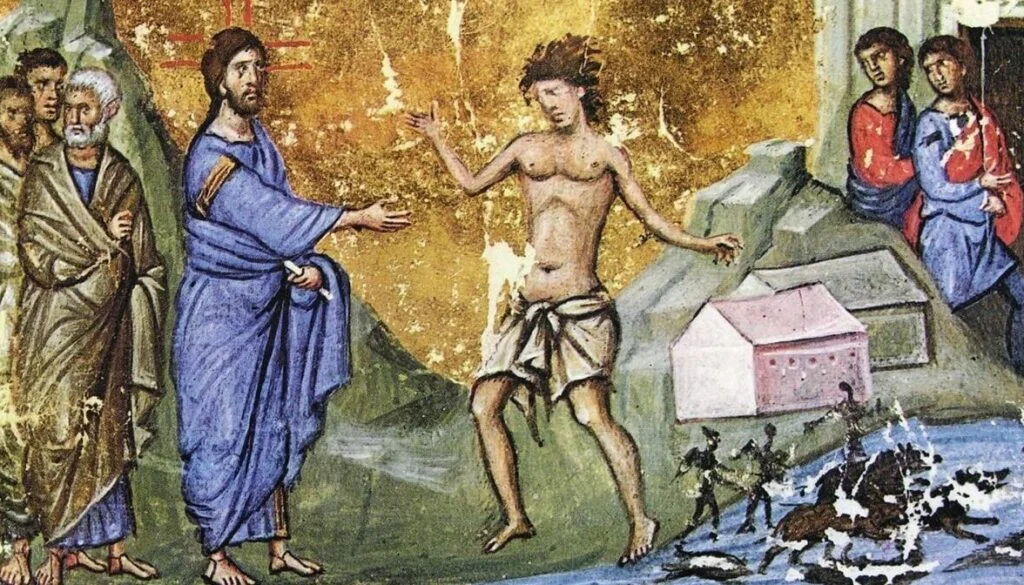
My beloved brothers, when we listen to the Gospel pericope about the healing of the demoniac of Gadara, we see that Christ crossed the Sea of Galilee, into the region of the Gadarenes, and there He met a demon-possessed man with whom He spoke. But, if we look more closely, we see that He did not speak with a man. The Gadarene was, of course, a man, man being the creation of God, but within the man was the devil. That man had many demons. Therefore, before Christ were two entities: the man, who is after the image and likeness of God, but also the devil, who had entered the man and was speaking through him.
It is, therefore, about the encounter of three entities, or rather, of Christ, the true God, with two entities that acted as one: man and the devil. When the devil takes possession of man's 'fortress' [meaning the brain], he speaks through him. It is one thing when he influences us from the outside, through thoughts; it is another thing when he incites our passions through senses and imagination; and it is entirely different when he himself dwells within man, when man, through the freedom he possesses, allows him, gives permission for the devil to enter him.
Let's see how this encounter and the discussion between them took place. In fact, not so much the discussion, but what the demoniac first said to Christ, and then what the man said after he was freed from demons.
The Sign of Demonic Energy
As soon as he met Christ, the demon spoke through the man's reason and voice. And what did the demon cry out from within the man? “What have You to do with me, Son of the Most High God? I beg You, do not torment me!”. That is, he asked Him: “What business do we have? What connection do we have with each other, Son of the Most High God? I ask You, I implore You, do not torment me!”.
What do we see in these words? A confession [of faith]: “Son of the Most High God”. The devil knows that this is not a mere man, but Christ, the Son of the Most High God. He knows Him. There is, therefore, a certain faith, but an exclusively theoretical faith. Just as the Apostle James, the brother of the Lord, wrote that “even the demons believe—and tremble”, but their faith has no life. Therefore, there is a confession: “Son of the Most High God”.
Then two more phrases. “What have You to do with me?” shows, according to Saint Theophylact of Bulgaria, great impertinence, great impudence. For someone to say: “What business do you have with me?” – and we often say it ourselves with insolence – reveals someone's shamelessness. And the other phrase, “I beg You, do not torment me”, reveals someone overcome by fear. Therefore, we see here the characteristic traits of the devil. He is a creature full of insolence, who wants to torment man, and at the same time, in the face of Christ, he is a cowardly creature. He fears Christ.
Look! These words: “Jesus, Son of the Most High God”, we also say them, but differently. We say: “Lord Jesus Christ, have mercy on me!” − so we add: “have mercy on me”. The devil, however, cannot say that. He cannot be shown mercy, for he is the instigator of wickedness. Instead of saying: “have mercy on me”, he says: “do not torment me”. Do you see the difference?
If we apply this to man, what do we see? Although there is the prayer “Lord, have mercy”, which we always say in church − “Lord, have mercy!”, “Lord Jesus Christ, Son of God, have mercy on me!” −, yet there are people who say “Lord Jesus”, address God, but add: “why do You torment me?”. They believe that the various problems they go through in life come from God. How many times do people not say to God: “Why did You do this to me?”, “Why do You torment me?”. This is the sign of demonic energy. He who perceives who Christ is says: “Lord Jesus Christ”, immediately adding: “have mercy on me, a sinner!”. He does not say: “do not torment me” − behold the sign of man possessed by the devil, that is, the sign of the demon's presence. That is what the devil said when he met Christ.
Two Ways of Speaking with Christ
But after Christ cast out the devil from the man, the man calmed down and sat at His feet, asking for His Grace and mercy. He sat at Christ's feet with gratitude and peace. And when the Lord Christ boarded the boat to leave − here we see how a man who does not have the cunning spirit in him behaves − Luke the Evangelist says: “The man from whom the demons had departed begged Him to stay with Him”.“Please, I want to be with You too, I want to come with You too!”
You see? One and the same man, when possessed by a demon, said – in fact, the demon spoke through him: “I beg You, do not torment me!”, and he himself will say, later, not: “What have You to do with me, Son of the Most High God?”, but: “Please, I want to stay with You!”The Evangelist says that he begged Him, implored Him to take him with Him. And Christ told him: “Return to your home and tell how much good God has done for you. Of course, you will be with Me! But now go!”, meaning He sent him to apostleship.
“Now that you have calmed down, that you have become an angel, go to your home, to tell how much good God has done for you and to become an apostle, a missionary. To teach people who I am, and what the devil is...”. Because this man now knew what the devil was and had lived in the tombs of that place, a terrifying and dreadful thing. After the demon left him, the man calmed down and begged Christ to stay with Him, but Christ told him: “Now teach others the difference you see within yourself [between how you were and how you are] and become an apostle, so that people may live as you live now, for you have been freed from the demon.”
What did I want to say, beloved brethren, through this brief analysis of how both the demon-possessed – in fact, the devil – and the man freed from demonic energy approach Christ?
Let us speak with God, let us pray to Christ, let us ask for His help... Let us not grumble, let us not contend with Christ, saying: “Why did you do this to me? Why did you do that to me? Why are you tormenting me?”He does not torment us! We torment ourselves, because we receive the demonic energy of the devil. Christ does not torment us, but is our Father, Who loves us beyond measure and takes care of us! He does not torment us, He does not want us to suffer. Our torment, which comes to us from Adam and Eve, stems from the influence of the demonic spirit. God loves us, He does not torment us!
Therefore, let us not live with this impression. Let us not rebel against God because of any illness, any pain, or someone's death! Let us not contend with God! Because this is a demonic work. But what should we say instead? “Lord Jesus Christ, Son of God, have mercy on me, a sinner!”When we say these words, we will calm down both spiritually and physically, and we will be blessed people, we will desire to be with Christ in peace and love.
Therefore: “Lord Jesus Christ, Son of God, have mercy on me, a sinner!”Amen.
Excerpts from the sermon delivered on October 25, 2026
Translation by Diaconesti Monastery