What does our world lack most?
Some will say: “Peace.” Others: “Humility.” Others: “Unity.” Others: “Love.”
Certainly, you are all right. But today, rereading the small book about Father Constantin Sârbu, I discovered that, beyond everything, what we lack most is Truth.
The world we live in has transformed, more and more, into a world of image. Of “as if,” instead of “being.” Of self-imagination, which takes the place of the self. And, if at first, when this tendency began to penetrate the world, we still detected it and guarded against it, little by little we were corrupted, penetrated, injected by lies, appearance, illusion, packaging.
Can one feed oneself solely on the packaging of a product, no matter how shiny it may be?
That is why we suffer from hunger. And, above all, from spiritual hunger.
Is there healing? Can we save ourselves, as long as our minds have already developed self-defense mechanisms against the Truth? Where can we find the way out of this vicious loop, out of this sickly spiral in which we take refuge, like the serpent, hiding from the Light?
A drop of healing, just enough to “restart” our spiritual immune system, we receive by reading “Tear and Grace.” The truth of Father Constantin's holy life literally radiates from the book's pages, confronting us with ourselves as we should be, as much as we can bear this confrontation. At first, we avert our gaze, pull our packaging over our eyes (“our beauty mask”), hide under the conviction that, yes, we are the greatest sinners, but still good, very good Christians, much better than others.
If we have the courage to read, to reread this book, it means we have taken the pill of Truth, which, little by little, will reveal our real state and will fill us, as we empty ourselves, with “Tear and Grace.”
Anca Stanciu
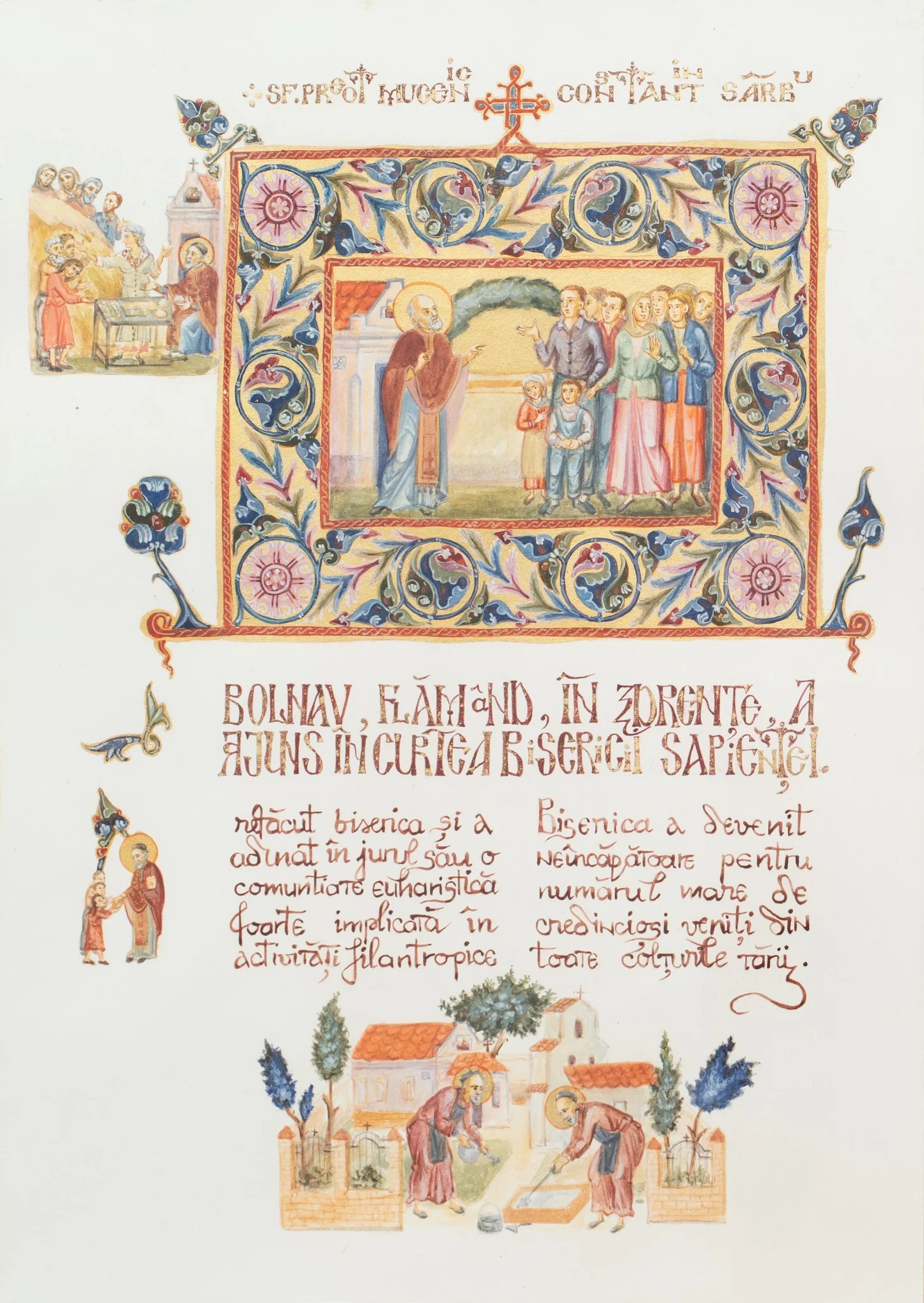
Icon by Veronica Mirea
* * * * * * * * * * * * *
Excerpt from the book
I wanted to do something for the soul of a deceased family member who always appeared to me in dreams. I turned to the faithful in the church, but the advice I received did not satisfy me. I was recommended to buy kilograms of wine, oil, candles, flour. I didn't understand what connection all these materials had with the soul, an immaterial entity. That's why I decided to ask Father Sârbu.
I found him on a bench, in front of the current tomb. Around, everything was freshly whitewashed, and the smell of damp earth and flowers was intoxicating. I felt life pulsating everywhere – and, paradoxically, in that old priest more than anywhere else around. His powerful, piercing eyes, like lanterns that penetrated your soul, forced you to confront the depths of your being, your restlessness, fear, despair, to know and continuously surpass yourself. He gestured for me to sit. I explained that I couldn't find the connection between wine, flour, and the soul of the departed, even though I had also seen that the burial ritual contains such elements.
He replied:
– You don't need all these things to help a soul, whether alive or departed from us. What you need is something entirely different, of spiritual essence. You need that force which created the entire universe, which sustains it; the force that moves the planets, making them vibrate in harmony; the force that made God send His Son into the world for the salvation of man; the force by which a poor sinner can become a saint in an instant; the force that sanctifies, heals, resurrects a soul, making it like God...
I was listening in amazement when I began to realize that a miracle was happening. His words became more and more faint, more and more distant, until I stopped hearing them altogether. My proud mind, which wanted to name everything, to “touch,” to define, to bring the infinite into its grasp, shattered under the power of the grace flowing from the Father's word.
Matter had vanished. I was light, floating in light, towards an infinite source of light that drew me like a magnet. Beside me, I saw only a vortex of luminous energy merged with the white that had become blindingly intense. We were two luminous energies projected into infinity, following our parallel path towards the same goal – Light. I was far away and yet seemingly everywhere. But above all, I was flooded with a truly exceptional feeling of joy.
Like an echo came the Father's question:
– Do you know what this force I'm talking about is?
Barely managing to break free from the enchantment, I answered him timidly:
– I feel it, Father, like an unburdening of my whole being, like a joy, like a light, but I don't know how to name it.
– Love! he replied. How simple, isn't it? A single word, a single energy to summarize the entire universe, all of life, to define Divinity and the meaning of the sacrifice of the Son of God! The flame of the oil lamp or candle is merely a material symbol of the spiritual flame in the human heart, which generates love. You only need to let it exist, not to stifle it with ignorance and pride. Open wide the gates of your heart, so that divine grace may nourish this flame, and surrender to its will. You only need love, nothing else!
I stood up and started walking down the street. How wonderful people seemed to me now! How much I longed to do something for those around me! I had finally understood the meaning of existence and suffering. The ego had to be subjected to trials, to break the wall of ignorance and selfishness that stifles the spirit and shackles love. The ego, vanquished by its own delusion, in which it believes itself to be the sole center of the universe, cannot find peace except by transforming itself, allowing itself to be permeated by the force that created and sustains it, dying to be reborn through the power of divine love.
Only beside a great saint can you experience such a thing. Holy are You, Lord, and among the saints, You rest!
From “Tears and Grace: The Martyr Priest Constantin Sârbu”
Bonifaciu Publishing House, 2022
5 Comments
un fiu
Bun așa. Pace pace, fără continuare. Ha, ha! Ca ortodocții...
Anca Stanciu
Sigur, sigur, m-ați prins cu mâța-n sac, dar și eu v-am servit mingea la fileu :) Pace-pace... Uite-așa se ceartă ortodocșii: ortodox! Cum altfel? :)
un fel de fiu
Ei, nu știi matale la ce Adevăr mă refer. Păi dacă nu știi, de ce ai scris cu majusculă? He, he! Cât despre preocuparea mea vizavi de "frățiorii și surioarele", matale făcând pare-se referire doar la propria-ți persoană, când te iei de mine, nu ieși oleac' din registrul personal la care faci apel? He, he! Cumva e "cine zice, ăla e"? Apoi iertare că te-am ispitit cu "tonul" meu și felul în care am apreciat direcția ca fiind corectă ("cald-cald"). Ce să zic, am cam ispitit..., dar și "mândruț smeritul"...cum se spune. Ha, ha!
Un fiu
Felicitări!... Tot așa!... Călduț-călduț. He, he! Adică nu e chip de a ajunge la dragoste fără adevăr. De multe ori, frățiorii și surioarele noastre se erijează în poziția "făcătorului de pace", acolo unde consideră după moft și ton că pacea exclude dreptatea, folosindu-se de prea cunoscuta sintagmă care însă, atenție, nu indică nici o secundă că acestea s-ar exclude. Adevărul este drept, iar acesta doar în urma primirii și cunoașterii sale naște dragostea să fie. Cu alte cuvinte, doar cel care cunoaște adevărul are capacitatea să fie îngăduitor, iertător și să facă pace acolo unde nu există înțelegere și e doar neputință. Ignoranța nu va fi niciodată justificată, căci prostia e un păcat. Dumnezeu nu a făcut oamenii proști. Creația Sa este perfectă. Natura creației este pervertită doar prin alienare și abatere de la adevăr. Domnul să lumineze cotloanele minților și sufletelor noastre.
Anca Stanciu
Nu știu la ce Adevăr vă referiți dvs, pare a fi un adevăr general, așa, cu stea în frunte, pe care să-l vadă și să-l recunoască toți, dar să știți eu m-am referit la Adevărul-Hristos, de la fața Căruia fugim, de la lumina Căruia ne ascundem. Mă refer, așadar, la păcatul meu, la lipsa mea de adevăr în fața Domnului, la propriul fariseism. Și cred că, ori de câte ori îndreptăm degetul nu spre noi, ci spre „frățiorii și surioarele noastre”, exact asta facem: fugim de la adevărul propriei priviri spre Dumnezeu. Orice privire spre Domnul nu poate fi decât exclusivistă: orice altă privire spre frați dispare.