
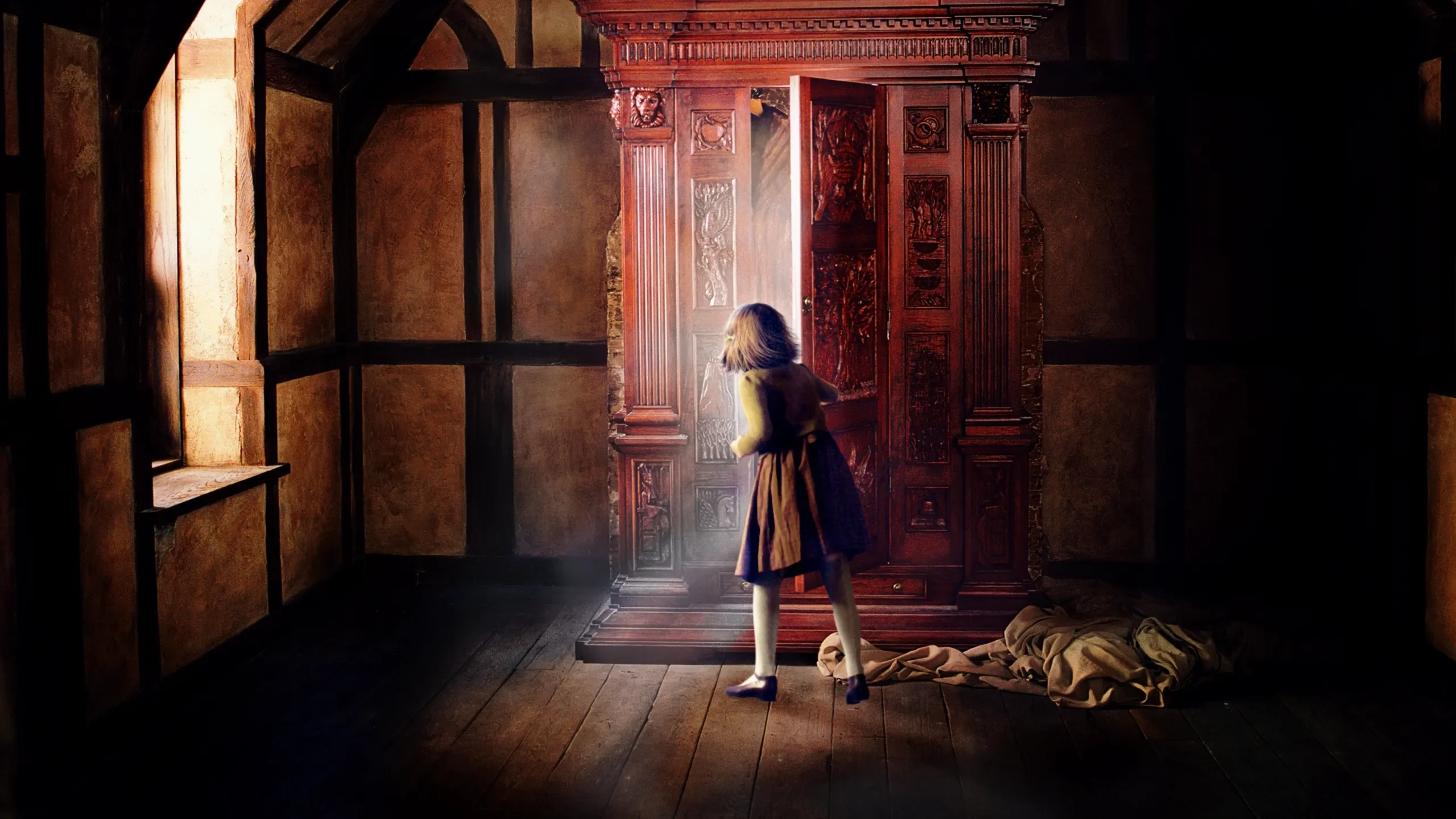
A Journey into The Chronicles of Narnia
In The Lion, the Witch and the Wardrobe, the second volume of The Chronicles of Narnia by C.S. Lewis, four children are surprised to discover that the wardrobe is not a permanent gateway to another world, but only opens access to the world of Narnia on certain rare occasions. The children then exclaim: "But if a thing is real, it ought to be there all the time!" – "Ought it?" replies the professor, like Christ in the Gospels, with a revealing question.
The gateway that literature opens for us to another world is sometimes there, if we have the patience to seek and await it; and other times it is not, because literature, as is said of Aslan the Lion in The Chronicles, is not "tamed," but rather a "wild" reality. Its images and symbols lead us to other worlds or help us better understand our own, to discover its wonderful and mysterious side. But if we try to force the gate, if we demand too much relentless logic or a clear mathematical sense, or if we use it for a dishonest purpose, then it closes or remains invisible to our eyes.
This can also be applied to reading The Chronicles of Narnia. It is a work very rich in meanings, despite its apparent simplicity as a "children's story." In what follows, I propose to examine only one of these meanings: the role that literature can play in our lives. Throughout the seven volumes of The Chronicles of Narnia there is a game of mise en abyme: the heroes recite poems, sometimes recount their lives, or ask other characters to tell them stories. We will see the different forms of literature that the characters in Narnia use and how these can also help us analyze other literary works.
The Perversion of Literature to Manipulate the Reader
The Calormenes – this powerful, cruel, and sophisticated people living south of Narnian territory – prefer to express things through metaphorical formulas, often to conceal a very pragmatic or boring meaning: "the proverbs (or verses) of old." Thus, for instance, in The Horse and His Boy, when young Shasta asks the fisherman Ahoshta what lies beyond the hill to the north, he replies that "one of our poets has said that work is the spring of prosperity, and those who ask questions that do not concern them steer their ship of folly towards the rock of poverty." He says this, the author informs us, so as not to admit that he did not know the answer and that the question did not interest him at all. The verses of the Calormene poets thus bring us back, through figures of speech and hypocritical metaphors, to an often sordid reality. It is an attempt at "literary manipulation." History will later reveal that, in fact, beyond that hill lay Narnia and young Shasta's true destiny.
The Calormenes, however, also have another form of literature: the art of storytelling, which among them has remained a true craft taught in schools. Their stories transform life events into a fairy tale and bestow dignity upon them ("I would never have said it so beautifully!" marvels a protagonist in The Horse and His Boy).
There is, however, another form of perverted fiction, even more serious than the manipulative poetry of the Calormenes. The Witch-Queen of the Underworld, in The Silver Chair, tries to make the children believe – through a kind of inverse fiction – that they imagined the sun based on a lamp, the only concrete reality, and that the surface world exists only in their imagination. Then, the witch claims that this fiction is merely a form of childish dreaming, which alienates us from reality. She proposes a completely false "alternative truth" that reduces the higher to the lower – and, by extension, reduces the spiritual to the material. It is an inverted fiction, because true literature is precisely the opposite of this: it helps us glimpse and intuitively deduce, through story, the existence of higher realities, as we shall see further on.
In Narnia, there is also "fake news" type fiction, malicious fiction that pretends to be reality ‒ as happens, for instance, in The Last Battle, when a monkey makes the Narnians believe that a donkey disguised in a lion's skin is Aslan, and invents commands from this false Aslan to terrorize and exploit them.
The Proper Use of Literature
All this happens in times of crisis; but in ordinary times, the Narnians and the inhabitants of Archenland, the neighboring and allied country, have developed a form of literature worthy of this name. Among them, bards recount through songs the adventures of heroes and of Aslan, such as the one at the end of The Horse and His Boy, which narrates the story of the four children, or the blind poet who, at the beginning of The Silver Chair, tells the "ancient story" of the same The Horse and His Boy. Prophecies are expressed through short poems, such as the prophecy about Aslan and the four kings and queens from The Lion, the Witch and the Wardrobe:
“Evil turns to good / When Aslan comes again.”
In this type of literature, the real intertwines with the fantastic ‒ or, rather, the fantastic is revealed as real ‒, and poems express truth better than prose. This literature keeps ancient truths alive and serves as a spiritual guide.
In "Narnian literature", certain fairy tales and legends prove to be true ‒ just as, in a more indirect way, they are "true" in our world too. It is, moreover, also a mise en abyme, which invites reflection on the profound truth of the book itself, because these legends sung by bards, to which reference is made, often refer to a story recounted in another chapter of The Chronicles. For example, in Prince Caspian, we learn that Caspian's nurse used to tell him stories about Narnia's past, when animals spoke and there were spirits of trees and rivers, as well as other fantastic creatures ‒ a reality described in previous volumes. But these stories were forbidden in Caspian's time, because they were considered subversive. For several generations, the people who had conquered Narnia had tried to erase even their memory. Thanks to these stories, Caspian learns to love "old (true) Narnia". One day, he finds out that the stories he loved are true… and becomes the ally and, ultimately, the king of these fantastic creatures.
In The Voyage of the Dawn Treader, the heroes Lucy and Edmund know many things that can guide them in their adventures in search of Aslan's country, because they have read "the books that needed to be read" ‒ meaning adventure and travel novels, books about heroic deeds, knights, and dragons. Their cousin, Eustace, on the contrary, has not read them ("the kind of books the Pevensie children read," he says with scorn); he has only read "documentary books, with pictures of grain silos" and refuses to acknowledge the reality of Narnia ‒ one of the traits that makes him unbearable at first and which does not help him at all to cope during this journey, before his transformation. He doesn't know what a dragon is before becoming one of them, nor what dangers are associated with a dragon's treasure. Reepicheep, the talking mouse-knight, on the other hand, is nourished by stories of adventure and heroism ("for his mind was full of desperate ventures, of attacks to win or to die, and of last heroic encounters"), which makes him a brave seeker of Heaven: a traveler towards Aslan's Kingdom, and the only one to reach it in the end. Not only true legends and ancient prophecies formulated in verse, but also fictional romance, heroic fantasy, and fairy tales help heroes live an adventure fearlessly, find the right answers, and make just decisions.
In the same book, we are even offered a kind of prototype of a fantastic story that reveals ultimate truths. Lucy reads, in the star-magician's book, a story that enchants her, the most beautiful story she has ever read, and which later becomes, for her, the model of a beautiful story. She immediately forgets it, retaining only the memory of "a cup, a sword, and a green hill," a clear reference to the legends of the Grail. However, although it is part of a corpus of legends derived from Celtic tradition, the Grail is also the eucharistic chalice, a symbol of Incarnation and salvation. Lucy asks Aslan to tell it to her again, and his answer ‒ "I will tell it to you for years and years!" ‒ is, without a doubt, the Gospel in literary form.
In lieu of a conclusion
The Chronicles of Narnia are themselves a kind of "true fiction," because the heroes truly find themselves, within history, inside a story. But they are at the same time an imaginary world built to their measure, which reveals spiritual realities to both the characters and the readers. Children are sent there to better meet Aslan in our world (as they are told at the end ofThe Voyage of the Dawn Treader).
Narnia thus helps us understand what "good" literature is and is not. Narnia shows us what fiction can have that is dangerous, when it is used hypocritically to hide reality (manipulation) or when it deceives us through "fake news" and "alternative truths." But Narnia teaches us above all that literature can be a mysterious gateway to "Somewhere Else"; a revealer of truth, a preserver of Memory; a means of overcoming our earthly limits; a guide that sets us on a quest for archetypes in all things and leads us to the Kingdom.
Alexandra de Moffarts
A first version of this article originally appeared in French, in the journal Chroniques du Sycomore