
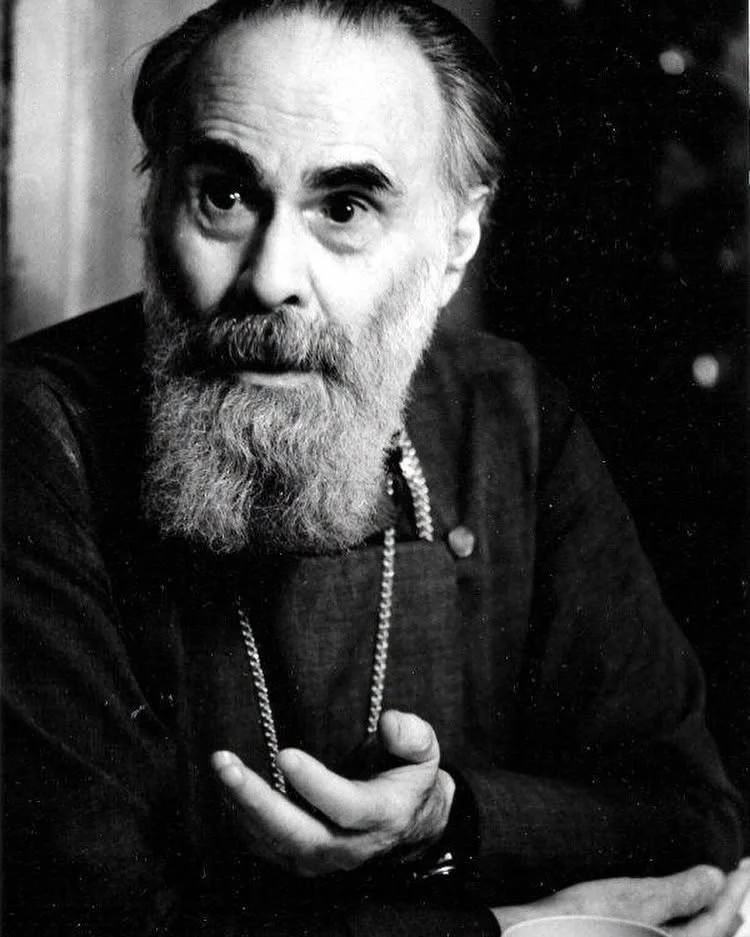
Metropolitan Anthony of Sourozh speaks to us
At the front, however, there was some danger, and therefore the awareness that you are truly in God's hands sometimes reaches a very high degree. Along the way, you make all sorts of discoveries: that you are not so wonderful, that there are things much more important than yourself; that there are different levels in events. There is, let's say, a level at which you live and are afraid, or other feelings overwhelm you, but there are, besides this, two more levels: above, above you - God's will, His vision of history, and below - the flow of life, without noticing the events related to your existence.
I remember once lying on my stomach under a rain of bullets, in the grass, and at first I clung tightly to the ground, because it was somewhat unsettling, but then I got tired of clinging and started to look: the grass was green, the sky blue, and two ants were crawling and dragging a straw, and it was so clear that here I was lying and fearing bullets, but life flowed on, the grass turned green, the ants crawled, the fate of an entire world endured, continued, as if man had nothing to do with it; and, in fact, he had nothing to do with it, except for the fact that he was spoiling everything.
Well, and then very simple things, which suddenly become very important.
You know, when it comes to life and death, some questions are completely eliminated, and under the sign of life and death, a new hierarchy of values emerges. Small things acquire a certain significance, because they are human, while some big things become indifferent, because they are not human.
Let's say, I dealt with surgery, and, I remember, it was clear to me that performing a complicated operation is a technical matter, but taking care of a sick person is a human matter, and that this moment is the most important and most significant, because any good technician can do a good technical job, but here the human moment depends on the person, not on technique.
There were, for example, those who were dying; the hospital had 850 beds, so there were quite a few seriously wounded - we were very close to the front - and then, usually, I would spend the last nights with those who were dying, no matter which ward they were in. Other surgeons found out I had such a strange idea, and that's why they always warned me.
At this moment, technically, you are not needed at all; well, you sit with a man - young, in his twenties, he knows he's dying and has no one to talk to. And not about life, not about death, but about his household, about his harvest, about his cow - about all sorts of things like that. And this moment becomes so significant, because the man is in such a state that such things gain importance. And behold, you sit at his bedside, then the man falls asleep, and you stay there, and from time to time, he just fumbles with his hand: are you here or not? If you are here, then he can sleep on, or he can die peacefully.
Or small things... I remember a soldier, a German - he had been taken prisoner, had been wounded in the hand, and the chief surgeon says: "Cut off his finger!" (it was infected). And, I remember, the German then said: "I am a watchmaker." You understand? A watchmaker who loses his index finger is already a ruined watchmaker. So I took him under my wing, worked on his finger for three weeks, and my boss laughed at me: "What a foolishness, you could have finished all this in ten minutes, and you're struggling for three weeks - for what?! The war is still going on - and you're struggling with a finger!" And I replied: "Yes, the war is still going on, and precisely for that reason I'm struggling with his finger, because it is so important! His finger plays a colossal role, because the war will end, and he will return to his city with his finger or without his finger...".
And behold, this context of great events and very small things, and the relationship between them, played an important role for me... Perhaps it will seem strange or amusing, but behold, this is what I found in life then, and I also found my scale of values in it, because I was never a remarkable surgeon and didn't perform big operations, but this was life, namely the deep life of human relationships.