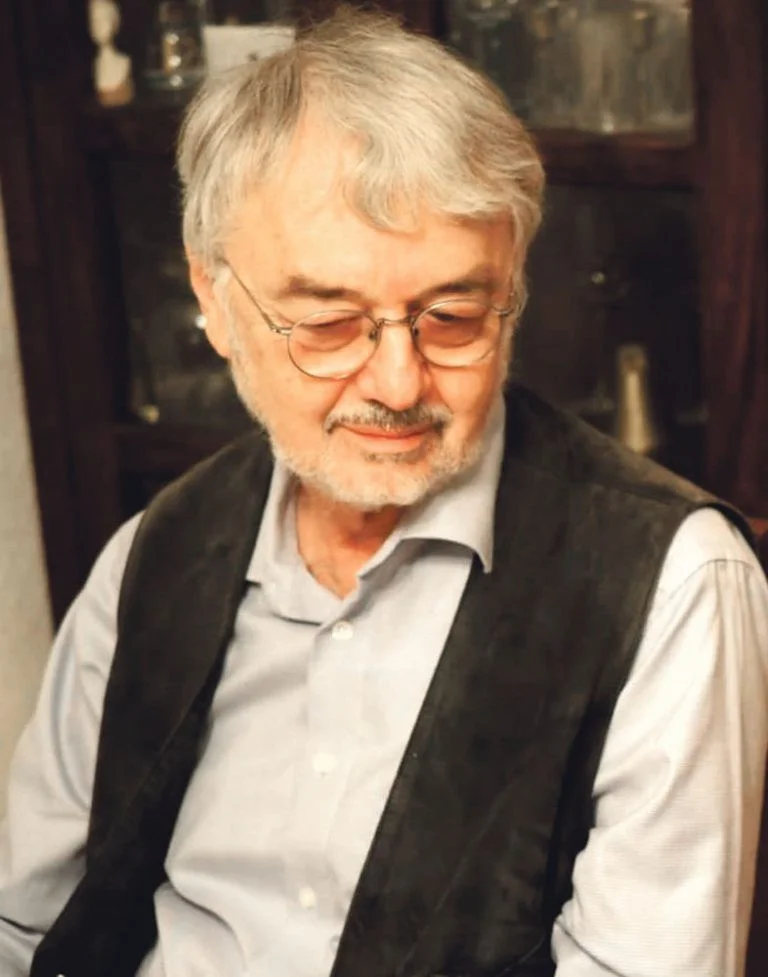
Cristina Chirvasie in conversation with Costion Nicolescu
The Cultural Horizon
I remember Father Dumitru Stăniloae, when he once spoke about his childhood in his village, Vlădeni, somewhere between Brașov and Făgăraș. He said he believed the world extended only as far as the horizon of his village. Beyond it, there was nothing more… This was the world for him; beyond it did not exist, or rather, it was something nebulous, very mysterious, unknown. And I realized that, ultimately, each of our worlds extends, in a way, as far as our cultural horizon. Only what we know truly exists for us. What we don't know, we merely suspect exists, but it doesn't hold particular importance. So it is with my horizon – my world is the world of my cultural space. Within the cultural space, I include the direct human space (i.e., friends, relatives, acquaintances) and the ideational space, the bookish space, which is, in a way, vaster and more intimate, because it is more closely connected to me. The bookish space belongs to culture, in the stricter sense of the word. Within it, the arts hold a privileged place. Otherwise, of course, the course of life places you in various contexts, in various places, in various relationships with people. Some are passing through your life, with others you journey for longer, but, of course, each has its importance to you. You might only cross paths with someone in life, and yet, this encounter can remain unforgettable for you, and sometimes even be decisive. All your life you carry the memory of that moment with you. Every time you recall it, your heart leaps with a secret joy, somehow, because it is yours and only yours… One difficult to express and convey outwardly. And of course there are people with whom you journey for longer periods, perhaps even for your entire life, and who change it or set it better on a certain path, if your journey has already begun.
A moment of total and intense experience
There are people you only cross paths with in life, but who leave an unforgettable mark on your memory. I'll give you a very simple example. I was on holiday. I had been to Ciucea for Octavian Goga and took the train to go further. After I boarded, through the window I noticed a girl on the platform, a peasant girl. She had such a pure face, of a rustic purity, I don't know how to describe it, much like we sometimes find in literature, rarely in a good film. The train started, and at that moment, our gazes met for an instant. For me it was something very intense, special, and indescribable; I will remember it all my life as something extremely profound. I've exchanged glances with people thousands of times in passing, but only that one, from Ciucea station, remained with me like a moment of total and intense experience. The memory of an experience... And why is this important? Because somewhere, within you, something crystallizes, in the sense that Stendhal spoke of the crystallization of a dried fir branch in the salt mines of Salzburg. It was an image through which he wanted to suggest the transformation that falling in love can bring upon a person. If you leave a dried fir branch in the salt mines and take it out after a while, it is full of crystals and shines. From an unremarkable dry stick, it has become something extremely beautiful. Something similar happens with a person. He may be quite dull and ordinary, generally, with weaknesses, with flaws, but once immersed in a bath of true love, in a state of infatuation, he becomes something entirely different, an enlightened and luminous person, in whom all qualities begin to bear fruit.
The Road to Emmaus
So you can have such encounters, like the one above, or you can have meetings, and you can have companionships. Companionships are wonderful! To travel with someone and explore life together! It's a path I love very much, which I often give as an example: the road to Emmaus (cf. Luke 24:13-33). The two, Luke and Cleopas, walk with the resurrected Christ, talk together, but do not recognize Him. Christ does not reveal Himself from the beginning. Only after He breaks the bread and disappears do they understand it was Him. But there had been something that had told them beforehand who He was, without them taking notice. Namely, the heart that burned within them in His company. This burning of the heart on the road that you have with someone seems formidable to me! To be with someone and for your heart to burn, perhaps just like that, without necessarily realizing from the beginning what value they will have for you, all their qualities. For your heart to burn and to joyfully move forward, oblivious to other, disturbing signals!
So, there are people with whom you travel and keep company more… And another thing to note: there are also partings – that’s how life takes you, to part ways. From some, you part because they go before you to God, naturally or less naturally, by our judgment, for by God’s judgment, it is always natural. The people important to you remain with you, they follow you in a way, they inhabit you in the most pleasant, most joy-giving way possible. All those mentioned follow me, each in their own way. This doesn’t happen because you intend it; it happens naturally. These presences of theirs within you, their degree of persistence, give you a certain hierarchy of their importance for your life.
Then, close friends are very important, because, normally, they are the most present in your life. Even when you see each other less often, they remain very important. They are the ones who can help you get out of delicate situations. And I'm not necessarily thinking only of concrete, material or spiritual situations. They give you the tonic feeling that you are not alone on your journey, that you are always with someone, that you feel a shoulder next to yours. Even a word or a thought is of great use to you. And in older times, that is, during communism, friendship was truly a refuge and a place where you lived your life with fullness and meaning.
Before, salvation was represented by culture and friends
Now things are not quite like that anymore. Life is scattered with greater social and professional worries; things are riskier, in a way, from this point of view. Before, they were safer, as they were, but they were safer. Now everyone is largely absorbed by the daily struggle for a comfortable material stability. But before, salvation was represented by culture and friends. This way, you somewhat sheltered yourself for spiritual survival. The enemy, that entire communist ideology, with its associated politics, was easy to define and isolate. You endured it, of course, you confronted it, you couldn't help but feel it in one way or another, but you knew you had a private space, within which were friends – it was culture. Enough for your being to breathe. The cultural offer was clearly smaller, but it had become much more vital.
Now it's completely different. You go into a bookstore today – and I'm giving the example of a slightly more specialized bookstore, like Librăria Sophia in Bucharest – and you see that they have hundreds of titles, at least a few dozen of which are very attractive and interesting. And you don't know what to do, which one to choose and which one to take. Back then, there was quite a scarcity from this point of view. For example, a Philokalia once every two years. Well, we had time to read it, to underline it, to calmly go through it from one end to the other; no other book was pushing us from behind… There were queues at bookstores, you had to have connections to get certain books, or buy them bundled with all sorts of indigestible books, many of them propaganda. But when you had a coveted book, what joy!
From "The Winged Man" by Cristina Chirvasie
Memory Cultural Foundation Publishing House, 2022