
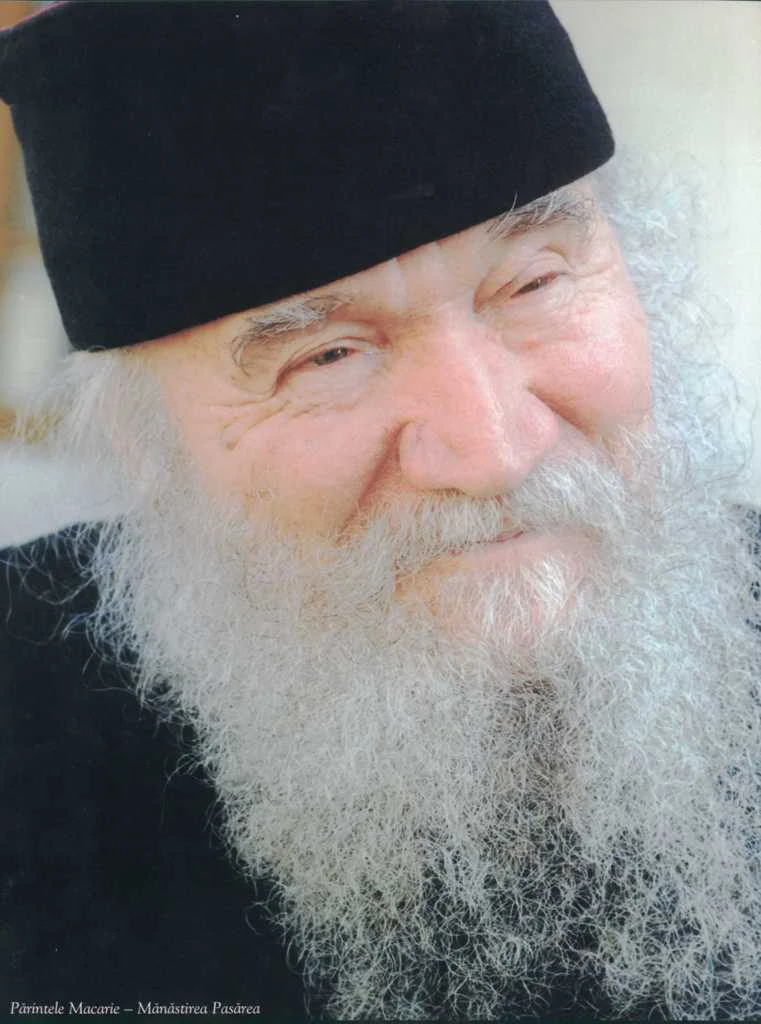
Father Macarie from Pasărea, The Very Image of Joy (Part I)
Author
Publish Date
Father Arsenie Muscalu speaks to us
Father Macarie Ioniță († August 3, 2007) is part of the cohort of great spiritual fathers of our nation, alongside Father Paisie Olaru, Father Cleopa Ilie, Father Arsenie Papacioc, or Father Sofian Boghiu, who bore on their shoulders the burden of an entire century, the bloodiest and most painful in human history. Let us listen to one of his disciples, Father Arsenie from Cornu, as he recalls his first steps under Father Macarie's guidance, offering us not just a simple story, but a true spiritual communion in the presence of this Elder from the Paterikon of our times. (A.S.)
- Father Arsenie, you were a disciple of Father Macarie from Pasărea. Do you still remember your first meeting with Father Macarie?
- I don't know if I have specific memories from my first meeting with Father Macarie, but I think I rather retained the spiritual atmosphere that surrounded the Father. It happens that after a while, we get used to the presence of spiritual people, of our Fathers, and perhaps we no longer savor as much the blessing that comes to us through them. It happens! But the first encounters are more vivid, and I believe that's what remained in my soul the most: something of the spiritual atmosphere diffused around Father Macarie.
I think the first meeting was around 1985 ‒ I was in eleventh grade of high school and I came to Father Macarie with a Physics teacher, a spiritual son of Father Macarie, who brought me then for the first time to confession with the Father. I remember we walked from Brăneşti through Pasărea village and, at one point, the monastery appeared. That's how it seemed to me then, seeing the monastery, that the connection between heaven and earth was very strongly felt. Undoubedly, many ascetic nuns lived there, who sanctified their lives – you know that the monastery was founded by Saint Hierarch Calinic of Cernica, and Saint Calinic's mother was among the first inhabitants of the monastery. That's how I felt then, that there was a great grace upon the monastery. And then, meeting Father Macarie, this impression was strengthened, from which I understood that Father Macarie's prayers also contribute to that felt connection between heaven and earth.
It meant a great deal to me that I met Father Macarie at that age. Before, I used to confess in my home village, to a married priest, a God-fearing man, from whom I benefited ‒ both from his presence and his ministry –, but the meeting with Father Macarie was a turning point in my life. Through Father Macarie, my calling to monasticism was somehow fulfilled, although the Father did not do anything specific in this regard, he never urged me to go to a monastery, but it simply happened that way. A spiritual connection was then created, and it continued after high school. I entered the Faculty of Physics, in Măgurele, still somewhat close to Father Macarie; I confessed more often, the spiritual connection strengthened, and things proceeded in that direction. And that's how I felt, that Father Macarie played an important role in defining my path.
- What was the Father like as a spiritual guide?
- Father Macarie had a great deal of meekness. He was a spiritual father at Pasărea Monastery for over thirty years, and Mother Tomaida, who cared for him almost throughout this entire period, said that she never saw him angry. Being a cell disciple, she would have had the opportunity to see him! The presence of Father Macarie radiated a great deal of peace, meekness, and kindness. But peace, kindness, and meekness did not mean weakness, for at the same time, you could feel his firmness, especially when it came to the fight against sin. And this firmness of the Father also helped you to be firm in the fight against sin.
I remember that back then, as a child, I had the habit, I don't know where I picked it up, of mentioning the name of the evil one. And I believe that's what I told him at my first confession. And the Father then gave me the penance that, each time I let this word slip, I should say "Our Father" three hundred times. After one or two relapses, I was cured! It wasn't so much the harshness of the penance – because it's not very easy to say "Our Father" three hundred times – but rather the fact that it helped me to become aware of the evil, the weight, the gravity of sin. The Father's presence radiated, as I said, much kindness, much gentleness – and as a spiritual father, during confession, he had the patience to let you express yourself. He was very discreet, he didn't make you uncomfortable with his presence when you poured out your soul before God. Indeed, through his kindness, gentleness, and patience, he helped you in this sense. But you also felt this firmness.
- What brought him joy in his spiritual children?
- What brings joy to any spiritual father, after all: for them to be obedient to God.
"I am in God's service"
- How was the Father's ministry?
- I served with the Father a few times, but the most powerful impressions were from the first times I saw him serving, when I was a student, when I would catch the Father at a service. And I'll tell you how I perceived him. I realized later that physically he wasn't impressive, but I had the impression he was enormous. A massiveness, but not an oppressive massiveness. His presence conveyed something grand, but, at the same time, the Father's voice and the way he served were very smooth and delicate, he had a fragility – he didn't utter the litanies with an impressive voice, but with a subdued, very calm, very quiet, very composed voice. And beyond this apparent fragility of his voice, you felt that the recitation of the liturgical words came from somewhere deep within, and conveyed a great deal of spiritual power.
- What did he emphasize more: spiritual experience or ascetic struggle?
- He placed more emphasis on spiritual experience, if we are to express ourselves in these terms. Father Constantin Coman, who interviewed him, was a little amused by the fact that Father Macarie said that he also observed among his spiritual children that, if he pushed them with ascetic struggle, things would falter a bit. That is, he noticed that if he gave them a penance to do prostrations or to fast or to say many prayers, they wouldn't do it! And Father Constantin Coman was especially amused by the fact that Father Macarie had a simple and pleasant way of saying things, stating that he achieved the best results with "Our Father." The penances he gave were to say "Our Father" a number of times. So his emphasis, if we can put it that way, fell on spiritual experience, but he didn't hesitate to put you to work either!
I remember how Father Macarie once told me about an old man from Brăneşti – he must have passed away since then – who hadn't confessed much throughout his life, but in his old age he came to Father Macarie, and the Father gave him to say "Our Father" a hundred times daily. And Father Macarie recounted how conscientious the old man was and how he transformed, how happy he was, what inner joy he had acquired after a clean confession and having gained this inner preoccupation of mentioning God's name, not with the Jesus Prayer, but with "Our Father." So Father Macarie did, however, also place an emphasis on ascetic struggle.
- But did he tell you about the difficulties he went through in life?
- He also told me about the hardships he went through in life. He witnessed the establishment of the communist regime; he was young then. And it was a great burden for him, a great pain to see the destruction of a village way of life. He saw how the fallen people of the village received positions of responsibility – they became mayors, presidents of collective farms (C.A.P.) – and how the peasants began to spiritually deteriorate. During that period, he left for the monastery, and in the monastery, he was destined to go through a very difficult moment, when Balaciu Monastery was closed. Father Macarie was the abbot of the monastery when the church doors were padlocked on Good Friday – on Good Friday, of all days! They loaded their few belongings into a car and were taken by truck to Căldăruşani Monastery – along with Father Macarie was also Father Damian, who had been abbot at Sitaru. They arrived at Căldăruşani right during the Funeral Service.
Father Macarie used to tell how in that year he didn't feel that Holy Pascha was truly Holy Pascha; he didn't feel the joy of the holiday. He said this because, as a child in his village, he had experienced the joy of the holidays with an intensity that perhaps we no longer feel now. Father Macarie said that this joy of the holidays did not come from material abundance, because they were poor, but especially from the state of brotherhood in which they lived. The whole village rejoiced as one heart. They experienced the joy of the Savior's Birth or the joy of His Resurrection as a single family, as one soul. But in that year, he no longer felt the joy of the holidays; everything was very oppressive. And there was a kind of small miracle in his life during Bright Week – the day of the Life-Giving Spring had arrived, and he was still in this state of oppression, of spiritual heaviness. Then the Abbot asked him to confess someone. And, at the moment he was confessing this woman, a thought came to him – a simple thought, but one that came from above, and which told him: “I am in God's service. My service rendered to God has not been diminished in any way. Why should I be sorrowful?” And suddenly, that sorrow lifted from him. He felt in his purpose and in his place and no longer felt the burden.
“I owe you nothing!”
He also had difficult moments at Căldăruşani. He was the monastery guide, and the Securitate tried to recruit him. There was pressure on him. And, because I mentioned the Father's steadfastness, I recall it again, because Father, although he was so discreet, delicate, and kind, things were not grey for him – things were very clear. Those who came to recruit him told him that, as the monastery guide, he possessed certain information and had to help them in their service. And then Father Macarie said: “I don't know who you are. I am an employee of the Archdiocese of Bucharest. I owe you nothing.” They started to laugh ironically: “Oh, don't pretend you don't know who we are!”, trying to intimidate him. But the discussion ended like this, Father remained firm in his position: “I do not answer to you. I do not answer to anyone but my superiors. I answer to the Church.” But he lived in fear after this moment. Although there were no visible consequences, a difficult period followed in his life, because he received many tasks – another task, another task, another task... He was a sacrificing man, a man who would not refuse when asked or told to do something, and he became exhausted, he reached a point where he couldn't sleep, feeling physically ruined. God saved him in this circumstance too, and little by little, he recovered. Perhaps something similar to what Abbot Thaddeus of Vitovnica experienced, who also, during a certain period of his life, went through a strong depression, from which he slowly recovered.
- People remember Father Macarie as a countenance of gentleness and joy. The name “Macarie” itself means “blessed” or “happy.” How did he preserve his joy in these times of persecution?
- With trust in God, he preserved his joy, with the trust that all things are in His hands. He had this faith that beyond peace or persecution, beyond the difficult or easy circumstances of life, there is God's providence. He had this unwavering trust in God's care.
I have recounted this incident before, that I used to come to Father Macarie together with other Fathers ‒ we were at Cernica Monastery at the time ‒ and, as it happens, to start a conversation, we would sometimes say, as people do: “Oh, how hot it is outside!” Even in such circumstances, when one might give a complaisant answer, the Father was very attentive – this somewhat revealed to me the state of sobriety in which Father Macarie lived, his inner collectedness. He did not assent, he did not join us to fuel the conversation, but if we happened to say: “Oh, how hot it is outside!” he would raise his finger and say: “As the Master commands!” He was so conscious that everything is under divine providence, that even something seemingly trivial, for the Father, was under divine providence.
(to be continued)
Interview conducted by Anca Stanciu
From “Familia Ortodoxă”, August 2021
See also:
Father Macarie of Pasărea, the face of joy (II)
1 Comment
Alexandrina
Cât de mult mă bucur să citesc câteva rânduri despre Părintele Macarie! Am tot auzit de sfinția sa și la Diaconești, și de la Părintele duhovnic, iar acum să găsesc mai în amănunt lucruri despre viața dânsului... Aștept cu nerăbdare și partea a 2-a! Multe mulțumiri!