
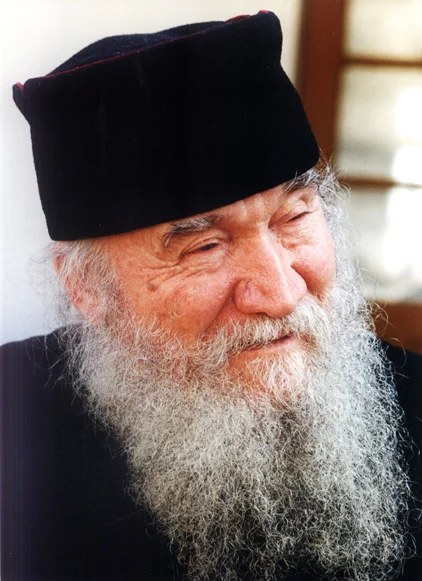
Father Macarie of Pasărea, the Embodiment of Joy (II)
Author
Publish Date
Father Arsenie Muscalu speaks to us
The word of our Fathers is spiritual oxygen to us, a life raft, firm ground under our feet in the shifting sands of this age. We thank Father Arsenie from Cornu for the blessing of portraying the image of his spiritual father, Father Macarie from Pasărea (†August 3, 2007), thus presenting us with a powerful word that still works to this day. (A.S.)
- Father Arsenie, you told us that Father Macarie lived through the great events of the 20th century, but also experienced the changes brought about by the '89 revolution. How did Father Macarie view this transition from the serene life of the old village to the experience of post-December freedom?
- It's hard for me to say. I only know that Father Macarie had a way of participating in what was happening with quite a lot of involvement, although outwardly one might say it wasn't apparent. He was already old, he was a monk, a spiritual father; he wasn't politically involved, but he was very attentive and eager to know what was happening, and he placed great hopes in a rebirth of the Romanian people. He believed in a rebirth to a devout life, a life of faith. But the years that followed brought him bitterness, because he saw that things did not, after all, unfold as he would have expected.
Something comes to mind now regarding Father Macarie's expectations and desires, and how he saw things could change for the better. It might seem simple and naive, but I think I can convey quite well what the Father said then. He learned that, shortly after the events of December '89, somewhere on a wall in Bucharest, someone had written with charcoal: „Securists! More coal for the country!” That is, this suggested that „Until now, we were the oppressed, but now it's your time! To the mines with you!” And the Father was a bit taken aback and perhaps saddened by that. „That's not how it should be done,” he said. „If we are to be reborn, we must forgive everything. Such an attitude will lead to animosity. If we are to succeed in rebuilding something, we must not base it on resentment and revenge, but on forgiveness.”
It's true that someone might say this is debatable – I'm not in a position, nor am I an expert on the subject, but I know that there was talk about a lustration law, and people would have needed certain things to be clarified. Mr. Gabriel Liiceanu had an „Appeal to Scoundrels,” which was a poignant and beautiful message, but even if he was right from his perspective, I believe that at the same time, Father Macarie's urging also remains valid and true. If we try to correct or repair something in a spirit of resentment, we will multiply evil.
- But what solution do we have to forgive?
- I don't know what solution we have to forgive... Especially forgiving those who have wronged us or loving our enemies seems to be beyond our human powers. But Saint Silouan says that we neglect the fact that we can draw the Holy Spirit towards us. God looks at what we incline towards, ultimately. I can incline towards forgiving my enemies, for God's sake, even though I see that I don't have the strength within me. And if God sees that I have this inclination, He will help me.
„The sealing will not come furtively”
- If Father Macarie had lived in today's time, how do you think he would have viewed the COVID pandemic?
- People are now troubled regarding, for example, the meaning of the vaccine. They wonder if accepting the vaccine means a compromise. Some go much further. A young man came to me the other day to tell us that vaccination means sealing. These are extreme positions, and I believe few people are currently holding this position, but people, I think, are a bit agitated, a bit troubled regarding the meaning of vaccination, wondering if, beyond the medical aspect, it doesn't also have a spiritual meaning.
Regarding this, I cannot tell you with absolute certainty what Father Macarie would have said, but I can tell you how he approached a disturbance that we also experienced to some extent when products in commerce began to be inscribed with barcodes, and it was claimed that the number 6-6-6, “the number of the antichrist,” was present in the barcode. And then people were troubled: what attitude should they adopt? And I remember very well how calm Father Macarie was ‒ this because we've already spoken of the Father's calmness, serenity, and gentleness, stemming from his trust in God. The Father was serene and urged us not to agitate ourselves anymore, not to fret over these matters, because the sealing will not come furtively; we will not lose our souls without knowing what is happening. And he told us that when a certain act signifies sealing, everyone will know what is happening. Without necessarily following the news day by day, without seeing what international politics entails, what decisions the world's leaders are making or not making, every person will know that by performing that act – whether that act means receiving an identity document or accepting the vaccine or similar things – when this moment of sealing comes, every person – Father Macarie said even an illiterate person – will know that what they are doing is sealing, or at least will know that what they are doing is a compromise. And the fate of the soul will depend on the conscious acceptance or non-acceptance of the compromise, not on what a person does unconsciously, if they are deceived.
Our protoparents were deceived, they were deluded in Paradise, and precisely for that reason, repentance and their restoration were possible, whereas the devils were not deluded but conceived evil from within themselves, and for them, repentance was no longer possible. The danger of sealing is precisely this: sealing will also mean the impossibility, the inability of someone to repent anymore. Sealing will mean such a hardening, such an acceptance of compromise, of sin, of evil, that a return will no longer be possible. But when a person is deluded, they always have the possibility to turn back, to repent, and to be saved. And the Father said not to be afraid, not to be overly concerned with these things, because the more we discuss and contradict each other, the more troubled we become and the less we understand. The calmer we are, and the more we pray and attend to our Christian life – attentive to what is happening, without a doubt – the clearer we will be and, as Father Macarie said, at that moment, if such a moment is to come, we will decide not to violate our conscience, if we have the strength not to make a compromise, regardless of who it comes from and what kind of pressures might arise.
“I cannot violate my conscience!”
I would like to somehow reinforce what I have learned from Father Macarie and I would use the example of Saint Maximos the Confessor, about whom it is said that, at the moment he gave his testimony, he was somewhat alone, meaning the apostolic thrones ‒ at one point even those of Rome, Constantinople, and Alexandria ‒ had fallen into heresy, and the saint had refused communion with their hierarchs. The Patriarchate of Constantinople sent a delegation, which included a bishop, to urge Saint Maximos to enter into communion with the Church. Because now everyone was in communion, but they were in communion in heresy. And why do I want to give this example, what remained very clear in my mind? That Saint Maximos could not be reproached for even a single word of insult or defamation against the Church leaders of that time or against the emperor. Of course, they used a trick, because they wanted to accuse him of lèse-majesté, but no witness was found ‒ only false witnesses, who were proven to be false ‒ no witness to prove that he had undermined the authority of the emperor or the patriarch through defamation or irony. But he firmly refused to enter into communion. And his argument was this, when they tried to convince him to enter into communion: “I cannot go against my conscience! I feel that, by doing what you say, I violate the loyalty to the testimony of our Fathers, something I personally uphold. I want to preserve loyalty to our Fathers and that is why I cannot enter into communion with you.” Somehow, Father Macarie also said something like this, that everyone will decide very personally at such a moment, everyone will feel that, by accepting a certain thing, they make a compromise, and it will depend on them whether they accept the compromise out of fear, self-interest, or other reasons, or whether they will not accept the compromise.
Although I'm extending my answer, I tell you that, in support of these words, Father Macarie also recounted an incident he experienced as a confessor. He said that once a woman came to him who had practiced white magic for many years. She was convinced that she was working with good spirits to help people, and people came to her with all sorts of problems. And, at one point, those spirits she worked with told the woman very openly: “We are not what you think we are. We are devils and we want you to collaborate with us consciously!” At that moment, the woman got scared, and that's when she came to Father Macarie. And Father Macarie said: “You see? The devils couldn't entirely win her soul, because she was naive. She truly believed she was working with good spirits. They wanted conscious agreement from her.”
We think about her now, that perhaps the devils counted on obtaining this conscious agreement, because she was already, let's say, famous, she had material advantages, money, and the devils probably thought she was so advanced on this path that, for the advantages she had, she would accept the compromise. But she, in her simplicity, got scared, realized she was in danger, ran to her confessor, and was freed from that evil. That's why Father Macarie somehow reinforced that devils gain no benefit from what we do naively or unconsciously. We're not saying it's not dangerous, because even naivety can lead us into dangerous situations, but the soul is lost through what we do freely and consciously; this affects its eternal destiny.
“A holy life”
- What was Father Macarie's teaching about monasticism?
- Father Macarie was, if I may say so, saddened to see that our monasticism was recovering with difficulty. He used to say that our monasticism emerged from under the communist regime barely surviving. And he said that he didn't believe he would live to see monasticism recover even to the state it was in when he entered monasticism. He called it 'a self-willed monasticism.' Perhaps Father Macarie's words don't sit well with us, but that's what he said. Because that's how education was back then: children who came to the monastery were already formed in this way; a monasticism in which the cutting off of one's will, obedience, the safeguarding of the blessing – the foundations of monastic life! – were kept with sanctity. And they were observed naturally, organically, not as discipline, because it wasn't about discipline. Rather, children came to the monastery like that, with the awareness that God works through their spiritual fathers or through their superiors in the monastery. They didn't enter with their minds entangled in all sorts of complications, as we do now: whether the abbot follows the Holy Fathers or not, whether he teaches us as he should or not ‒ it was a simple and pure faith, and according to their faith, they felt the manifestation of God's work in their lives.
- How were the Father's last days?
- The Father suffered several strokes, and this slowly, slowly incapacitated him physically. He could no longer serve, and remained in his cell. In his last days, the Fathers who were serving at the monastery at the time performed the Holy Unction for him several days in a row, they gave him Holy Communion every day, and his end was peaceful. A little before his end, I remember Father Macarie telling Mother Tomaida, his cell attendant, that he would soon depart, because 'Grandpa' had visited him. He said: 'Mother, I am not a child anymore. I can distinguish a dream from reality. It wasn't a dream, it was Grandpa!' The Father was already bedridden. And why did Father Macarie say it wasn't a dream? Just as when someone arrives, they bring a faint breeze, a small current of air, that's how it was when he saw Grandpa. He felt the soft stir of a coming, of a presence from another world. Grandpa was radiant, he was joyful. He looked at him smiling and then disappeared. And the Father said: 'I will soon depart,' and so it was. The Father passed away with us beside him, reading prayers to him.
- To the question: 'How shall we be saved?', what did the Father answer?
- He said this to each person individually, because each person is a salvation. And the Father had such words that addressed a person very personally. But of course he also had words that referred more generally, to the current situations and to how we should be saved in this world, and ultimately, he said very simple things. Father Macarie insisted very much that we regain our faith, that we should not live with the illusion that we have faith. Our faith is very cerebral, very rational, while he, in the village where he was born, lived this natural faith, as natural as your breath. He himself said that the life he knew in the village where he was born and lived and grew up, that's what he called it – and he didn't use words lightly: a holy life. Father Macarie was not one for romanticisms, for pastoral sentiments; he was a simple peasant. That's how it remained etched in his soul: a holy life.
And, as I was telling you that he didn't use words lightly, I remember that once, while discussing with someone – I was present – he mentioned Father Cleopa's teaching about the manner of communion, that there are several ways to receive communion. And he called Father Cleopa 'a holy Father.' After he spoke the word, he paused. He had a moment, like a person who pauses briefly, considers what they've said, and then confirms it. With such care he used a word! He wasn't quick to easily characterize a situation. He called the life he knew in the countryside 'a holy life' and insisted very much that we regain that faith.
Interview conducted by Anca Stanciu
From 'Orthodox Family', September 2021
See also:
2 Comments
Bianca
Bine spui, Anca, cu adevarat nisipuri mișcătoare sunt vremurile noastre, iar acești Părinți, de a căror prezență Domnul ne învrednicește să ne bucuram și să ne folosim (...mă gândesc că ceva se lipeste și de noi de pe Dânșii....), și cuvintele lor ne sunt chiar ca o gură de oxigen când simțim că ne scufundăm și înghițim nisipuri...
Anastasia
Cat de frumos!!! "Mai ales iertarea celor care ne-au făcut rău sau iubirea faţă de vrăjmaşi pare că e dincolo de puterile noastre omeneşti... Eu pot să înclin spre a ierta pe vrăjmaşii mei, de dragul lui Dumnezeu, deși văd că nu am în mine puterea. Iar dacă Dumnezeu vede că eu am înclinaţia asta, mă va ajuta." Cât de minunat și adevărat! ❤️❤️❤️❤️❤️❤️❤️❤️❤️