In October, the Romanian Language Festival took place in Brașov, a regal of poetry and conviviality that brought together poets and publishers from France, Greece, Italy, Denmark, and Romania, a joy of the spirit poured over lovers of "fitting words." Beyond the colloquium's theme "Literature and the Book Market," discussions covered topics related to translation and translators, about publishing houses, poetry and poets, the literary magazine "Libris" from Brașov was presented, and opportunities for translating Romanian authors' poetry into other languages were analyzed.
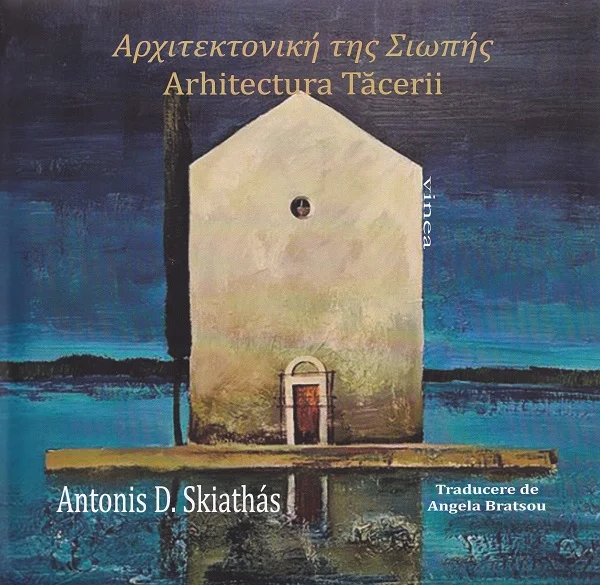
Among the book launches during the festival days was that of the Greek poet Antonis D. Skiathas: The Architecture of Silence, translated by the renowned Hellenist Angela Bratsou.
Antonis Skiathas is one of today's most esteemed poets in Greece, an anthologist and literary critic, by profession a chemical engineer with studies in creative writing and the conservation of artworks. He is the director of the International Poetry Festival of Patras, the Poetry Bureau, and the cultural platform Culture Book.
The volume "The Architecture of Silence" is part of the author's impressive poetic repertoire of over twelve volumes of poetry, published in Romanian by Vinea publishing house by editor Nicolae Tzone. The volume is part of the trilogy Memory-Time-Silence, 101 poems, the anthology being shortlisted for the national poetry award in Greece, 2023. In the Romanian edition, we find poems from the other two books of the trilogy: The Scrutiny of Time and Unconsecrated Myths, which reflect the author's poetic dimension for the Romanian reader.
Antonis's poetry is spoken of as being full of dramatic realism, especially in the present volume; it adopts a melancholic/reflective tone, guiding the reader through a multitude of states, depending on the disposition of the poet capable of glimpsing the "worlds" that populate him.
In The Architecture of Silence it's hard to establish a priority of themes; they succeed each other in a somewhat silent rhythm, even if time vibrates in remembrance. Memory becomes an anchor for the present; upon it, the great architecture of being was built, in which silence transformed the life of the world and the poet: "Even in silence, these branches/ resist the babbling of history./ Even in silence, eagles with flesh/ of unhappy animals in ivory dawns/ become kites./ Even in silence, the echo of words/ becomes an underwater homeland with uninhabited islands/ and refugees clinging to kayaks./ In silence, both now and then/ words change life./ In silence, death is born,/ even if there are crickets in the yard/ in the days and nights of the great carnival." ("Carnival of the Psalmists")
For the poet "death is an exercise for life", and "the geometry of words and their ashes" can crush this death into eternity. The power of the poetic word is what gives eternity to time, a "wrinkled time" that encompasses everyone, a profane apocatastasis in which, in "the exile of the fulfilled", all the drowned and despised of the world ("Endowment").
The world appears in a continuous race, encompassed within a ship/vessel in a continuous celebration of illusions. The journey takes on a new contour when "the majestic shadows recalled time in readings of gospels" ("Navigation with Illusions").
The poet is convinced of the irreversibility of time, which he contemplates in his own way, attentive to the great passage that does not necessarily have a salvific meaning. It is a passage that transfigures the world towards light: „Always, but always, there is a Crucifixion and certainly a Resurrection. Ultimately, there is a beginning, because otherwise what end would there be. In today there is the vitality of yesterday that defines the crowned tomorrow, be it with ivy or wild olive, even if the night has day, and the morning, a wooden cross./ And this spring wants to make love with an owl on a lilac branch searching for the moon. And this spring wants to make love with clouds atop cypress trees that hide time's unmourned view./ The bicycle, however, left under the lemon trees, in the sun's martyrdom, is all white, and the day again from the beginning awaits the cyclist.” („The Cyclist”)
Between Crucifixion and Resurrection, as a time of human becoming, there is an eternal spring that man traverses in motion, convinced by the transparency of the world and of objects that change their materiality towards light. It is a process that pertains to one's own crucifixions and resurrections from which no one escapes.
Between the two worlds there is no hiatus. That „beyond” is present „here” and does not necessarily manifest through a quality of being. Man is in a continuous struggle with himself because „in the trades of the future, the loneliness of freedom is learned, but also the freedom of loneliness./ Not a word about the harmony of the original sin of mortal winds.” („Elegy of Fears”)
Solitude is, in the poet's vision, that which „stabbed, swayed through the whole house”, and the poet seems to feel in its presence „imprisoned, stateless, in the apartment with the library of a pale life, the empty pool of words, of phone books with names of the dead, and the unwatered vegetable garden and clothes hanging in the darkness of the veranda”. („Herd Immunity”) After all, „invisible is now the poet/ in the crucifixion of time.” („Summer Apology”)
Solitude is not necessarily a burden accompanied by a lack of life perspective, but rather a source of memory regeneration, which becomes „deathly silence in the hopeless ambiguity of the ending.” („Herd Immunity”) The memory of life is outlined in another poem of great epic force: „September then, a September now”.
The poet writes „about the fate of poets/ and not about the laments/ in their poems.”(„Visits”) Because „the poet's face, a historic talisman/ in wordless nights,/ with enigmas and facades of ruins,/ opposes/ the deadly final blizzard,/ with genius reductions plays/ in the universe of death.” („Teenage Geniuses”)
He knows that the life of poets has „innumerable question marks”, but poems will exist „as long as bells exist in the morning”; it is humanity's destiny to occasionally feel the light of verse. Antonis D. Skiathás bestows upon us, in The Architecture of Silence, a true literary testament where the profane occasionally takes on a spiritual outline. The poet probes the complexity and disorientation of contemporary man, in an enigmatic and harsh universe, making silence his form of protest against the horrors of the world he is called to live in, but also the constructive presence of memory, which becomes overwhelming.
I don't know why, I have the feeling of a different kind of Ernesto Sabato Before Silence.
Fr. Cristian Muntean