
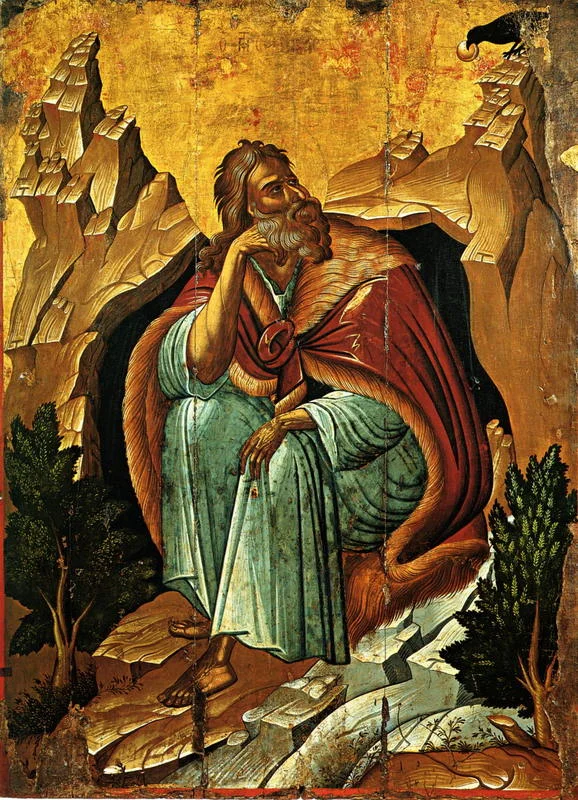
Thoughts on Saint Prophet Elijah the Tishbite († July 20)
- And I have lived and fought for You "with thought, with word, and with deed"!
...this is how I imagine Saint Prophet Elijah might describe his life before the Lord. Wasting not a single moment, not straying even one step from his mission, not faltering under the shadow of any doubt, not allowing himself any respite. Fierce, stern, determined, upright, unwavering in his faith in God, the One who gave meaning to his entire existence.
I try, with a wavering thought, to imagine Saint Elijah, and I feel like an ant at the foot of a mountain. And I marvel, again and again, at how wonderful the Lord is in His Saints. And at how far we remain from what we could be, in our blind stubbornness to do everything ourselves, to prove that we can, that we are worthy, deserving of appreciation, of honor, of promotion.
Saint Elijah had but one desire: to be well-pleasing in the eyes of the One Whom he loved and served with such fervor. And, placing his heart in the hands of the Lord, he received guidance and power from above.
"Those who seek the Lord shall not lack any good thing."
Saint Prophet Elijah was born more than 800 years before the Incarnation of the Savior, in the land of Gilead, on the other side of the Jordan, bordering Arabia and the city of Tishbe, from which he was named 'the Tishbite.' At the child's birth, his father, Sovac, saw angels in shining garments wrapping the infant and feeding him glowing embers. It was thus revealed to him that his son was a chosen vessel of the Lord, a dwelling place for the light of the gift from above, destined to receive a word powerful as fire to shatter the idols of disbelief and turn hardened hearts back to God.
Born of priestly lineage, Elijah grew up and lived in spiritual and physical purity, placing all his hope and desire in the Lord. He was a seeker of stillness and a lover of prayer. He suffered seeing the disbelief, decay, and moral depravity of his people, who from a 'chosen nation' had descended into the mire of idol worship and human sacrifices on idolatrous altars.
At that time, Ahab was king of the Israelites, and he had taken a Phoenician wife, Jezebel of Sidon, a worshipper of Baal, one of the prominent gods of the Phoenicians. Under Jezebel's harmful influence, Ahab abandoned, without remorse of conscience, the faith of his ancestors, covering the land of Israel with pagan temples, persecuting those who remained devout, and raising Baal's servants to great honor.
In those sorrowful times, Saint Prophet Elijah responded to the Lord's call without hesitation, and appearing before the king, he had the courage to rebuke him directly for all his transgressions, asking him to return to the righteous path. And, seeing that the ruler of the people remained hard-hearted, Saint Elijah threatened him with three and a half years of terrible famine upon the land. Being himself obedient to God, God therefore heard his prayer and bound the clouds, sending no drop of water to the earth throughout that time. People suffered, exhausted by thirst and lack of food.
To make known the power of the Most High even among those of other nations, Elijah was sent by the Lord to Zarephath of Sidon, to a poor widow who was dying of hunger with her son. But the Prophet, through the power of his prayers, multiplied the flour and oil in the woman's house and resurrected her son, clearly showing that "those who seek the Lord shall not lack any good thing."
"The God of Elijah is the true God!"
Meanwhile, the king fiercely sought to destroy him, but Saint Elijah hid in the Kidron Valley, being fed by ravens with bread and meat. After three and a half years, Saint Elijah returned to Ahab's court, commanding all the tribes of Israel and the prophets of Baal to gather on Mount Carmel, so that all might be convinced who the true God is.
Thus, two altars of sacrifice were prepared, one dedicated to the Lord, the other to Baal, so that both Elijah and the pagan priests would pray to their God to send fire from heaven and consume the sacrifice offered. Saint Elijah further heightened the tension of this unprecedented confrontation and requested that abundant water be poured three times onto the altar of His God, thus prefiguring the mystery of the Holy Trinity.
In the thicket of our thoughts, full of weedy disbelief, how many of us might not have felt a shadow of so-called malicious regret... If only we too could have witnessed this “duel” firsthand... well, yes, with such proof it would be entirely different! Then we could calmly believe in Elijah, and in Him by whose power he works! But as it is, unable to trust with our own eyes, we read further about the Prophet's wondrous deeds, somewhat reassured that our disbelief is, after all, justified. We read them like an old tale, interesting, it's true, but one that leaves the core, the stone, our mountain of doubt unshaken.
“Therefore I tell you, whatever you ask for in prayer, believe that you have received it, and it will be yours.” (Mark 11:24). And Elijah prayed exactly like that. With all his heart, with all his soul, with all his mind, and with all his strength (cf. Mark 12:30), being convinced, knowing without a trace of doubt that fire would engulf the altar, even though the sacrifices had been sprinkled three times with water.
And his prayer was heard. The power of the true God was revealed once again, to turn the lost back to the righteous path.
“The God of Elijah is the true God!” (1 Kings 18:39) – this was the cry of the people awakened from their slumber, upon whom, at the word of the same Prophet, heaven poured down blessed rain, stopping the drought, famine, and suffering. Until a time came when the Israelites again forgot Him who was the Source of their blessings and returned to their iniquities and idols.
The Treasure of a Still Living Heart
Burning with the pain of the people's disbelief, Saint Elijah directed his steps toward Mount Horeb, traversing a journey of forty days and forty nights without food or drink, strengthened only by his unwavering love for the Lord. And, settling in a cave, Saint Elijah spoke first with the angel of the Lord, then with the Lord God Himself. Not in a terrifying thunder that shatters mountains and hills, not in a consuming fire, but in a thin and comforting wind, there the voice of the Lord was revealed to him, reassuring him and entrusting him that not all Israelites had betrayed the righteous path, not all had abandoned Him, not all had closed their eyes, blindly following the deceitful voice of misguided leaders. Not all had indulged in pleasures and comfort, not all had allowed themselves to be seduced by the allure of an easy and struggle-free life. Not all had been tempted by grandeur and honors. Not all had adapted to the times and the demands of the city.
“I have reserved seven thousand men for myself who have not bowed the knee to Baal.”
Seven thousand unknowns, scattered in various places, unaware of each other, yet united as a single body, each sacredly guarding the treasure of a still living heart, secretly, unsuspectedly awaiting the moment when they would be called to deposit it in the Lord's treasury.
Also on Mount Horeb, God foretold to Elijah the imminent demise of King Ahab and Queen Jezebel, and revealed to him the name of Elisha, commanding him to anoint him as prophet. Saint Elisha was, most certainly, one of the seven thousand chosen men. He was a faithful disciple to Saint Elijah, and when he was informed of the Prophet's impending departure to the Lord, he requested that Elijah's gift pass to him in double measure.
By God's will, Saint Elijah was taken up to heaven in a chariot of fire, not passing through bodily death. Watching this ascension in wonder, Elisha saw Elijah's mantle fall from the sky, which he received and, parting the waters of the Jordan with it, just like Elijah, crossed on dry land, becoming an heir to the gift that worked in his teacher.
Saint Prophet Elijah, who, being alive from then until today, appeared alongside Moses at the Transfiguration of the Lord on Mount Tabor. According to the teaching of Holy Scripture and Church Tradition, Saint Elijah will return to earth at the end of ages, as a forerunner of the second coming of Christ, rebuking the Antichrist as he once rebuked Ahab and being killed by him, only to be resurrected by the Savior.
O Holy and Glorious Prophet Elijah, "guide to salvation and enlightener of those who lie in darkness," pray to the good God also for us, that perhaps, according to our humble abilities, we may be deemed worthy to be among the hidden hearts of this age that still burn with longing for God!
Aniela Târnaucă
3 Comments
Georgiana
Amin! De fiecare dată când citesc gândurile dumneavoastră despre Viețile Sfinților mă umplu de nădejde... Minunată lucrare aveți! Vă mulțumesc!
Maria
Amin!
Anastasia
Amin!