
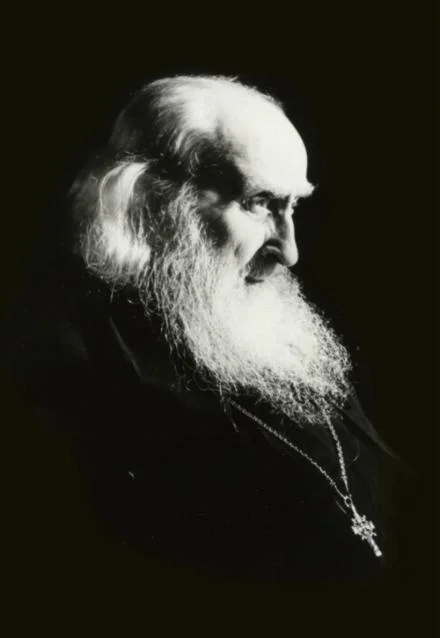
Mother Magdalena of Essex speaks to us
First of all, I will give a brief introduction, to orient ourselves to the topic.
The soul is the immaterial aspect of man: our thoughts, feelings, desires, our inner life. The spirit – not reason, intelligence, but pnevma – is not a separate entity of man, but the highest part of the soul, that which aspires towards God, that which enters into communion with God. I quote from Saint Sophrony, from one of his letters: „The existence of the three terms: spiritual, psychological, and physical, in ascetic terminology, nowhere signifies that man is considered trichotomous. According to the teaching of Holy Scripture and the Holy Fathers of the Church, man is composed of soul and body. That being said, even since the time of the Holy Apostles, a distinction has been made between soul and spirit (pnevma). We affirm, in fact, that man is composed of spirit, soul, and body.”
Saint Sophrony wants to avoid the term "trichotomous" for two reasons. Firstly, because this terminology is linked to heresy, ever since Apollinarius affirmed that Christ had a human body and a human soul, but not a human spirit. Secondly, he avoids this term because if the spirit (pnevma) were considered a third entity, separate [from body and soul], numerous misunderstandings could arise from this. For example, the soul, thoughts, emotions, the psychism, the psychological, all these would be removed from the search for God (as believed by the one to whom the letter was addressed). No, rather, the whole man is called to this search: „You shall love the Lord your God with all your heart, with all your soul, with all your mind, and with all your strength” (Mark 12:30).
Saint Paul uses the term „soulish man” or „carnal” to distinguish between the psychological man and the devout, spiritual man, or „the heavenly man”. Saint Sophrony aligns with this anthropology of the Holy Apostle Paul when he states that „Christ came to restore the integrity lost at the Fall: the unity of spirit, soul, and body. Eternity belongs first of all to the spirit, but our psychism and our body can also become the temple of God. The spiritual aspect” – which relates to God and our eternal self – „and our psychological aspect are distinct, but, in practice, impossible to separate. Our spiritual zeal influences our psychology and manifests itself in our psychological state, and reciprocally, our psychological state influences our relationship with God, our prayer and faith, or [conversely,] our lack of prayer and faith.”
„The psychological is necessary”
We will see some examples.
Saint Sophrony, like the Holy Apostle Paul, speaks negatively about the purely psychological level, but there are texts circulating on the internet, sometimes presented as quotes (although in reality they are not), which seem to suggest that Saint Sophrony urges us to shy away from psychology and psychotherapy. This must be corrected with what he simply said. Like Saint Porphyrios, Saint Sophrony admired wise psychologists and psychiatrists, recognizing the need for their expertise, but he was saddened by psychologists and psychotherapists for whom the idea of a healed person was limited to earthly values.
“For us, human health is understood as a victory over sin and passions and as a new life full of grace in God. According to the prevailing conceptions in psychiatry, a psychologically healthy person is considered one in whom conflicts have not reached a peak form, visibly destructive for the individual or unbearable for society. In this view, a psychiatrist completely disregards the fact that someone indulges in bodily excess or is dominated by another passion, as long as the person themselves does not feel the pain of an inner conflict, or has done nothing to disturb the usual norms of society. Thus, for a psychiatrist, healing consists of eliminating inner conflict, while for a Christian, healing means sanctification. In Christian life, following Christ, as the prototype of humanity, sometimes goes against what we feel or think: ‘Your will be done’.”
To conclude the introduction, I remind you that man is fallen. In the thinking of this world, the passionate condition is often understood as natural, normal, while in Christian thought, we understand that our psychology has been distorted by passions. Furthermore, there is often a conflict between our different parts. Those who have written about these things discern a kind of ladder of thoughts and feelings. At the bottom are the bodily passions, followed by the more refined passions – it must be emphasized that they are no less dangerous! – up to the highest aspirations of the soul, which have remained in everyone, despite the fall. The Hesychast Fathers attribute the different human energies deposited in the heart as follows: the grossest passions are located at the bottom, and prayer is at the top.
Saint Sophrony says:“Be courageous, as in the first centuries! Christians had the courage to believe in divine eternal life – to believe, because divine eternal life is beyond our comprehension. And it is necessary to believe. But what does ‘to believe’ mean? To believe is not a psychological act, but an ontological act, pertaining to the Divine Being. Now that we know Christ, we have no other basis for our faith than Christ Himself. When we see Him, we understand the pre-eternal thought [of the Holy Trinity] for human creation [...]. We see Christ as our Creator Who assumed the form of our existence.”(Saint Sophrony)
“We do not kill the psychological, but transfigure it”
Another word from Saint Sophrony:“Every spiritual work, and in particular prayer, is rooted in the beginningless and endless God, and itself becomes an immortal power. For the ‘psychological’ ones, a life of passions and emotions is normal; it is what the ascetic Christian strives to transfigure, through the power of the Holy Spirit, according to the word of Saint Apostle Paul: ‘For this corruptible must put on incorruption, and this mortal must put on immortality’ (1 Corinthians 15:53). In principle, the Christian does not take on the task of killing in his own being what God so wonderfully created ‘in the beginning,’ that is, thoughts, feelings, or even the body. He strives to restore to our nature, overcome by sin, the beauty and purity it had when it was created”(Saint Sophrony).
“The psychological is necessary”– this is a phrase that Saint Sophrony repeats. Giving precedence to the spiritual does not mean a quasi-Buddhist indifference on the psychological level: “The psychological is necessary. We love people. It's not about telling ourselves: ‘it’s disgusting,’ but: ‘I love him’.”First, it's not about me, in my condescension, “granting love.” This cold love shows indifference towards the other. Second, if I love, I also feel it on the psychological level:“We cannot deny the psychological, for in doing so we can destroy the spiritual as well. The psychological state can change. Grace does not guarantee an unwavering psychological state. This is influenced by events. If you hear that someone is ill or sad, you become grieved. If you hear that someone is much better, you rejoice. Even in connection with God, sometimes you can feel assurance and peace, and other times you can have a very strong struggle.” − and what he adds to conclude is very important: “but prayer continues without ceasing.”
“We learn to overcome psychological states − it is a lifelong lesson −, we learn not to be disturbed by someone with a negative reaction, not as opposition, but because we react spiritually. We can always learn to react according to the Gospel, according to the spirit of Christ. We do not kill the psychological, but transfigure it. Just like the body: we do not kill it, but spiritualize it.”
“We do not kill it”, and yet Saint Sophrony says that what is sinful in the psychological aspect must die: “All thoughts and experiences that have their source in sin, all these will perish. ‘Every plant that my heavenly Father has not planted will be pulled up by the roots.’ (Matthew 15:13) The converse is this: any act, any thought or experience set in motion by grace, coming from God, will not be destroyed, but will remain forever and ever.”
Nevertheless, we must repent of our sins, otherwise the spiritual consequences remain: “If we truly want to live according to Christ’s commandments, we perceive sin as the work of death within us. Sin is not a moral phenomenon, but an ontological one: it separates us from the true Father.”
This term, “ontological,” refers to being itself, the fundamental reality. We do not incessantly analyze the distinction between a purely psychological understanding and an ontological understanding, of a person or a work, to see what we must do, but rather we fix in our minds, in our thoughts, principles that will have a beneficial effect on our spontaneous reactions.
“Martha was psychological, and Mary, ontological”
Saint Sophrony wanted to use the term “hypostasis” to distinguish between the theological meaning and the usual psychological meaning of “person”:“It is necessary that the hypostatic principle be revealed within us. Firstly, eternal life belongs to the hypostasis. The hypostasis is, above all, capable of receiving deification.”
Many people confuse the person, or the principle of the person, with personality. This is a terrible error, not a simple terminological confusion. The true self is not simply the mosaic of traits that we distinguish at some point in someone's personality. The fallen state does not reflect the true self. The psychological domain must be freed from passions.
“And this is the Christian life: to become like Christ, to have the same movements of the heart, the same thoughts as Christ (cf. Philippians 2:5). “And if we have this goal in our consciousness, the small frictions, the small conflicts will pass almost unnoticed.”
The non-theological world tends to categorize people and human characteristics without distinguishing between passionate forms and sanctifying energies. Pride and confidence can be confused; humility can be seen as an inferiority complex; forgiving others can be considered a weakness; an extroverted personality is often admired, although this person may be full of pride, arrogance, and egocentrism.
Without the spiritual dimension, the Gospel becomes nonsensical when it tells us to hate our own family, and even our own soul, while urging us to love our enemies. We must distinguish between what belongs to the hypostasis and what we must get rid of. Through spiritual criteria, the Christian tries to discern what is truly good from what merely makes one feel good:“In life there is a difference between the psychological and the spiritual, and also between the ontological and the psychological. What is psychological does not endure...” – and here it is not limited only to the sinful element, which we spoke of earlier – “...does not remain in eternity. Spiritual work is eternal and will remain, as I think, always in God’s remembrance and in eternity. A moment of grace is preserved in His remembrance, but what is purely psychological will not remain. If the dimension of eternity, of grace, is introduced into a situation, then it becomes ontological, it has eternal consequences for being. This is how I understand Mary and Martha: in their relationship with Christ, Martha was psychological [or soulish], while Mary was ontological or spiritual, and her part «shall not be taken away from her» (Luke 10:42). Always bring God into a situation, and it will acquire eternal value.”
There is a beautiful saying by Saint John Cassian that relates to this interpretation of Martha and Mary, which Saint Sophrony valued, but I think I will skip it to save time, however, I will still read one sentence:“When it says that Mary chose «the good part», it certainly does not mean that she blamed Martha. However, by praising one, it is implied that the other is inferior. So what she did is useful and very good, but not necessary.”
From the Psychological to the Spiritual
Saint Sophrony says:“To love Christ must not be understood in a purely moral sense, but as the true life that springs from God. Outwardly, this love can manifest as morality in our daily lives, but by its true nature, it belongs to the ontological plane of eternal life. The uncreated light reflected in Christ’s commandments, in decreasing hierarchical order, becomes Christian morality. We do not reject this; on the contrary, we preserve the possibility of transition from the lower to the higher, as if there were a certain bridge between the psychological and the spiritual, a path from a small light to a great and perfect light.”
Another word I found in this regard:“Meekness in English, πραότητα in Greek – as we would say in French douceur [gentleness] –, means «to remain unmoved in both honor and reproach» (The Ladder 21:2). Meekness, as described in The Ladder:”, is not a psychological quality, but a spiritual one.”
Saint Sophrony is on the same line as Saint Apostle Paul when he says that “The psychological [soulish] man can never understand the spiritual man, and generally discretion and prudence are needed. For example, if someone does not respond when accused, like Christ, they will say about him that he took tranquilizers and feels nothing. They judge psychologically what is spiritual, and they cannot judge correctly.”
Another example:“The heart of someone who prays becomes very sensitive” – somewhere it says that “it is like a radar” – “and from the outside people might say: «Look how nervous he is!», as was said about Saint John of Kronstadt.”
Father Sophrony thus affirms that the psychological can serve as a springboard for the spiritual:“If we feel a certain psychological inclination, for example to cry or other psychological feelings, we can turn them towards God. If we cry for a psychological reason, then we will not focus on what caused the pain, but rather turn the content of our crying towards eternal values, towards God.”One more quote:“If tears are caused by emotional experiences, the ascetic immediately exploits this psychological stage, transposing it into spiritual prayer.”
Practical advice in this regard: at least ask God for help; even pray for the one who hurt us; we turn to spiritual causes of sadness:“They accuse me, but in fact I am worse than that”, to repent.
Two Kinds of Tears
If the beauty of nature or music has moved us, we thank the Creator:„Tears are at the boundary between psychological life and spiritual life. There are two types of weeping. One, when the thought is connected to God: 'How far I am from God!' and so on. The Fathers value these tears. They are a sign that the mind experiences the same thing as the heart, the heart experiences the same thought, and prayer has found its true path.”− this contributes to the wholeness of the entire being, because the body itself is a participant −, „but the Fathers do not encourage psychological tears, born out of worldly difficulties and human relationships. We should rather be patient and weep for eternal things.”
Psychological sadness can be exploited, but we must not cultivate a morbid dolorism. Saint Sophrony often said, but I quote what he once said when speaking about war and about the women who had lost their sons and lamented in pain: „When they calmed down, they had the impression that this calmness was a lessening of their love, so they cultivated their lamentation, their mourning.” And one more word related to rather passionate weeping (I am not saying that the mothers' tears were passionate): „If you weep passionately, your tears exhaust you, but spiritual tears give life and rejuvenate and restore the purity of the new-born [spiritually] man. It is difficult to speak of these things, for the terminology is the same. At the psychological level, we also speak of tears, heartache, etc., but the tears of an ascetic and his weeping are something incomprehensible to modern psychology. Look at the example of Elder Silouan. He was a very strong man and had an iron constitution, mentally and physically. He could carry a 90 kg sack of flour, yet he wept night after night. He is a good example of those who weep without being weak and morbid. Not to mention Christ Himself, who was not nervous, fragile, yet He wept, and He wept as no one has ever wept, until His sweat became like drops of blood. Christ suffers because He has such a great awareness of evil.” (Somewhere, Father Sophrony compares Him to a musician who is pained when hearing a false note, while the rest of the world doesn't even notice it.) „Christ suffers because He has such a great awareness of evil. It is a spiritual suffering, not psychological. In Gethsemane, He suffered especially because His preaching had not reached its goal.”He manifested the natural, instinctual fear of death, but it is a fear that I dare to call biological, devoid of any element of sin.
„On the contrary, whoever has a heart of stone feels nothing, can endure many insults and difficulties, but their heart is like stone and cannot love. I heard talk of a way to resist during tortures: to overcome the taunts of the oppressors, one must hate them with all their being. Hatred diminishes pain, and then nothing can harm the victim. But the Lord said to love our enemies with such a love that sheds tears for the sinner, or for the tormentors who have not known the path of salvation.”
Saint Sophrony said that Christ, during His Passion, always had His attention turned towards the Father, and that is why He endured the torments. Spiritual people have psychological sensitivity, but the greater the love, the greater the capacity to suffer. There is nothing morbid in this, because the attention is not turned towards oneself.
„Then your heart expands”
In the following saying, Saint Sophrony speaks about the pain of repentance: „Our self-condemnation is spiritual, and not at all psychological. Self-condemnation is completely different from the guilt complex of psychologists. To blame oneself, when done spiritually, is a balanced thing, for it is a consequence of love for God, and not a psychological despair, and people remain perfectly healthy.”
In both cases, we feel pain, but the difference is that purely psychological despair stops prayer, while spiritual despair ignites prayer.
And, finally, I quote: “The transformation of pain into joy through grace is not psychological, but ontological.”Saint Sophrony says that our own sorrow can serve as a trampoline towards co-suffering. This can be applied to everything we suffer. Saint Sophrony gave, among other examples, that of headaches: “Pray for those who, in their turn, suffer from migraines, and you will do them good, for your prayer is then fervent.”
Other examples he gave are: when you return tired from work or struggle with anger or are in prison, etc., and you naturally pray for others who are going through similar situations. And Saint Sophrony says that “thus you too will benefit, because your heart expands to encompass more of humanity in your life.”
There are also other themes, such as raising children or the differences between men and women, which Saint Sophrony clarified using the distinction between the psychological and the spiritual, but time is short and I will cheat by directing you to my book, “Conversations with Children”[1], because I discuss these two aspects in detail there and, in fact, I merely convey the teaching of Father Sophrony. Furthermore, for our topic today, it must be emphasized that, on the spiritual plane, there is neither male nor female. In spiritual life – I used the word “spiritual” to refer to the title of our conference, but I prefer to speak rather about Christian life – the same ascetic scheme applies: life according to the evangelical commandments brings healing and restores integrity for all. A man or a woman who becomes holy is an example of restored human nature.
This coming Sunday [of the Dread Judgment] shows us that love is the key, so I would like to conclude with a word from Saint Sophrony about love: “When I was young, I believed that love was a psychological, sentimental phenomenon, and that is why I abandoned Christianity. I thought: ‘Why does Christ keep telling us to love our neighbor, to love God? These are mere sentimentalisms!’ God made me understand that seeking perfect knowledge solely through rational means does not lead to God. Knowledge through love is not psychological, but eternal life. Orthodoxy is life, therefore it is love that brings knowledge. We say ‘God is love,’ we do not say He is knowledge, for love is the communion of being.”
Online conference from February 18, 2023
From corortodox.blogspot.com
[1]“How to Communicate the Orthodox Faith to Children. Conversations, Reflections and Other Advice” by Mother Magdalena, Deisis Publishing House, 2008.