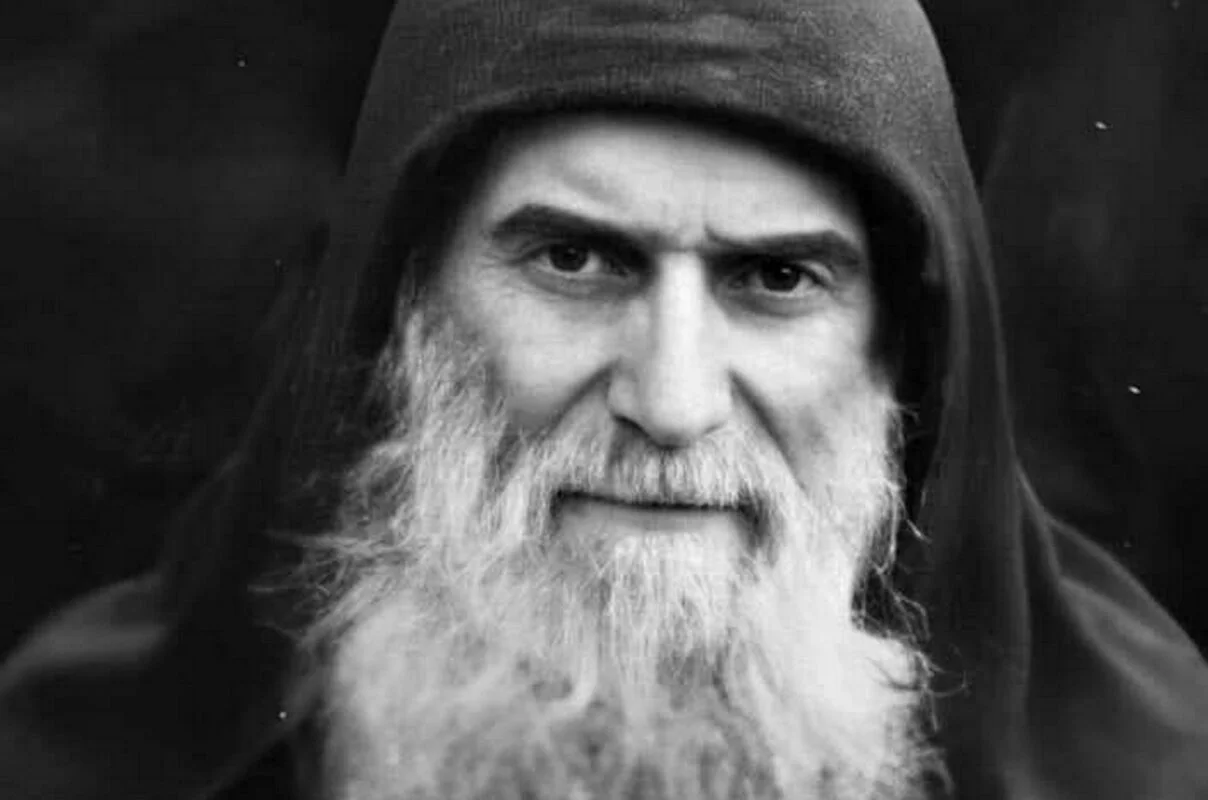
Georgia, a land Christianized from the early centuries and remaining Orthodox despite the ravages of history – the Monophysite heresy, then the Tatar and Muslim invasions, and finally the Bolshevik persecution. Here, one of the pillars of the Universal Church of our days, the Venerable Gabriel († November 2), toiled and became holy, having poured out the blood of his heart to receive within him the Holy Spirit – “Who rests among the saints, and gives life to the brokenhearted” (Isaiah 57:15).
The Venerable One was born to the family of Vasili and Varvara Urghebadze on August 26, 1929, in the capital of Georgia, Tbilisi, receiving the name Goderdzi at baptism. The communist rule had by then launched a furious persecution against faith: churches were closed and demolished, and innocent people were deported and executed. Goderdzi was two years old when his father was killed under circumstances that remain unclear to this day. From then on, his family called him 'Vasiko,' in memory of his lost father.
He was an extraordinary boy, filled with divine grace from childhood. He used to build small churches out of pebbles, in which he would then light matches. Vasiko was considered a strange, silent child who preferred to be alone. He had an unusual game: he liked to run with a stick in his hand, on which songbirds would gather and follow him everywhere, causing wonder to all who saw him. He was a very kind-hearted child. He would scold those who set mousetraps and would release the captured mice in the yard.
At six years old, he started school. He learned to read, write, and count with great ease, and everyone loved him for his kindness. When he was seven, he heard the name of God for the first time, and he was overwhelmed, and his life changed completely. He began to save money to buy a Gospel.
A new life began for him then. From that day until his death, Father Gabriel had only one thought and one dedication: to live for Christ. He always read the Gospel, and nothing else piqued his interest; he learned and studied less for school so he could dedicate more time to the Gospel. Before going to sleep, he would enter his room and pray extensively before the icons.
Here is a wonderful event that the Father recalled from that time: “I was standing on the second-floor balcony, deep in thought, when an inner voice commanded me to look at the sky. I stood up, went to the edge of the balcony, looked up, and saw a gigantic cross in the sky. I didn’t know it then, but that was my cross, which I would carry out of love for God and my people. After I fell asleep, I suddenly woke up in the middle of the night and saw a demon, terrifying in appearance, standing before me. It stared furiously at me. By the Lord’s mercy, I was not terrified, but only tensed up. I didn't try to banish it; I just looked at it in amazement. It roared at me: 'You're fighting me, aren't you?' and punched me.” His mother then entered the room and found her son unconscious, but God saved His chosen one's life. And, the Father said, “from that vision, my faith in Christ was strengthened, and I said to myself: 'If the devil exists, then all the more so must God exist.' And I valued, even more, the beauty of human beings.”
Thus were revealed the gifts with which God endowed young Vasiko since the age of 12, for his love and piety...
“This dead man is not worthy of glory!”
In 1949, Vasiko was called to fulfill his military service in the Soviet Army. He served in Batumi as a border guard. Despite the strict army regime, he continued to fast, and even snuck into St. Nicholas Church to receive the Holy Sacraments.
After his compulsory military service, Vasiko returned home. He was then summoned to a mental hospital and interrogated about his childhood visions, which everyone knew about. After a few days, he was diagnosed as mentally ill, with a prohibition from working. He was medically retired with a Grade II disability – a blatant violation of the law, as such a patient could not have passed the Soviet army's medical examination. All this was orchestrated by the KGB and the communist political officers to remove him from public life.
From then on, Vasiko pursued his spiritual life with even greater zeal. He built a small cell in his yard, where he performed his spiritual work in peace and quiet. For services and sermons, he went to Sioni Cathedral. There he attracted the attention of Patriarch Melchizedek III. With his blessing, Vasiko became a guardian at the cathedral, then a reader. In January 1955, he was ordained a deacon, and in February, he became a monk, choosing the name Gavriil. In the same month, he was ordained a hieromonk. He stayed at Vithania Monastery until 1962, when the regime closed it, and the Father had to return to Tbilisi, to the All Saints Cathedral.
It is difficult for today's generation to imagine what it meant for a young monk to do what Father Gavriil did during the communist regime: he set fire to a giant portrait of Lenin in front of the Council of Ministers at the May 1st demonstration in 1965 and fearlessly shouted before the terrified people: “This dead man deserves no glory; rather, all glory belongs to Christ, who conquered death and blessed us with eternal life!”The furious crowd began to throw stones at him. A Grade 1 alert (the highest in the Soviet Union) was declared in the city, and only the intervention of the 8th Regiment saved Father Gavriil's life.
Half-dead and severely wounded, with seventeen cranial fractures and others throughout his body, the Father was placed in solitary confinement in the KGB hospital. He was sentenced to death and interrogated only formally. However, the communist authorities had a specific interest: to make Father Gavriil confess his involvement in a supposed conspiracy of the Georgian Orthodox Church, and in exchange for his confession, he would escape the death penalty. Despite prolonged torture, the Father remained steadfast. On the contrary, during interrogations, he called Lenin "a beast" and was beaten even more fiercely.
News of what had happened eventually reached the European and American press, so the Kremlin decided that, instead of condemning him to death, they would commit Father Gavriil to a mental asylum, intending to leave him there forever. But God took care of His chosen one and spared him from such a fate...
“Your life is my life”
In his final years, the Father became seriously ill with edema. In addition to this, he broke a leg and remained bedridden until his death, unable to walk. Only on very rare occasions, enduring terrible pain, would he ask to be helped up to stand in front of his cell. “Your life is my life. If you don't sacrifice yourself for your people, nothing good will come of it”, he used to say.
His compassion and generosity remained unforgettable to those who knew him. Before he broke his leg, he used to give all guests food from what he cooked himself; after he could no longer cook, he would ask Mother Parascheva to cook, in order to serve those who came to him.
He constantly strove to bring closer to God all those who visited him. His warm words, full of divine grace and power, penetrated everyone's hearts. His prayers were always accompanied by abundant tears, and no one could remain indifferent in his presence.
For years, Father Gavriil taught the people about God and love for one's neighbor, repentance, humility, and goodness, but in his final days, Father Gavriil preached only love and, with tears in his eyes, taught his visitors: „Do not forget, God is love. Practice goodness as much as you can, so that you may be saved through goodness. Be humble, for God pours out mercy upon His humble servants. Repent of your sins and do not wait until tomorrow, for it is a trap of the devil. Love one another, for a person without love will not be able to inherit the Kingdom of Heaven”.
The day before he passed into eternity, Father Gavriil said: „The time has come for me to leave”, and embraced the icon of the Savior, holding it near his head with his right hand. He remained silent for a while, then said: „I have followed You, Christ, since I was 12 years old. I am ready, take me!”.
He suffered terribly all night until 4 AM, when he began to breathe heavily and cry out: „Mother, mother! Sister, sister!”. The entire community and his blood relatives gathered, along with a few other laypeople, a doctor, and some priests. Father Gavriil gazed intently and lovingly at the icon of Saint Nicholas of Myra. Archbishop Daniil began to read the prayers for the departure of the soul. In the end, Father Gavriil smiled and passed away peacefully. It was November 2, 1995...
Excerpts from the article written by Radu Hagiu and published in „Familia Ortodoxă” (November 2015)
No comments yet. Be the first to comment!