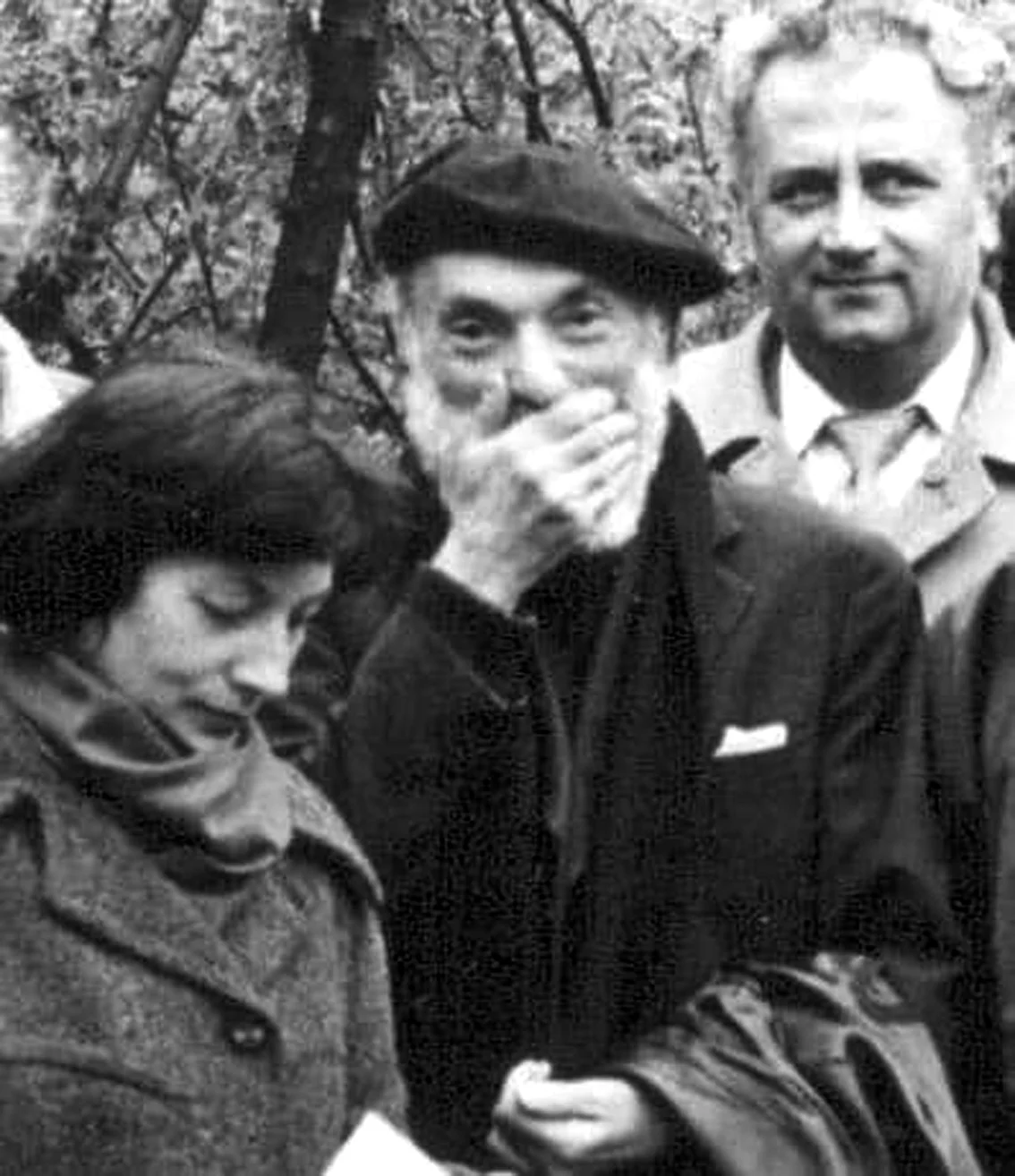
Flashes from a possible film about the 'underground' of the 1950s are offered by every page of The Diary of Steinhardt. For instance, this one describes an 'act of gravity' that occurred (nota bene: a longer quote follows) 'in a medical office, where they take us for dental extractions, done with a chisel and without anesthesia, by a feldsher'. A relative close to the guard played by Toma Cuzin in The Cardinal and Forgiveness, 'the gypsy guard kills time by asking us tricky questions: how old are you? how long are you sentenced for? why? what were you? did you also put women at the cabaret to climb naked on the table and spray them with soda? (This thing with naked women sprayed with soda on cabaret tables is everyone's obsession, it represents for them the ultimate display of wealth and debauchery, the nec plus ultra ideal, the dream, the Himalayas; it's their Duchess de Mortemart. You can't go further, a kind of speed of light limit for the theory of relativity.) He asks me if I'm Romanian. I am, I reply. What, aren't you a Jew? My blood is Jewish, I retort, but in thinking and feeling, I think and feel Romanian. He realizes he didn't get it right and falls silent. Then he rushes to another: but you, old man, how many estates did you have?'
(My answer, paraphrasing Churchill, whose mother was from the United States and who declared: I am fifty percent American and one hundred percent English, could have sounded: I am one hundred percent Jewish and one thousand percent Romanian.)
— We can find out everything, we can know everything, we can learn everything.
Only suffering, no. We believe we know what suffering is, that we can no longer have surprises, that we have gone to the very end.
Not at all! Suffering is eternally new, infinitely protean, always fresh.
— The most extraordinary thought ever read, outside of the evangelical texts, is Kierkegaard's. The opposite of sin is not virtue, the opposite of sin is freedom.
— To C. G. Jung, in Ceylon, a priest tells him: 'No, you cannot pray to Buddha. You cannot implore him. Buddha is no more. He is in Nirvana.' This is the big difference. Christ, who always prayed, always awaits our prayer. He is with eyes and ears on us, always at the door. Christ, like the Father, always works (John 5:17), and at every liturgy, He sacrifices himself. He is not in Nirvana, at rest, in repose, disconnected. He is on the construction site and lends a hand.
— Only sinners can taste Christianity in its full richness. The reason is expressed by St. Symeon Metaphrastes in his preparatory prayer for Holy Communion: 'There is no sin that overcomes Your love for humanity.' (The title of a book by a leader of the Oxford Group, A. J. Russell: For sinners only. Only for sinners. It's just that, it seems we are all sinners.)”
A film inspired by the personality and metamorphoses of Nicolae Steinhardt's becoming: a utopian project, just as unlikely to ever reach screens as it was for Mircea Săucan's films to receive a broadcasting visa. They didn't receive it. But back then was the period of our (illusory) emancipation from the Soviet yoke, and Săucan simply didn't play along, wasn't in trend. Now, bringing a personality like Nicolae Steinhardt's to the screen is equivalent - for any potential author who would dare such an undertaking - to house arrest, accusations of immense damage caused to the country, etc., a perfectly orchestrated defamation campaign (not just by influencers who explain, depending on their interest, how much cinema is or isn't in this or that production, how 'reactionary' it is or isn't, etc.), an uninterrupted harassment. Therefore, we return to Steinhardt's volumes, widen our eyes in amazement, and each project our own film of happiness…
Marian Sorin Rădulescu