
I have always looked with a certain fear and admiration at this character whom biblical history, by force of circumstances, places near the Lord's Resurrection, as one (among many) who doubted the Teacher's Resurrection. The fear was somehow linked to the surprise that one of Jesus' disciples could doubt His Resurrection, as if believing He rose again were within anyone's grasp.
Over time, I began to feel a sense of admiration for his courage in expressing his disbelief in the words of his brethren, and even frustration at not being present when the Savior appeared among them, through the way he challenges them. After all, who was he for the Lord to show Himself to him again too?! Shouldn't he have been present with the other apostles?
There's also an entire dispute regarding his name concerning faith: was he faithful or unfaithful? We still ask ourselves this in various ways today. Some exegetes called him "the unclear one" or "the doubter," even "the skeptic" – he was the one who always had something to say, who changed the group's perspective by offering alternatives. It seems there are as many answers as questions. We also notice that the appellation "the Twin" puts us in a new dilemma, and if we look at him intently, we get the feeling that he belongs to us, becomes familiar to us, as if he were brother our. After all, who hasn't been told at least once: "You're like Doubting Thomas!"?
I was tempted to begin these lines with the idea that we live in times of great doubt (like Thomas) about the human condition, the presence of God, the meaning of life, but I realized that this doesn't fit what the apostle himself conveys to us. He has no doubts about who Jesus is, but only about the event he didn't witness. He doesn't confront the Teacher, but merely wants to be a witness to the presence. His courage can become a model for the Christian who is not content with what they hear, but needs to see, and seeing is a matter of attention.
The times we live in are largely the result of how we choose to live our lives. The decline in attention in this digital age is evident. Simone Weil spoke not only of a crisis of attention, but of one of sight and hearing. It seems that "God did not die, but the man to whom God appeared." Perception today is driven by dependency, by digital stimuli, and more. Under these circumstances, the invitation the Savior extends to Thomas has become crucial for modern man: "Reach hither thy finger, and behold my hands; and reach hither thy hand, and thrust it into my side: and be not faithless, but believing." (John 20:27)
The current attention crisis is primarily linked to the fact that we have become a consumer society. We no longer look, we merely consume. We are dependent on consumption, and this affects our "gaze" attention. We are content with observations, without seeking the truth through which they were reached. Or, as Marin Tarangul says, we are content with what we are, without seeking to know how we come to be.
Thomas's search is legitimate; he knows through whom he exists, which is why he exclaims, at the Savior's invitation, "My Lord and my God!" Thomas didn't need confirmation; he needed presence.
The Christian is called to be a witness of vision, of the world's true appearance, because vision implies attention, which is at the same time the condition for its proper functioning in the world. The dialogue between Philip and Nathanael becomes decisive from the perspective of skepticism towards Christ. The invitation is simple: "Come and see!" But it implies an added degree of attention in the realm of sight. It requires a personal effort of presence and active waiting, which manifests, following the model of the apostle Thomas, in a continuous self-interrogation.
The current society of dependence has become an inattentive society, in which the digital machine makes people captive to eternal searches without a precise or desired end. Contemplative attention, which places us in a vertical relationship, towards Christ, is what dwells in waiting, not in searching, because 'only he who waits with perseverance receives grace.' (Simone Weil)
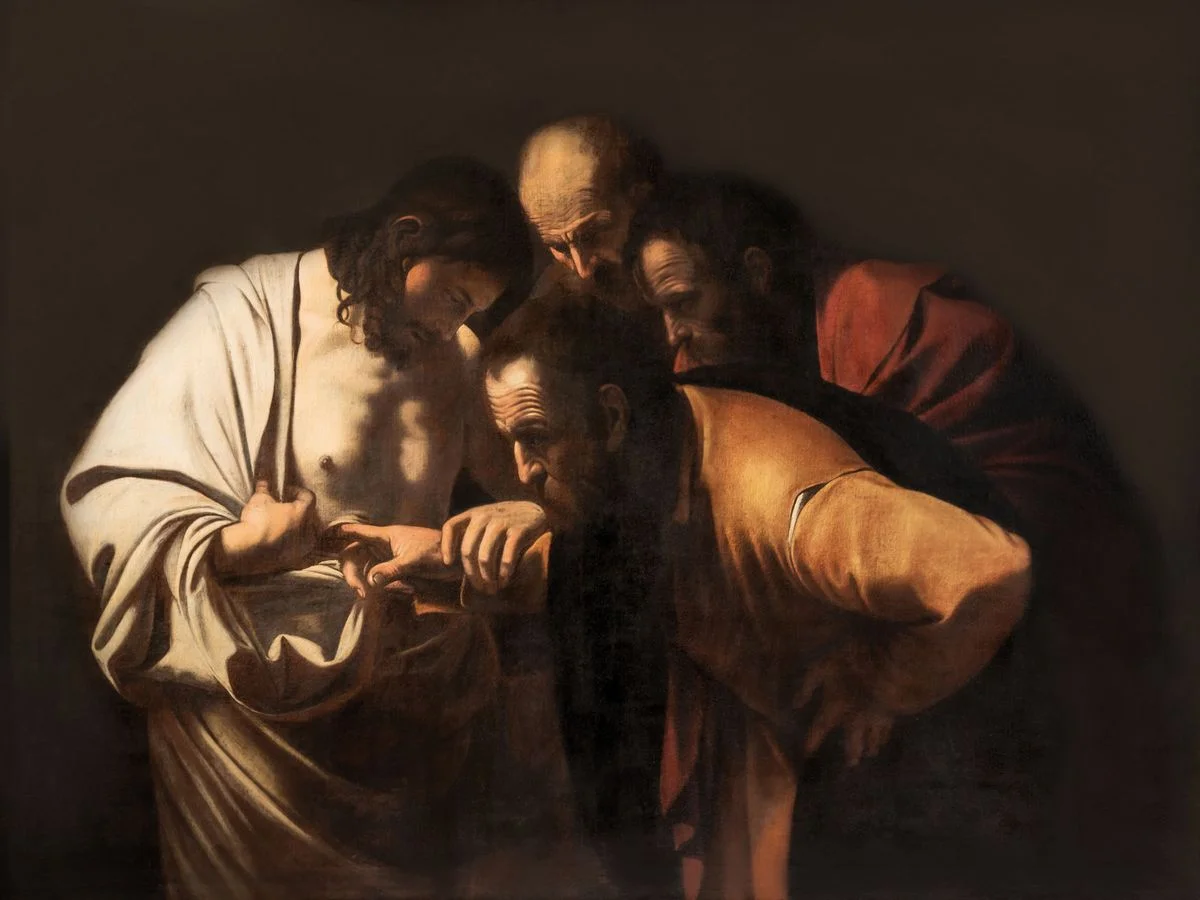
Many of us are familiar with Caravaggio's painting 'The Incredulity of Saint Thomas,' of a disarming realism. The painter captures the moment when Thomas inserts his finger into the wound in Christ's side, and He guides his hand. The way Caravaggio paints leaves the viewer with the impression of being part of the scene. You have the sensation that you are participating as a witness in the elucidation of Thomas's dilemma. It's another way of speaking about presence. The Evangelist does not present the facts in the manner suggested by Caravaggio through his 'photograph,' but the painting is worth looking at from the perspective of radical realism, which today takes on the most diverse forms.
Thomas's courage would be enviable for those who truly seek to clarify their faith. There is a need for reading, for spiritual counsel, for good deeds, for harmony, for spiritual vigilance – and all these presuppose an effort that contemporary man is no longer willing to make. Faced with a challenge somewhat similar to Thomas's, I don't know if they would choose a confrontation of ideas instead of tacit acceptance. We often live in passive, comfortable forms of faith, in a ritualism without the real essence of the desire to be with Christ.
And this seems most serious to me for someone who declares themselves a believer but shows no interest whatsoever in their so-called confession.
A Scripture exegete called Thomas: 'the patron of those who seek information from the source.' He was not convinced by his fellow apostles; he wanted to couple faith with reason, and he succeeded. But I also seem to hear the Savior's words: 'Because you have seen me, you have believed. Blessed are those who have not seen and yet have believed'...
It's our chance.
Rev. Cristian Muntean
In the image: 'The Incredulity of Saint Thomas' by Caravaggio