Anyone walking in the 1970s from Mihai Vodă Bridge towards Uranus or Izvor would easily get lost in the labyrinth of such aristocratic streets that you had the impression you weren't in a Balkan city, but in the very heart of a museum of the most refined urbanism, a Louvre or Sans Souci scattered beneath the Dâmbovița hills, a display of tastes and eras among the most diverse and yet unified in that bon goût of our past centuries, full of charm and distinction, of elegant manners brought from Paris, Vienna, Rome or Madrid and embodied for eternity (as our wise ancestors believed) in the most harmonious miniature villas and palaces over which, for almost four centuries, the most elegant princely foundation in Bucharest reigned – Mihai Vodă Church.
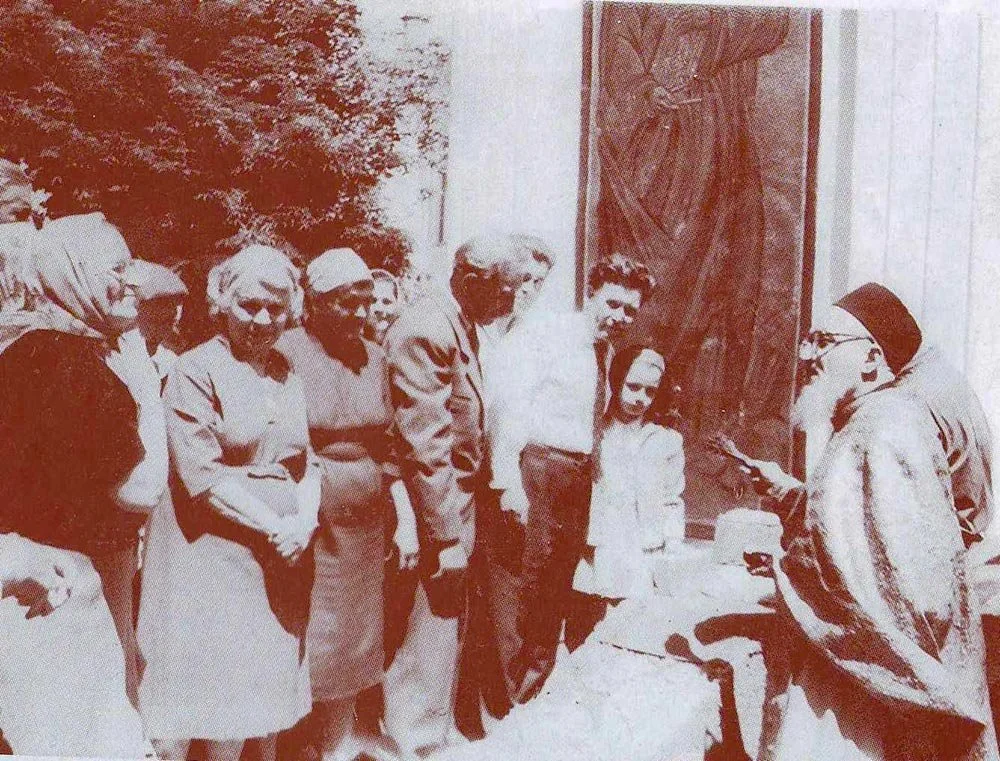
In such a wandering, motivated by an endless architectural ecstasy, through the neighborhood of our capital's tragedy, today submerged in the depths of a paranoid megalomania, halfway down Sapienței street, my gaze fell upon a modest house, yet one that possessed an aura of mystery that stopped you in your tracks, puzzled; only after you lifted your gaze higher did you see a cross standing guard on the flat roof and understand that you were in front of an improvised church. It was the only case I encountered in Bucharest, and I entered more out of curiosity than piety. What struck me from the outset was the incredibly large number of worshippers in such a tiny room, and, discreetly rising on tiptoes, I estimated the number of those present, at an hour and at a time when the country's churches were almost deserted. The silence was absolute, and the order was perfect, a fact which also partly explained the possibility of that massive communal gathering in such a humble space. These, however, as I would later come to understand, were only the effect of the true cause, and the unraveling appeared in the form of a priest who impressed me so strongly that I distinctly remember having a sleepless night after going home.
Like the improvised little church, the priest's appearance was far from captivating through beauty, or elegance, or other gifts of the Creator. I could say that if I had only retained that first impression, today I would not have such a decisive memory, or, more certainly, I wouldn't have had one at all. Everything intrigued me most acutely, and I went the following Sunday early in the morning, securing a spot near the choir stall, close to the iconostasis. With this first Holy Liturgy, not only did my inner turmoil not settle, but I could say that the traditional religious universe, meek, or perhaps frozen in automatic and poorly understood forms, was shattered. Although I had grown up in the church and had never missed a liturgy in my life, here I can say that I experienced, compactly and integrally, phrase by phrase, word by word, gesture by gesture, second by second, the first liturgy understood in its original essence. The priest was not repeating a script written more than a millennium and a half ago, but was building with unparalleled skill and intelligence, point by point, the splendid Eastern liturgical edifice, each time for the first time and only for the present day, just as the Holy Body and Blood are consecrated only for the moment of communion.
“Further on, it's not possible”
The past melted into this absolute moment, and the future no longer interested anyone. We were in primordial time and at the heart of the original act; conventional categories did not exist in that liturgical topos, transformed into an interiority that consumed any duration, quantity, mass, density, etc. Of course, my ego, with its typically pietistic conventionality, did not want to yield to this “atomic icebreaker,” and it was only after two or three months that I managed to transcend stupefaction towards wonder and humble understanding, brought to my knees by this liturgical genius. For me, he remains like the mysterious Melchizedek – Priest of the Most High – for I know nothing else about Father Constantin Sârbu, and I only saw him during the liturgical service. Moreover, I would not wish to add anything more to this supreme and dazzling image, for from him I understood the essence of liturgical ministry, that is, everything about the Liturgy. To no one but this giant liturgist does Nicolae Cabasila's famous phrase apply: “Further is not possible.”
He performed the Liturgy not just in the Holy Altar, but throughout the entire church, and not only the priest, but the whole congregation. In the Church of Wisdom there was no spectator; he had the astonishing gift of engaging everyone totally and fully, so that, in the small church, which had become entirely an altar, and in the assembly, which had become entirely eucharistic, the Christian ideal of communion invoked by the Savior in His high-priestly prayer (John 17) was, at last, fulfilled. The deepest longing of the Teacher and Friend's heart, expressed through the powerful formula, of Hebrew and psalmic origin: “With fervent desire I have desired to eat this Passover with you”, was realized at the end of a century and millennia, in the most modest eucharistic “bower” in the city with a mystic-luminous name, under the hand of this sacerdotal genius.
When I later read Schmemann, in the masterpiece of his liturgical thought – L’Eucharistie – with every page I trembled with an overwhelming joy, because what he proposed I “had seen with my own eyes and touched with my own hands”: the liturgical word embodied in concrete life, in the heart of much-suffering Bucharest. Upon leaving, after having experienced a sacred time and space, you were completely different. A believer once expressed this (he worked at Otopeni customs): “When I leave the service at the Church of Wisdom, I feel like I can build an apartment block.”
Priest Ion Buga
Fragments from “Contemporary Minipatrology”
Symbol Publishing House, Bucharest, 1994
No comments yet. Be the first to comment!