
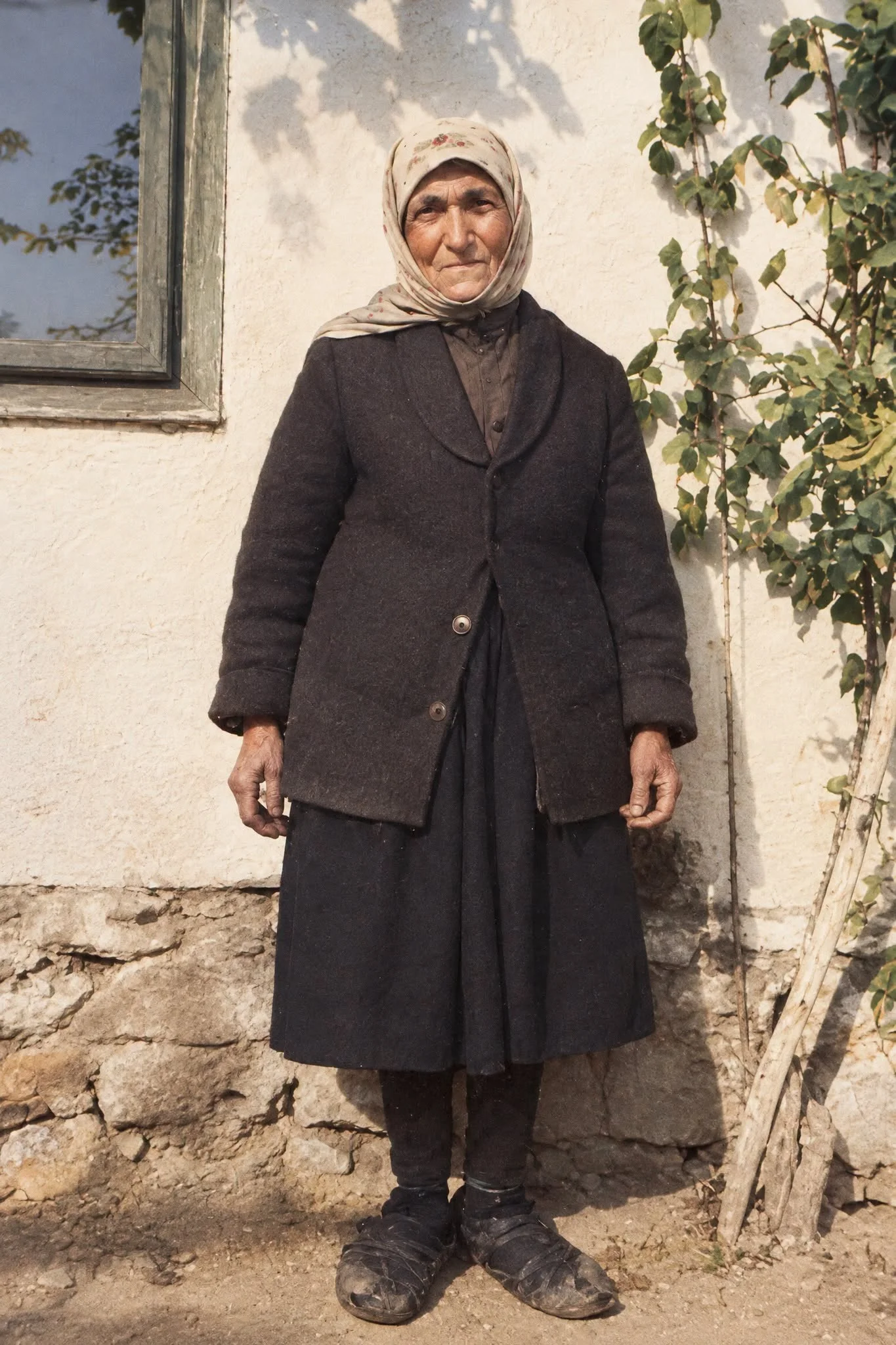
Saint Mandaline (Magdalene) of Mălainița (†October 15) was born in the village of Șciubic in the Timoc Valley, in the year 1895. Coming from a chosen family, she grew up from early childhood in the spirit of the fear of God and the fulfillment of His commandments. In addition to the piety towards holy things and the habit of prayer that she inherited from her family, she also received a secular education at school, an education to which few girls of that time had access.
She married in the neighboring village, Mălainița, but soon after became a widow with a newborn infant. Mandaline, then only nineteen years old, received suffering as a sign of divine election towards a life dedicated to prayer for the entire world, severely tried in the fire of the First World War. Thus, the young woman distanced herself from worldly amusements, leading a reclusive life, in which she grazed her small flock of sheep and at the same time busied herself with reading Scripture, the Lives of Saints, psalmody, strict fasting, and Hesychast prayer. In this way, she strove to renounce passions, entering with her mind into the “secret chamber” and praying to “the Father who is in secret.”
Through prayer for those in trouble during those difficult times of the Great War and the Bulgarian Occupation of Timoc, her heart was enlarged (cf. 2 Corinthians 6:13), and her pain transformed into intercession for the entire world. Thus, she became a pillar of strength for Christ's lesser brethren, her fellow human beings, without distinction of nationality, she herself being descended from a Romanian mother and a Serbian father. Seeking in the depths of her heart the “pearl of great price” of love, she fixed the eyes of her heart upon the Lord, Who sealed her soul with the gift of Christ's humility.
She strove to gather the scattered children of God to services, knowing that as long as “two or three gather in His name” for prayer, the gates of hell will not overcome “the little flock,” “the leaven from which the whole lump will rise again.” Thus, Romanians and Serbs continued to keep the flame of the Orthodox faith burning in those lands, partaking of God's grace, which strengthened them.
Furthermore, Mandaline, reading in Scripture: “When the Son of Man comes, will he find faith on earth?” (Luke 18:8), and seeing that in those parts, popular customs had come to mix with practices alien to Christian teaching, she strove to bring to the light of faith the people who “walked in darkness.” And, burning with zeal for the house of God, she traveled daily five to seven kilometers to the church in Șciubic, to perform the order of services for the people without a shepherd. She sometimes said: “I am a simple (humble) monk,” and she followed this path, while in the world, through prayer and ascetic effort, which makes even a layperson, alongside a monk, a participant in the work of salvation of humankind.
The words she often uttered — “Vidi Bog” (“God sees”) — attest to her hope, peace, and humility of mind, her inner freedom, and the foundation of her entire life upon the immovable rock of the Gospel. Through unwavering faith in God's will, “Who desires all people to be saved and to come to a knowledge of the truth,” she became an intercessor for all who, in trouble, seek comfort from the God of love.