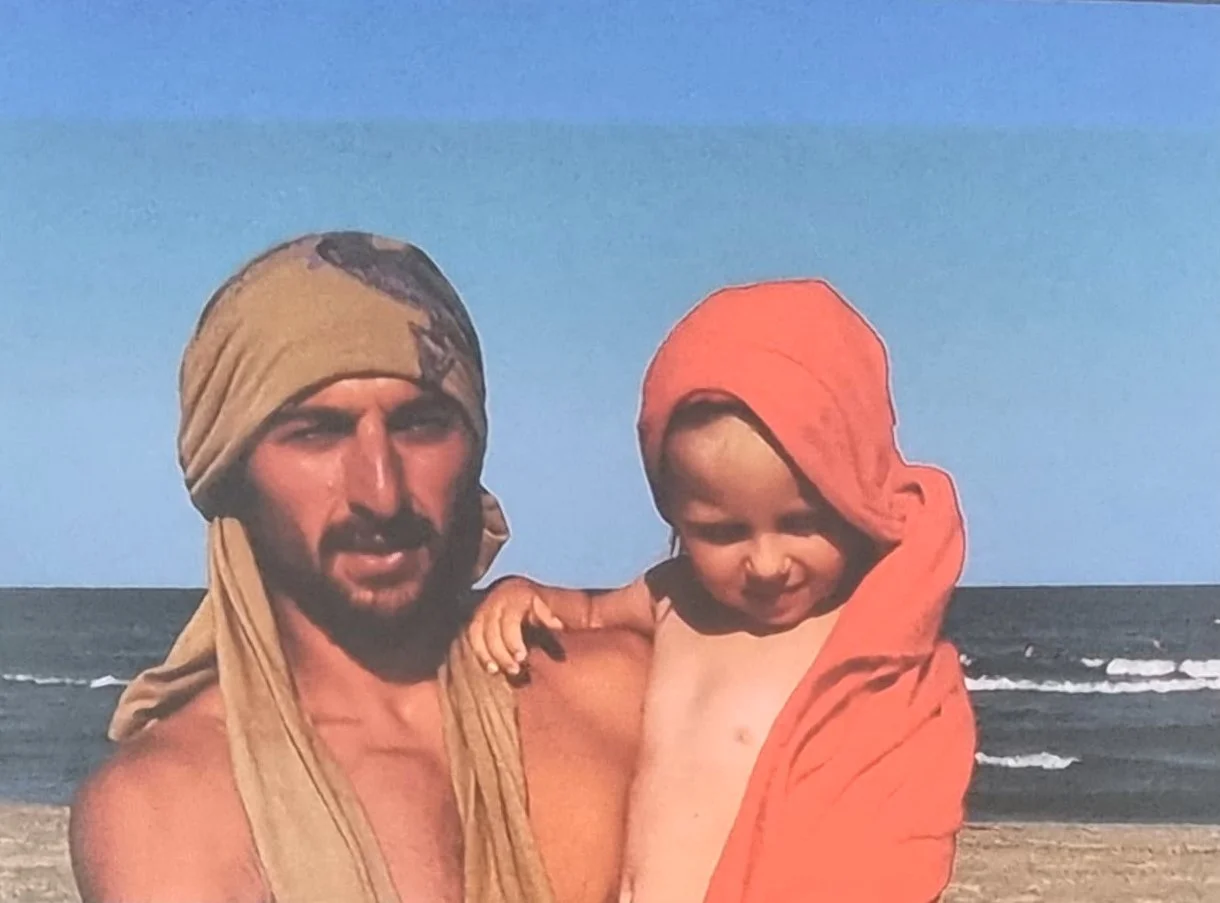
Since I first saw my daughter, carried in the arms of one of the midwives, I had the feeling that I had known her forever. I realized how much I had missed her. It's true that I had dreamed of her since adolescence, in her mother's arms. It's true that, on the day my parents made me choose between them and my future wife, we left by train for Sibiu, and a Roma woman insisted on telling our fortune for free; she prophesied that we would first have a daughter, much later a little boy; that the daughter would be wonderful and "wouldn't work with her hands." But I am convinced that I did not know her from there, but from eternity. From the life of the age to come, which is already here, where we will no longer (re)cognize beginning and end, but only eternity. Where, like the angels in heaven, in Christ we are brothers.
We chose her names at the maternity hospital, on the day I filled out the birth certificate. My wife chose Ana, I made a condition: it had to be Anamaria. I chose Gala, my wife made a condition: that we call her Ana. And so we did.
My choice came from the wife of the painter Salvador Dali. It took 20 years for us to find out that Saint Gala Zăvorâta exists and is celebrated on October 18th. Well, one morning on October 18th, my wife's water broke. At the maternity hospital, during the ultrasound, the doctor surprised us by saying that the due date had passed by a week. Then, a complication caused our Gala to be born only on October 19th, around noon. Mysteries...
I found it hard to get used to calling myself a father. I knew my daughter from eternity; in my soul, I felt like a poor child; I would have rather considered myself an older brother. This always defined our relationship. My wife sometimes reproached me for treating Gala as an equal, but it wasn't true: I saw her as superior. Having reached maturity, Gala reproached me for leaving the role of the adult in the room on her shoulders. The fact is that, whenever I tried to play the role of a father, her reply was, rightly so: "Too late, you missed this train!" So I decided to accept the fraternal one. I call her "your fraternity," with a mixture of amusement and reverence.
At the beginning of the year I met my wife, I made a decision: if I didn't get married that year, I would take my sheep and go to a monastery. Since I was about 16, I felt an emptiness in my chest that even the grace with which God abundantly flooded me, whenever I was at a crossroads, could not fill. The love for my future wife did not fill the emptiness; it erased it permanently.
I was immature and passionate. Waves of overwhelming grace made me a child, then they passed, and I would wake up directly serving a herd of pigs. My wife was firmly anchored in reality, responsible and mature. An anchor. My extremes dislodged her countless times, leaving the family ship adrift.
Gala grew up between these extremes, on a ship sometimes rocking, sometimes carried rudderless by currents, often caught in storms; sometimes firmly anchored by her mother. With a father too little present, more often gone in search of pastures... I express everything symbolically, because perspectives are numerous, stories intricate, details can be unravelled indefinitely, illusory, wonderful, strange or gloomy, sometimes entirely dark.
I myself grew up and lived with the perception that my parents made my life a Calvary. Happy intervals barely sweetened the bitterness a little. Only at 38, under the epitrachelion, during confession, I told my confessor: "Now I understand that if my parents had made me happy, given the passions I have, I would have been a spiritually dead man." To which the Father sighed: "Not just spiritually...".
Reading Ava Ghelasie from Frăsinei, as well as Saint Dumitru Stăniloae, I finally understood that we, parents, are chosen to have children because only they can save (us). And that, starting with the Nativity of the Lord, the destiny of children is to be saviors. Even the Virgin Mary, who is most pure, most innocent, was still saved by her Son.
I have no justification for my own passions. I understood late that, the more I strive to heal them, the cross of my children will lighten. And I don't think I've achieved much in these 7 years, compared to the standard which is the Lord Christ.
It is an illusion, however, that perfect parents guarantee happy children. The Mother of God serves as our example: we cannot claim that her Son was happy, in the worldly sense of the word.
Happiness comes only secretly, through the assumption of the cross.
Yes, it would be desirable that, in reality, the cross of each of us does not also contain the sins of our parents. But who among us, being perfect, would consciously choose to bring children into the world with the purpose that they should suffer for the salvation of people who, rightly so, do not deserve to be saved?
The Mother of God is unique and unrepeatable. And those who follow her choose the monastic path because, starting from Christ, say the Fathers, the commandment is no longer "be fruitful and multiply," but "save (yourselves)." They fully assume the cross, no longer placing it on the shoulders of their bodily descendants.
Father Rafail Noica masterfully says that the cross of each of us is an honor that God bestows upon us. He does not choose each of our crosses according to our strength, but rather deliberately chooses each of us, according to His foreknown strength, to bear a cross that no one else among our contemporaries could bear.
But the cross is not a cross unless we ourselves consent to bear it. Otherwise, it is just a burden that foretells personal tragedy. And to consent, it seems to me, is precisely the threshold of perfection.
If I've learned anything from my own experience as a child and a parent, it's that the only true good a parent can do for a child is to "leave them in peace." At baptism, we offer our children to Christ, but we quickly take them back and no longer let them go to Him. They are "ours." We keep them bound with the chain of our will, so the relationship between us can only be a struggle in which children strive to free themselves. Blessed are those who want to free themselves to flee to Christ, and not to be independent. Blessed also are those who grow tired of independence and cut off their own will, entrusting it to the Lord.
Blessed are the parents who leave their children in peace, and the children can say: "My father and my mother have forsaken me, but the Lord has taken me in."
Marcu Jura